


“People who use AI will replace people who don’t use AI, just like people who used automation or computers probably replaced those who didn’t.”
— Shantanu Narayen, CEO
Investment Contents
1. Thesis for Investment
2. The AI Narrative Shift & MAX Conference
3. Business Model: Subscription SaaS at Scale
4. Stickiness, Customers & Growth
6. Risks / Competition
7. Financial Performance, Projections & Valuation
8. Concluding Thoughts
Investment Thesis:
Adobe has gotten hammered from its $635 peak in January 2024 down to where it sits today around $340-360 a share.
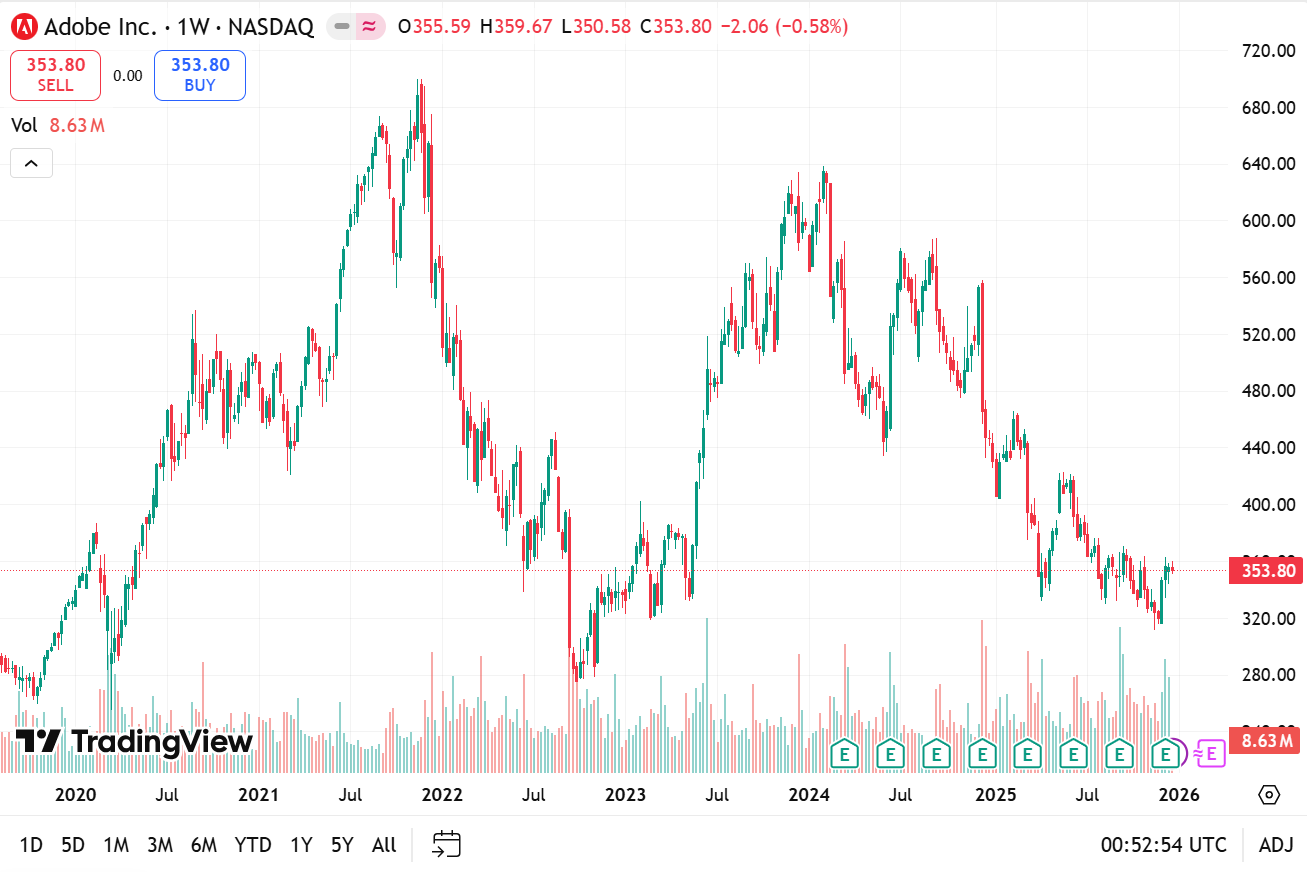
The stock’s 40-50% decline from the peak reflects investor concerns about AI disruption that recent product announcements and strong execution have demonstrably addressed.
The setup today is different than early 2024. AI expectations have been reset, the valuation has compressed lower and Adobe is now monetizing AI rather than defending against it. The business has improved while the stock has declined.
The combination of AI offerings and tech innovation announced at MAX 2025, along with recent partnerships and acquisitions with AI businesses like ChatGPT and Semrush showcase that Adobe is crafting their own AI narrative and pushing forward initiatives to make sure they are part of this new phase and don’t get left behind as an archaic SaaS business.
Coupled with an attractive valuation at a ~21x P/E, a robust buyback program and growing topline and bottom line double digits YoY, Adobe is a classic, misunderstood value play in the SaaS market.
The AI Narrative Has Fundamentally Shifted
When generative AI emerged broadly in 2023, investors voiced legitimate concerns about whether the technology would cannibalize Adobe’s subscription seat counts.
Rather than cannibalizing demand, Adobe has pushed for AI-powered tools to become a driver of engagement and monetization across Adobe’s Creative Cloud ecosystem.
At MAX 2025, Adobe showcased several key AI projects, solutions and offerings to bolster their innovation pipeline:
Firefly Foundry: Allows enterprise customers to train Firefly models on proprietary data and branded content, creating a uniquely customized AI experience. In addition, these custom models can now run on Google's infrastructure with native integration of Google's own generative AI models (Gemini, Veo, etc.).
Project Moonlight: Agentic AI assistant that allows users to delegate repetitive tasks and creative workflows to AI agents (rather than managing disparate applications)
Adobe Firefly Studio “All-in-one Offering”: Image generation Model 5 (explained below because I think it’s important), new audio generation and video editing tools, partner models (agnostic: OpenAI, Google, Luma AI, etc.) and collaborative boards
Firefly Image Model 5: Advanced AI model for image generation and editing, offering top-tier resolution, superior photorealism (lighting, texture) and powerful prompt-based editing
Project Graph: Tool that allows creators build, control, and share custom, AI-powered creative workflows by connecting Adobe tools (like Photoshop) and Adobe Firefly models

An important point here on AI innovation is that Adobe is no longer just pushing its own Firefly model.
Adobe is integrating third-party models (OpenAI’s Sora/GPT, Google Gemini, Runway) directly into its apps, ensuring that even if another company builds a better AI model, it’s all integrated into the platform and the professional work still happens inside Adobe software.
Adobe has also recently announced integration of their services directly within ChatGPT, making Photoshop, Adobe Express and Adobe Acrobat available within the LLM.
Earlier in 2025, Adobe integrated Adobe Express and Adobe Marketing Agents directly into MSFT 365 Copilot.
Adobe has made massive strides through these partnerships and others (Google, Runway, HUMAIN, etc.) to bolster their offering and make sure they aren’t behind during this wave of AI.

