


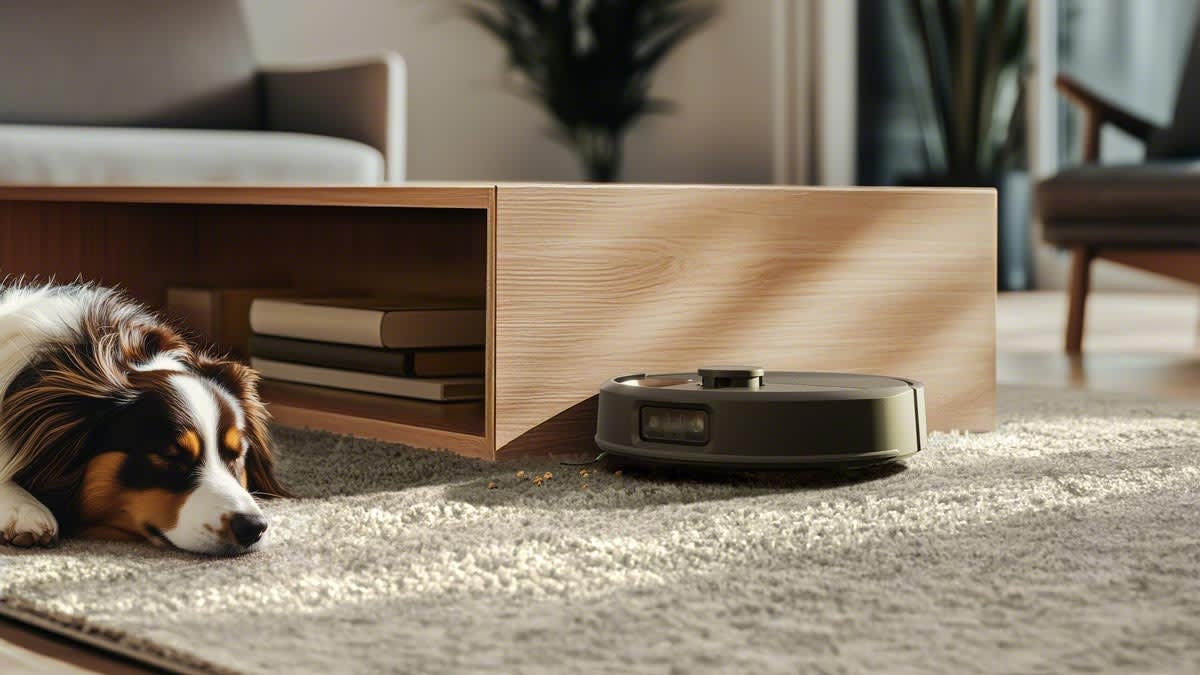
Somewhere in America right now, a robot vacuum is doing laps around a living room.
It hums out from under the couch, working its way across the carpet.
To avoid other furniture, it builds a map of the living room.
The vacuum then works its way across the floor, and returns to its dock.
In order to do this, it has to know where the couch is.
It has to know where the toys on the ground are.
It has to know where the other furniture is.
It has to know if the dog is roaming in the same room.
Early models used in these devices navigated by bumping into things and turning around.
Today’s robot vacuums do something considerably more sophisticated.
They build and store a persistent map of the home, using LiDAR, cameras and microphones to record room dimensions, furniture placement, doorways and stairs.
Many also learn patterns of use over time, including which rooms get cleaned when and, by extension, when the house tends to be empty.
The map is what makes the features people actually bought the thing for possible, which is cleaning rooms on command.
But the map does not stay inside the vacuum.
It syncs to the manufacturer’s servers so the app can display it, and many of the best-selling robot vacuums in the U.S. are made by Chinese companies.
Even iRobot, the American brand that created the category, manufactures largely overseas.
For years, none of this drew much attention.
That changed in February, when Sammy Azdoufal, a Spanish software engineer, accidentally gained access to roughly 7,000 DJI Romo vacuums across 24 countries while building a custom controller for his own unit.
He was able to reach live camera feeds, microphone audio and stored floor plans.
DJI patched the flaw within days.
Funny enough, DJI is the same company the Federal Communications Commission (FCC) added to its Covered List for drones two months earlier.
There is no public evidence that any government has ever used this data, but Washington’s position is now that it does not have to wait for evidence.
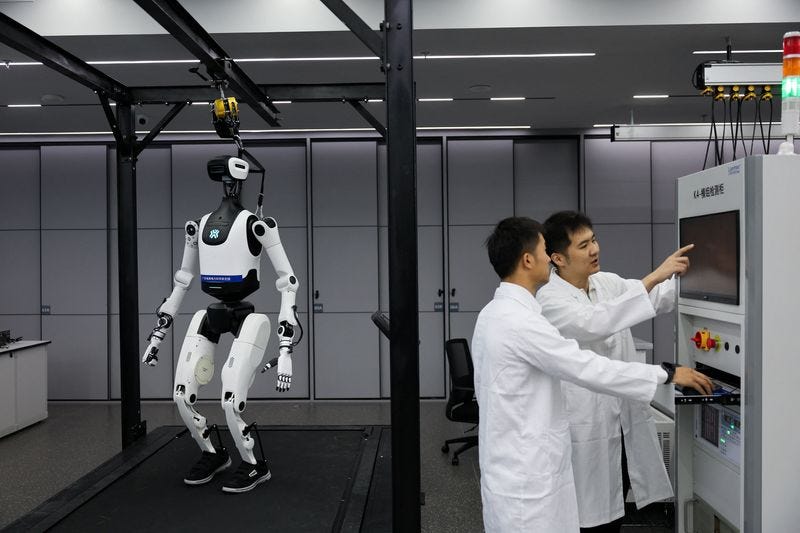
On July 27, the White House issued a National Security Determination stating that all foreign-produced advanced robotic devices pose an "unacceptable risk" to US national security.
The next day, on July 28, the U.S. government banned the import, marketing and sale of new foreign-made mobile robots in America.
As always, I would really appreciate if you shared this post and subscribed to ThePrivatePublicInvestor, as I try my hardest each week to give you custom, in-depth analysis on stock investments, market insights and portfolio strategies.
With that, enjoy this piece and let me know if you have any questions!
Why Pass this Now?
The decision fits into a broader push to strengthen domestic manufacturing, expand reshoring capabilities, and reduce reliance on foreign technology in critical industries.
The Trump Administration’s AI Action Plan identifies robotics as a next-generation technology essential to our defense and national security.
This National Security Determination states:
Robotics technology is rapidly advancing, driven by enhancements in AI, sensing, and actuation technologies.
Advanced robotic devices will be critical to creating efficiencies in our economy, dominating on the battlefield, and securing our homeland.
To ensure the United States is able to take advantage of this generational technology, the United States must have an independent and resilient robotics supply chain and industrial base.
Robotics is now being treated similarly to semiconductors and drones.
And this timing also reflects where the industry stands today and how the government views the growth of robotics.
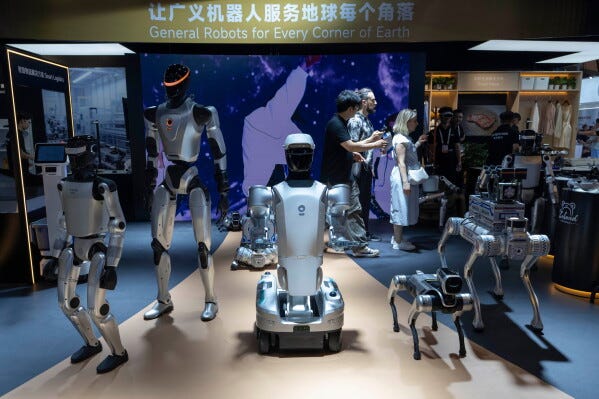
According to Omdia, roughly 13,300 humanoid robots shipped globally in 2025, with Chinese manufacturers AGIBOT and Unitree accounting for about 70% of those shipments.
Beyond just finished robots, much of the supply chain including actuators, reducers, sensors and rare-earth magnets also remains heavily concentrated in China.
Now the push is prioritizing American-made hardware and software in robotics.
Read the full National Security Determination below 👇

What the Ban Actually Covers
The ban focuses on mobile robots, not robotics as a whole.
Covered products under this ban include autonomous ground robots weighing more than 4.4 pounds that can sense their surroundings, connect to networks and navigate independently.
That includes new sales and marketing of humanoid robots, quadrupeds1, warehouse robots (AGVs and AMRs)2,3, and even robot vacuums such as the Roomba!
The rule does not apply to fixed industrial robotic arms, most collaborative robots unless mounted on a mobile platform, drones, automobiles or medical robots.
Now, the actual definition of “foreign-produced” depends on whether a product qualifies as a domestic end product under federal procurement rules, not simply where final assembly occurs.
That means a robot assembled in Texas could still be considered foreign-produced if most of its critical components originate overseas.
How aggressively regulators enforce this standard remains uncertain, but it creates a clear incentive for manufacturers to source more components domestically.
One important clarification is that this is not a China-specific rule.
The standard is whether a product qualifies as a domestic end product under federal rules, not whether it was made by a Chinese company.
That means products manufactured in countries like Canada or Mexico are also considered foreign-produced, even though those countries are close U.S. trade and defense partners.
As a result, simply moving final assembly to Mexico does not avoid the restriction, which is the precedent workaround that companies have pursued historically.
It’s equally important to understand what the rule doesn’t cover.
While the determination identifies components such as actuators, batteries, sensors, and end effectors as supply chain and national security concerns, the restriction applies only to finished mobile robots.
Individual components are not prohibited.
This differs from the past when the U.S. restricted foreign-made drones in 2025 — it explicitly included key components like motors, batteries, sensors and flight controllers.
But in this case, regulators highlighted components as a concern but stopped short of restricting them — the foreign picks-and-shovels players are still in play.
Lastly, you will notice in the determination that previously approved products remain authorized, and companies can apply for conditional approvals while they work toward moving manufacturing into the United States.
This way companies don’t have to trash current inventory and can work towards adjusting their supply chains and switching to new vendors.
Notes:
1Quadrupeds = That 4-legged Robot Dog thing
2AGV = Automated Guided Vehicle
3AMR = Autonomous Mobile Robot
How Long Will the Ban Last?
The Federal Communications Commission’s (FCC) Covered List has tightened steadily since Congress created it through the Secure Networks Act of 2020.
Each update has broadened restrictions on technologies viewed as national security risks.
March 2021: Huawei, ZTE, Hikvision, Dahua, and Hytera were added, targeting telecommunications, surveillance and communications equipment.
November 2022: The FCC stopped authorizing new equipment from those companies, effectively preventing new products from being imported or sold in the U.S.
2021–Present: Congress appropriated roughly $5B to replace previously installed Huawei and ZTE equipment, effectively reimbursing small carriers for physically removing that gear.
December 2025: Restrictions expanded to foreign-made drones and several critical drone components.
July 2026: Mobile robots and foreign-made power inverters were added to the Covered List.
The broader takeaway is that the Covered List has consistently expanded over time, with no companies or product categories removed.
Reshoring American infrastructure is the push across all innovative physical technologies with potential security risks.
Companies to Benefit
Join our community to continue reading and researching the best robotics plays 👇
