


“SEO is about being found. AEO is about being the answer”
Evolution of the Online Visibility Landscape
If you want a quick pulse check on whether a modern business actually understands how to sell product today, you don’t go to Google anymore (unless you’re in Gemini). You don’t dig through their website. You just… ask an LLM.
Who makes the best collagen supplement?
What’s the best budget travel backpack?
Which small-cap HR software is actually worth it?
Five years ago, you would’ve gotten a list of blog posts and long-form SEO farms.
Today, ChatGPT, Perplexity, Gemini, Grok and Claude respond immediately. If a brand shows up in those answers, that’s not an accident. That’s AEO (Answer Engine Optimization). And it’s turning into the most important marketing battleground most companies aren’t talking about yet.
SEO built the last decade of digital commerce. AEO will build the next one.
And for investors like us who spend time identifying emerging competitive advantages, this shift is a massive tell for which companies are going to win long term, specifically in marketing, advertising and overall brand engagement.

What Exactly is AEO? (Quick and simple)
SEO = building content so Google ranks you.
AEO = structuring your brand, products, and content so AI answers recommend you.
AEO focuses on presenting information in a way AI systems can quickly interpret and surface in answers. This means organizing data cleanly, writing straightforward responses to common questions, and reinforcing credibility through consistent, trusted sources so models can confidently reference your content.
The traditional SEO game was:
Write keyword-heavy blogs
Build backlinks
Optimize page speed
Build landing pages around “best ___ in 2021”
LLMs answer based on:
Structured product data
Brand clarity
Real customer sentiment
Clean descriptions and metadata
Clear positioning
Verifiable signals
Third-party product knowledge they can easily digest
Authority / trust
Put differently: LLMs don’t browse. They interpret. They summarize. And they pattern-match.
SEO gets you found; AEO gets you chosen. Search engines are rapidly becoming answer engines. When users ask a question—whether it’s typed, spoken to Alexa, or messaged in a chatbot—they expect a clear, instant answer, not a list of websites to sift through. This is where AEO comes in: it’s about being the trusted, authoritative answer source, not just another result in the crowd.

Why This Matters From an Investor’s Perspective
This shift is deeper than a new marketing strategy. AEO is an operational tell and a signal for which businesses understand distribution in an AI-native world.
This shows which companies have an intelligent team in place, look forward, continually innovate, and are not afraid of the future.
I like to think of the perfect management team as a group of folks who have the blend of a Gary Vaynerchuk mindset with a background in corporate / institutional business. You want people who intuitively understand attention, culture, and how narratives move online, but who also know how to operationalize that insight inside a real business with processes, accountability, and capital discipline.
Here are the big things investors should pay attention to:
1. AEO compresses the marketing funnel
In a Google world, the customer journey looked like:
Search
Click
Research
Compare
Buy
In an AI-answer world, it looks more like:
Ask the LLM
Buy the recommendation

That’s terrifying for any business that relies on “top-of-funnel awareness.”
BUT, it’s incredible for any business already winning recommendation slots in AI engines.
Think about the companies that benefitted early from Amazon’s “Frequently Bought Together.” AEO is the same dynamic but across the entire internet.
2. The businesses that win AEO will look like they have brand magic
But it’s not magic. It’s structure!
Brands that clean up:
Product descriptions
Schema markup
Customer FAQs
Training data sources
Public documentation
Review consistency
Press coverage clarity
…will suddenly start showing up disproportionately in AI-generated answers. Investors who spot this early will recognize brand momentum before it shows up in revenue.
Because before AEO shows up in revenue, margins, or growth acceleration, it shows up in behavior. In other words, in how companies actually talk.
As AI becomes the middleman between customers and products, companies don’t win by shouting the loudest anymore. They win by being clear, structured, and easy for machines to understand and trust.
The companies that get this right early get recommended more often, spend less on marketing, and compound faster over time.
This is why data is so important, and also why companies like Snowflake and Palantir have so an attractive service to most-all businesses.
3. AEO scales exponentially faster than SEO ever did
SEO had diminishing returns and became overly competitive, saturating the market heavily.
AEO is winner-take-most.
Once LLMs gain confidence that a brand consistently satisfies user intent, that brand gets recommended more often.
More exposure → more data → more confidence → more exposure.
It’s a flywheel.
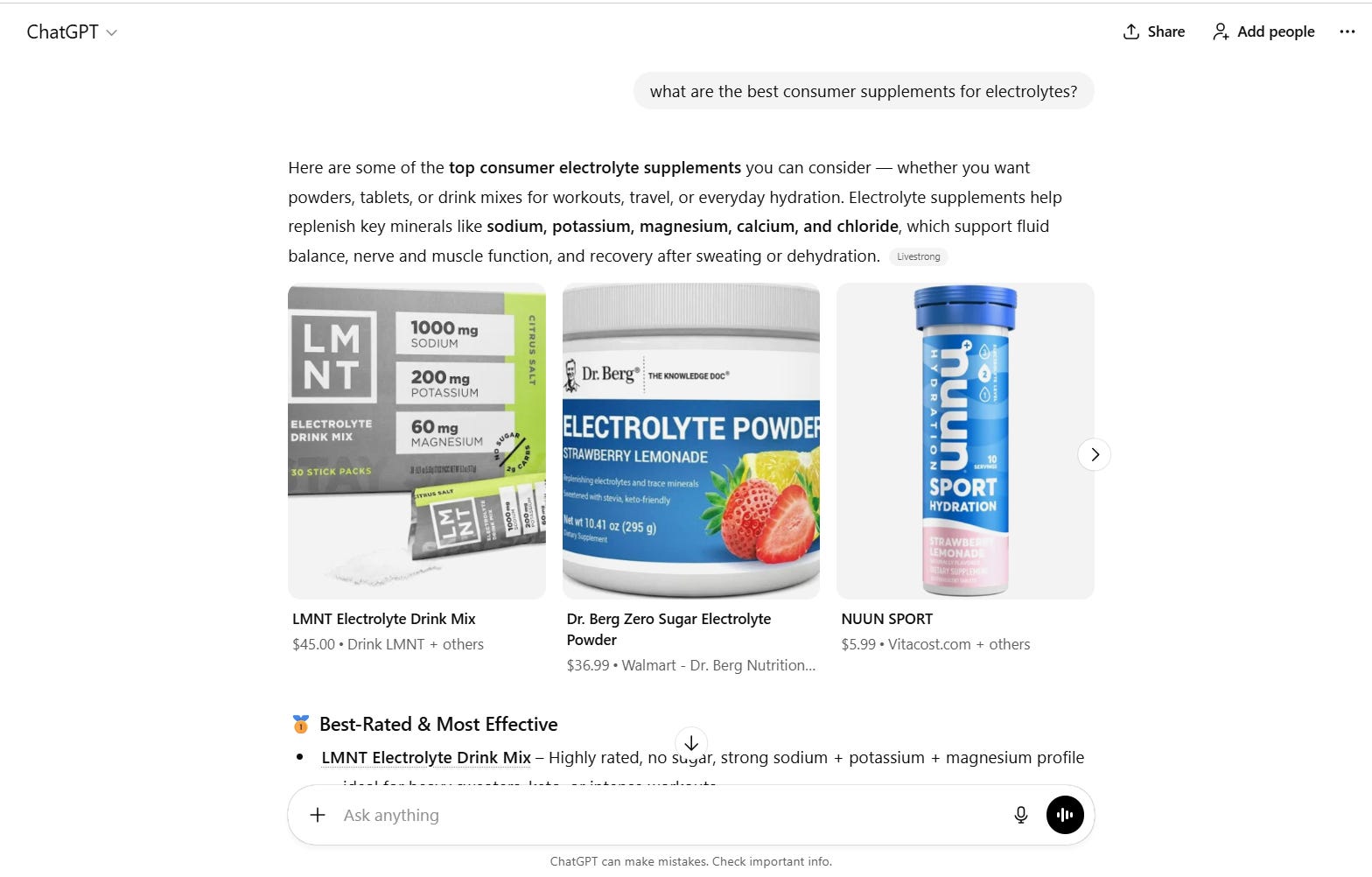
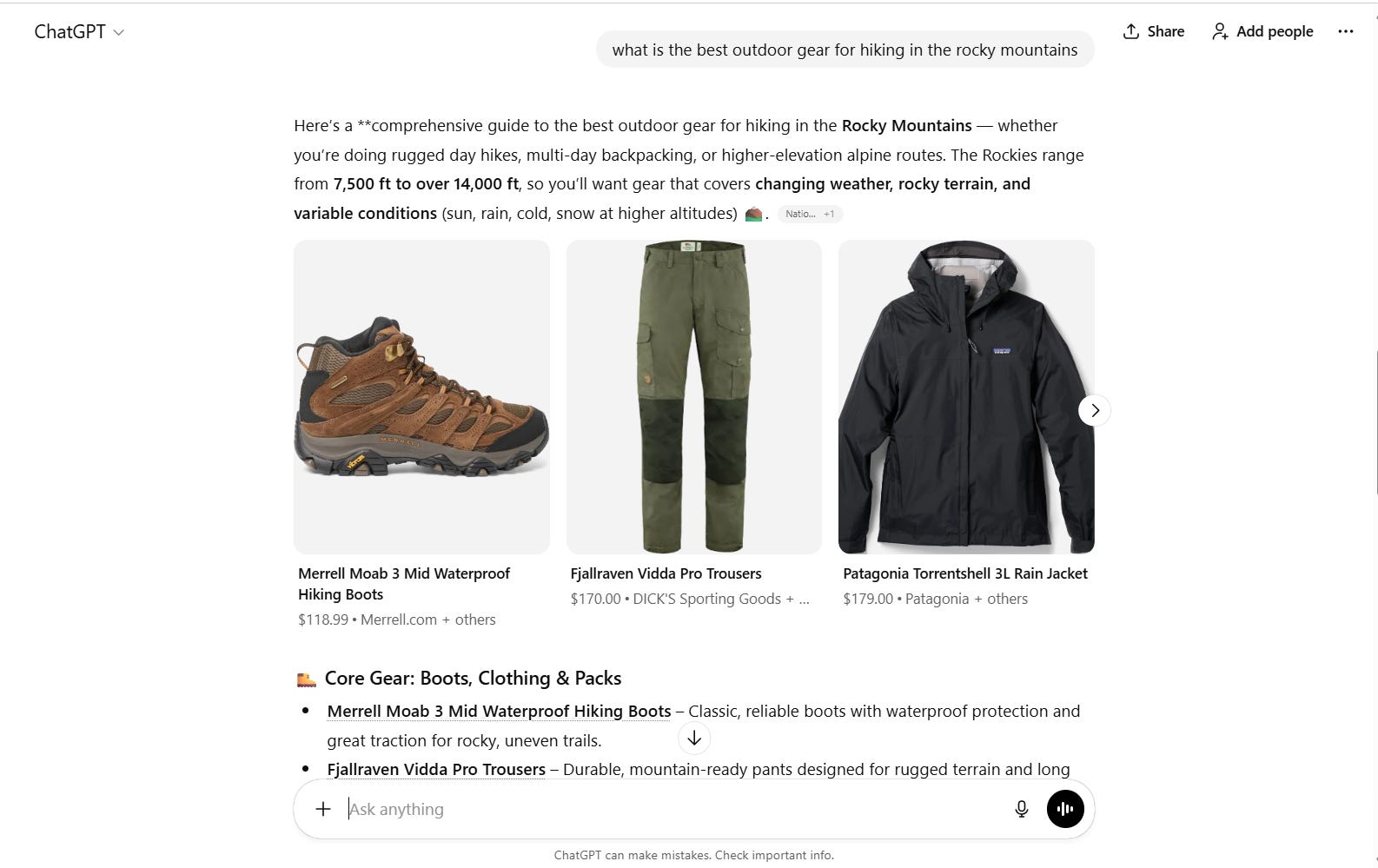
Try asking ChatGPT or Perplexity about categories like:
Consumer supplements
Travel gear
Kitchen items
You’ll notice the same 3–5 brands appear over and over. Those brands are already optimizing for AEO.
4. This CAN disproportionately benefit smaller companies
SEO was a big-company game. Whoever had the budget to pump out 200 keyword articles a month won.
But not for AEO.
If a 20-person DTC brand structures its data clearly and creates transparent product info, it can outrank a Fortune 500 brand inside AI answers instantly.
—> The LLM robots don’t have feelings or inherent biases. They don’t care how big you are. They care how coherent and credible you look in the data they digest.
This levels the playing field for up-and-coming brands, especially in:
Beauty
Consumer health
Outdoor gear
Supplements
Niche SaaS
Digital tools
As an investor, this can help you assess how efficiently a company (in an industry like the above) is utilizing AI to market and sell their products.
In these early stages of AEO ( I believe we are still early btw), small businesses can scale rapidly without spending exorbitant amounts of capital. I do think large conglomerates will dominate largely due to their endless budgets and willingness to dominate this space.
How Investors (like you) Can Actually Check AEO Strength
You already have the tool — just look it up on ChatGPT or another LLM.
Ask the models:
What are the best [category] products for 2025?
Which brands are known for [key attribute] ?
Recommend 3 alternatives to [competitor] .
What company is leading in [specific niche] ?
If the brand you’re researching shows up without you prompting it, that’s real AEO traction.
And if it shows up repeatedly across several LLMs? That could be a marketing moat forming.
What Businesses are Doing Behind the Scenes
The companies that really understand the shift are quietly rebuilding their entire marketing stacks around AEO:
Cleaner Product Taxonomy
LLMs need clarity and brands are rewriting product pages to be more explicit and structured
FAQ-heavy content
Models love Q&A format, so expect businesses to expand FAQs massively
Structured data markup
Gives context to web content for search engines (and now LLMs)
Consistent messaging
If a company’s own website, Amazon listing, and retailer descriptions all tell slightly different stories, LLMs flag it as ambiguity
Real reviews > SEO content
LLMs de-weight keyword blogs and up-weight user sentiment — businesses are beginning to obsess over reviews and the accuracy of them
Creating direct AI training data
Some brands are now publishing “LLM-ready” datasets about their products. This means clean, structured documentation explicitly written to be digestible for AI.
The smartest companies are treating models as their new customers.
Product Placement and The Shift to AI Shopping
This past Black Friday was a clear inflection point, with LLMs like ChatGPT being used at record levels to research products, compare options, and make purchase decisions.
Salesforce reported that AI and AI agents drove $14.1 billion in global online sales on Black Friday 2024 alone (Salesforce, 2024). Traffic from chatbots to retail sites increased 1,800% on Black Friday 2024 compared to 2023. These weren’t incremental improvements — they represented a fundamental restructuring of how people discovered and purchased products.
Adobe also published the following on their website:
Last holiday season, LLMs accounted for less than 1% of shopping traffic to U.S. retailers, but over the last year (as of July 2025), this traffic has increased by a staggering 4,700%. At this rate, LLM-driven shopping will still remain a small percentage of overall shopping, but these shoppers represent the future of e-commerce.
If a brand isn’t showing up in AI-generated recommendations, it’s effectively invisible to a growing portion of demand.
The companies that win from here will be the ones that understand how to translate brand, product, and trust signals into formats AI can surface confidently.
From an investing standpoint, AEO is becoming a real indicator of whether a company’s growth is built for the next decade or anchored to the last one.

Where this gets Exciting for Public Stock Investing
AEO isn’t just a marketing tactic, but rather a proxy S&M acumen for businesses you are assessing in the market.
For public market investors looking at a business where branding and an online digital matters heavily for sales, AEO matters mostly as a lens into how well a company can actually market and sell products in an AI-driven discovery environment.
This is especially true in categories like beauty, consumer health, outdoor gear, supplements, niche SaaS, and digital tools, where purchase decisions are increasingly influenced by recommendations, not ads.
It’s easy for a company to check the “innovation” or “cool factor” box, whether through a trendy brand, strong product design, or a well-timed acquisition, BUT innovation alone doesn’t matter if the business can’t efficiently get that product in front of consumers at the exact moment they’re deciding what to buy.
Take a little bit of time to figure out if the business you are looking at is doing this.
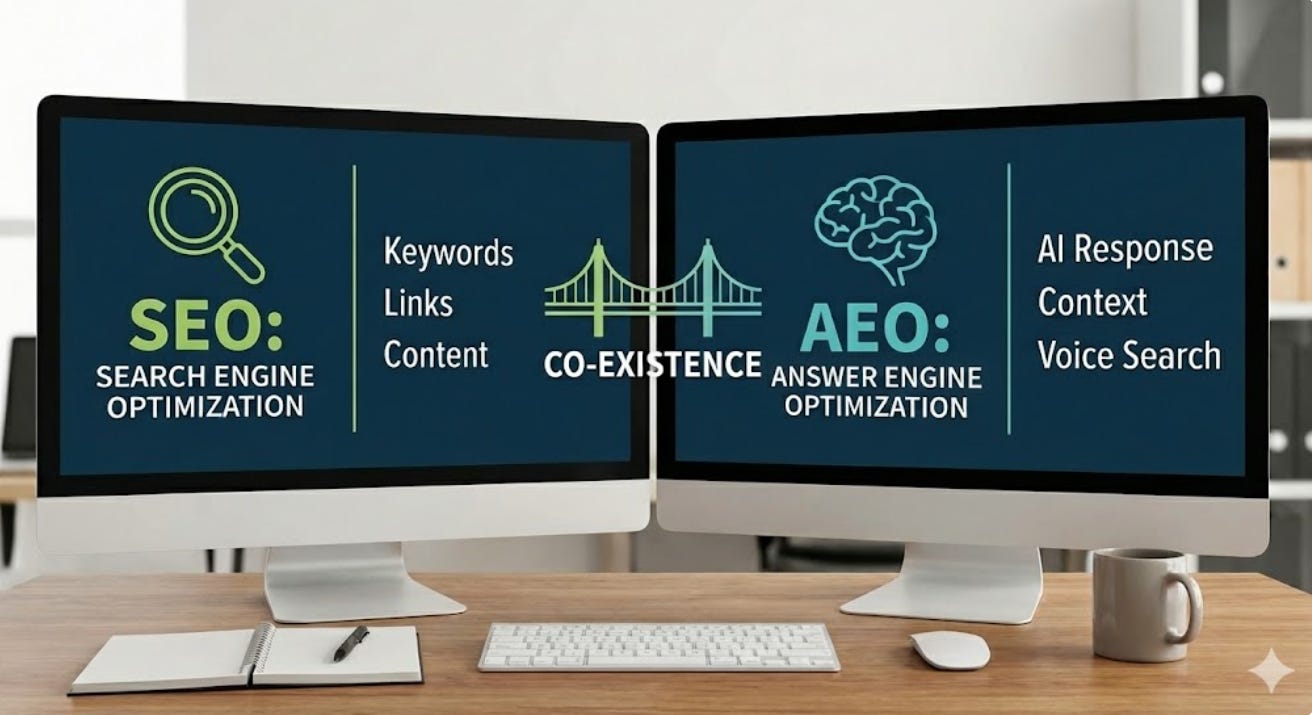
So… will AEO replace SEO?
No. From reading more into AEO vs SEO and if they co-exist or if AEO replaces SEO, I’ve come to the following conclusion:
The future is hybrid.
Traditional SEO will matter for navigational queries
AEO will dominate for recommendation and decision queries
It’s more accurate to view AEO as an evolution and extension of traditional SEO, not a substitute.
SEO still plays the foundational role of making a site technically discoverable and authoritative, while AEO builds on that foundation by tailoring content so AI and answer engines can understand and cite it as a direct response to user queries.
In other words, SEO helps a brand get found in search results, while AEO helps a brand get quoted by models like ChatGPT or Gemini — a distinction that’s becoming increasingly important as AI-powered interfaces change how people shop and research online.
In my experience in private equity, working with businesses that want to be knee deep in this rather than tipping their toes in, driving AEO alongside SEO is worth it.
In this complementary relationship, businesses must integrate both strategies to future-proof their visibility and avoid losing traffic to AI summaries that don’t link through to traditional search results.
Final Take
AEO is a structural AI shift in how customers find and trust products. It rewards companies that communicate clearly with the models shaping the modern web.
If you want to know whether a company is ready for the next decade of digital commerce, don’t check their blog.
—> Ask the models.
If they don’t show up, the market may eventually agree.
Disclaimer: The information provided in this publication is for informational and educational purposes only and does not constitute investment, financial, or other professional advice. ThePrivatePublicInvestor and its authors are not registered investment advisors or broker-dealers. All opinions expressed reflect personal views as of the date published and are subject to change without notice. While efforts are made to ensure accuracy, no guarantee of completeness or reliability is given. Past performance is not indicative of future results. The author may hold positions in securities discussed. Use of this content is at your own risk.
Couldn't agre more. How do brands actively reinforce crediblity for AEO with LLMs?