


“The journey back to greatness has only just begun… the direction is what matters”
— Elliott Hill, CEO
Investment Contents:
1. Executive Summary
2. Q1 2026 Earnings
3. Consulting CEO Nearly Destroys Nike
4. Enter Savior: Elliott Hill
5. The “Win Now” Strategy
6. Market Dynamics & Heavy-Competition
7. Financial Projections
8. Turnaround Summary = Outsized Returns
Executive Summary:
Nike. One of the most durable brands in the history of apparel. Is this legacy brand slowly dying? A lumbering dinosaur? We don’t think so. We believe this will be one of the strongest turnaround plays in the market during the next 12-48 months.
After a period of missteps under a consulting-focused CEO, Nike is refocusing on its core strengths: sports, innovation and wholesale partnerships.
The stock trades at a steep discount to its fair value, offering patient investors a chance to buy a world-class brand at an attractive value.
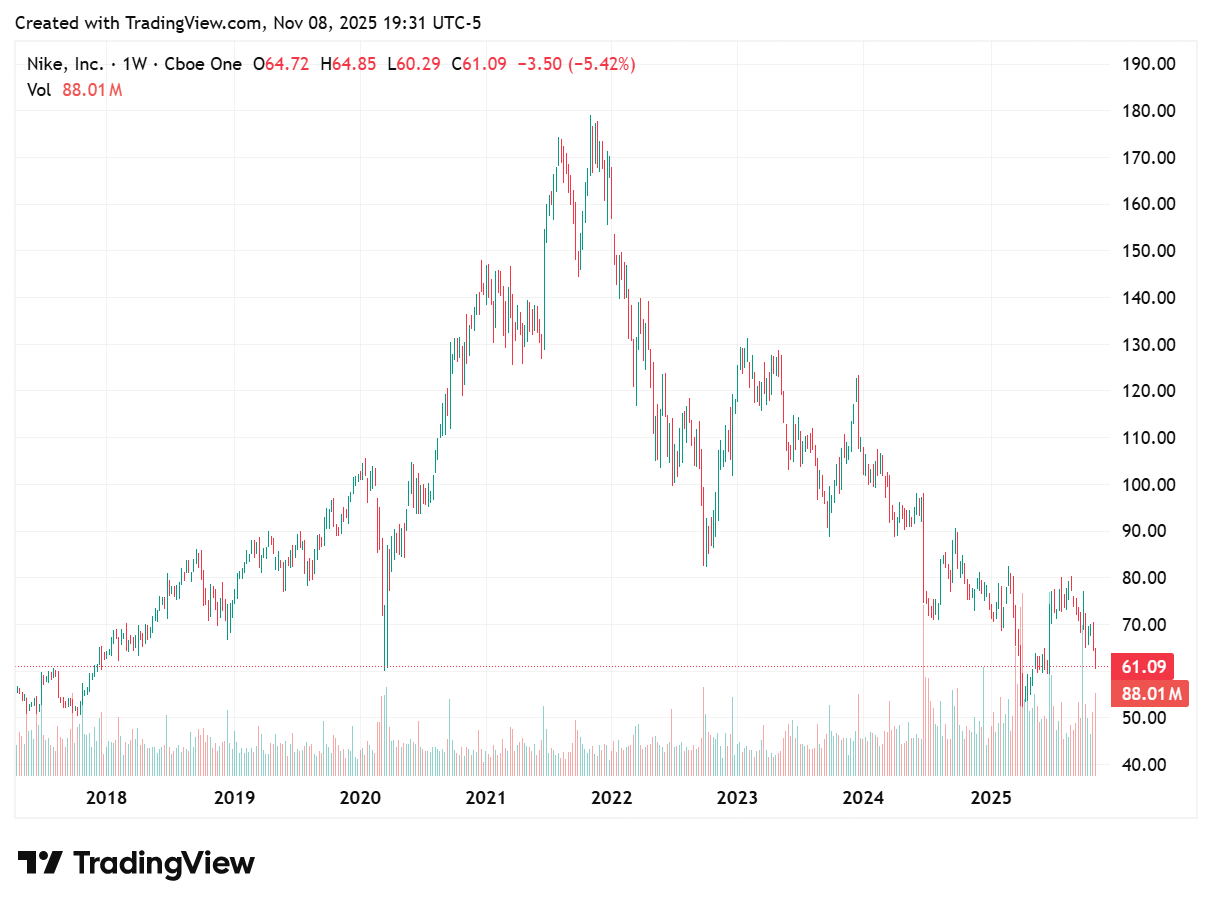
We are projecting Nike to return 20-25% (excluding 2.5% annual dividend) annually through 2029, forecasting Nike to crawl back near ATH sometime before EOY 2029.
Q1 2026 Earnings:
Let’s start with the most recent — earnings.
Nike came out with Q1 2026 earnings on September 30th (remember they have an awkward reporting period) — they were better than expected.
Total Revenues: $11.7 billion (down 1% YoY) — Beat
Direct Revenues: $4.5 billion (down 5% YoY)
Wholesale Revenues: $6.8 billion (up 5% YoY)
Gross Margin: 42.2% (down 3.2% YoY) — Beat
Earnings per Share (EPS): $0.49 (vs. $0.27 expected) — Beat
*Note: The numbers reported above are adjusted to be currency-neutral
The Numbers Tell a Recovery Story
This was the first top-line surprise in several quarters, driven by strong wholesale growth (+5%) and improving sell-through across regions (note: stronger sell-through = better inventory turnover / management).
Direct revenue was down YoY, as expected, as the team deliberately continues to clean up the channel mix.
EPS crushed expectations (81%+ beat!), illustrating disciplined bottom line management, even as the company is reorganizing a turnaround for the business.
Of course, investors focused on the negatives: gross margins down 3%+, Greater China declining ~9%, and cautious guidance for Q2 2026.
We believe analysts are missing the forest for the trees — although the company still faces a long runway to rebuild, Nike is executing.
Balance Sheet: Fortress-Like Strength (as of Sept. 2025)
Cash & Equivalents: $8.6 billion
Plenty of firepower for inventory investments, select marketing spend, strategic partnerships, or targeted acquisitions
Debt: ~$8.0 billion
Strong interest coverage with no meaningful payback worries
Inventory: $8.1 billion (Q1 2026)
Q4 2025: $7.49 billion
Q3 2025: $7.54 billion
Q2 2025: $7.98 billion
Disregard the Q1 2026 rise in inventory, as this occurs annually due to the seasonal buildup in preparation for the upcoming holiday season. Compared to the ~$8 billion of inventory in Q2 2025, the team is evidently pushing to clean up excess stock and improve working capital efficiency
Cash Flow: Nike generated $25+ billion in free cash flow over the previous five years and is forecasted to generate $27+ billion over the next five. Even in the midst of a turnaround, Nike prints cash.
Overall, the quarter confirmed the two-pronged strategy Hill laid out earlier this year:
Reignite growth through wholesale re-engagement and product innovation
Drive profitability through simplification and cost control
Nike isn’t out of the woods yet, but this quarter suggests the turnaround isn’t just talk.
Consulting CEO Nearly Destroys Nike:
John Donahoe
This guy stinks! (SpongeBob reference btw for any cool folks out there…)
Donahoe, who joined Nike in January 2020 from ServiceNow and eBay, brought a consulting mindset to a brand-driven business.
While I’m sure Donahoe would be a great CEO elsewhere, his tenure marked a fundamental misunderstanding of what made Nike special.
The Direct-to-Consumer (DTC) Obsession
Donahoe’s signature strategy was accelerating Nike’s shift to DTC sales, cutting ties with wholesale partners to capture more margin and control distribution.
On paper, this makes sense — higher margins and better data on consumer behavioral to use for marketing strategies across the business. This ended up being a disastrous strategy…
Strained Wholesale Relationships

Nike pulled product from key wholesale partners like Foot Locker, Dick’s, and even temporarily from Amazon!
The team bet that consumers would simply buy directly from Nike.com or Nike stores instead. So, with reduced product flow from Nike, it forced retailers to diversify toward other brands.
Specialty brands such as Hoka and On Running starting filling Nike’s shelf space. Even more ‘generalist’ brands like Adidas began replacing Nike’s shelf space.
By 2024, Nike’s market share in running-specific footwear had been carved up:
Brooks commanded 24% of the running shoe market, Hoka captured 10%, and On Running grabbed 9% and was expanding quickly.
Nike, despite being the largest athletic brand globally, was losing ground in a category it had dominated for decades.
In addition, without sufficient third-party channels to offload products, Nike was forced to use its own branded channels, including Nike.com and its apps, for deep discounting to clear the surplus.
This had a negative impact on the brand’s premium image, reputation and gross margins (opposite effect as intended by Donahoe).
There are more examples other than running — this is just for illustrative purposes.
In addition, Nike prioritized operational efficiency and cost-cutting over product development and athlete relationships.
These strategies didn’t just reduce overall revenue growth, margins and market share — it destroyed decades of carefully cultivated retailer relationships with wholesalers.
