


When AMD announced it was paying $35 billion for Xilinx in October 2020, I had no idea what an FPGA was…
Most of the Generative AI boom so far has been centered around GPUs and data centers, but the next chapter won’t live 100% in the cloud, but rather, will move to AI at the edge.
We’ve already seen a partial move of conversation past the narrow-focused raw compute scaling of power for datacenters via GPUs — with the newer talk of the town surrounding memory, as players like Micron and Sandisk have blasted higher in the past year.
The retail public is learning more every day on the tech stack of the semiconductor industry, as it has become the new ‘oil’ of the current world and economy as we see it.
Field-programmable gate arrays (FPGAs) are hardware that operates like software, and if we can make this chip technology cheap and usable enough, it could have massive potential for the world of AI and neural networks.
In this writeup, I want to unpack why FPGAs are genuinely a revolutionary technology, how much potential these chips actually have and how players like AMD, Intel’s Altera and Lattice Semiconductor might still turn them into the go-to brain for AI at the edge.
As always, I would really appreciate if you shared this post and subscribed to ThePrivatePublicInvestor, as I try my hardest each week to give you custom, in-depth analysis on stock investments, market insights and portfolio strategies.
With a subscription to the ThePrivatePublicInvestor, you will receive insight into my personal portfolio, along with each position I own and the related weighting, along with custom templates for valuation and modeling (coming soon) and the personal chat feature for the community.
As this channel grows, paid subscriptions will start to be incorporated, so subscribe early and stay subscribed to receive ‘founding member’ pricing and exclusive benefits.

What are FPGAs and why do they matter?
FPGA technology is much different from a CPU, GPU and an ASIC.
CPUs are chips that are designed to handle a single task efficiently. GPUs use parallel processing to handle multiple tasks a once, but each task slower than a CPU. An ASIC is a single-purpose machine used for one singular job — less flexible than a general purpose CPU, but much faster.
An FPGA is a type of chip that can be programmed and reprogrammed after it is manufactured to perform any task. It’s the most flexible chip technology on the market.
Unlike a CPU running software instructions over and over, or a GPU executing thousands of data vectors in parallel, an FPGA can be architected as custom hardware for your exact workload.
Let’s think about this using an analogy of transferring cargo from one location to another, with these different chip technologies representing the “vessel” for transferring the cargo:
CPU (The Commercial Jet): It finishes one mission (task) at a time incredibly fast. If the mission changes mid-flight, it can pivot instantly. It can also travel anywhere (flexibility)
GPU (The Cargo Train): It isn’t faster than the commercial jet, but it has 500 cars moving simultaneously. It’s perfect for when you have 10,000 identical cargo crates (or data) to move at once.
ASIC (High-Speed Monorail): This is a permanent structure that is custom-built to move (process) one specific thing. It is the fastest and cheapest way to move the cargo, but the structure cannot be moved or changed (not flexible)
FPGA (The LEGO Delivery): I like this LEGO analogy for the FPGA — a vehicle made of modular blocks. Before a trip/shipment, you can rebuild the chassis to be a cargo tanker. The next day, you can rebuild it to be a flatbed F-150. The next day, you can rebuild it to be a helicopter. It’s flexible, and it’s hardware that acts like software.

The Edge AI Application and Sweet Spot
For anyone who isn’t caught up on “AI at the Edge,” — it’s simply running inference AI locally on devices rather than in the cloud.
Why is this important?
Because latency. Latency can kill user experience.
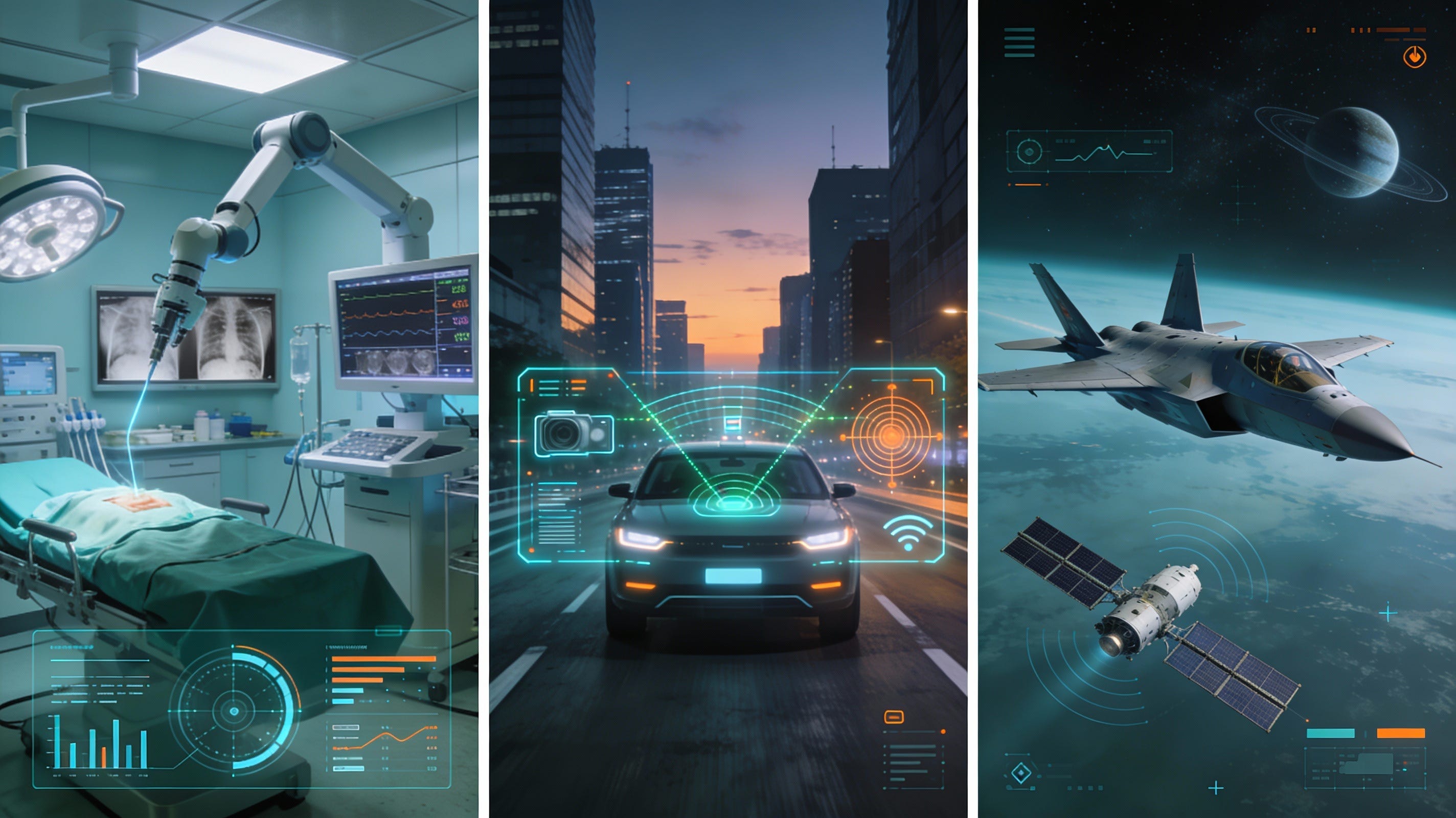
Classic examples of this are autonomous vehicles (AV), military drones and medical devices.
An AV can’t afford a 1-second round trip to the cloud to decide whether to brake…
A military-grade drone camera can’t tolerate cloud dependency for threat detection or aerial maneuvering…
Your Intuitive Surgical ‘Da Vinci’ robotic system performing surgery can’t wait for network delays…
FPGAs have 4 concrete advantages over other chips:
Ultra-low latency
3-4x power efficiency over GPUs with specific use cases
Runtime reconfigurability for algorithm evolution
Sensor capabilities
In more detail:
Ultra-low latency: A GPU processes data in batches. It waits for a buffer to fill, then processes everything at once. This batching introduces variable latency, usually milliseconds, depending on workload.
FPGAs don’t batch. They process data as it arrives, processing “pixel-by-pixel,”.
Extreme power efficiency: A GPU like NVIDIA’s H100 consume lots of energy.
FPGAs can deliver comparable inference performance at a fraction of the power. In some edge AI workloads, FPGAs use 3-4x less power than GPUs while maintaining low latency. That translates directly to longer battery life, which illustrates the efficiency of this chip technology.
Flexibility: Once an FPGA is deployed and integrated within a system, you’re not locked into a fixed architecture of compute. You can reprogram it to adapt to evolving AI models without purchasing new hardware.
This is valuable in uncertain environments such as AVs, military technology and medical devices where the environment constantly changes and the variables are unknown. The algorithm can freely change.
Direct sensor integration: Let’s think about our real-world examples again. Your AV “x-amount” of cameras, possibly LIDAR, radar and other technical sensors. Your Da Vinci robot has performance video processing, 3D visualization and precise motor control.
FPGAs excel at sensor control and taking multiple high-speed data streams, processing them in parallel and making decisions instantly.
IMPORTANT: GPUs and CPUs struggle here because they’re designed to pull data into memory, process it, then push out results.
FPGAs are architected for streaming data.
So Why Isn’t Every Company Rushing to FPGAs?
Because the reality is that FPGAs carry a high cost and complexity for programming that people can underestimate and is a brutal barrier for businesses.
According to a recent industry survey from Logic Fruit:
39% of engineers cite a “Time-Consuming design process” as the biggest obstacle to FPGA development. Another 30% mention high development costs as an issue.

According to another survey from Logic Fruit:
44% of participants think that FPGAs will eventually replace ASICs due to the demand for more adaptable and reprogrammable hardware solutions.
According to research, this could be the biggest threat to mainstream FPGA adoption. When you’ve validated your AI workload and know it won’t change, an ASIC delivers superior performance and power efficiency. ASICs are expected to grow at a 30%+ CAGR in the AI chipset market, which is much faster than FPGAs’ projected 10-15% growth.
Another 31% of respondents emphasized the growing integration of IoT and AI since FPGAs provide the flexibility and processing capacity needed for these cutting-edge technologies.

So there is a real debate around the viability of FPGAs and whether they will be the future of AI compute at the edge.
But here’s where I think it gets interesting on the cost front… FPGAs are actually getting cheaper!
The low-end FPGA market (small devices for the edge) is projected to dominate by unit volume.
Companies like Lattice and AMD are now building specifically for this segment using mature and cost-optimized manufacturing.
FPGAs are now cheap enough for applications where you need deterministic latency, real-time reconfigurability and sensor fusion. This is a different market than it was five years ago, and it opens up actual volume opportunities in automotive, medical and industrial robotics.
With this, I do think the pragmatic and conservative roadmap is to assume GPUs will continue to be used broadly for flexibility and breadth, CPUs will be used for interconnecting with GPUs and the natural plugin hardware for laptops, ASICs will be used for fixed, high-volume workloads….
… and FPGAs will be used for niche applications where you need custom hardware acceleration, extreme power efficiency and the ability to iterate in real-time with ultra-low latency.
The Market Reality and Size
The global FPGA market is valued at roughly $10-12 billion in 2025, expected to reach $18-20 billion by 2030, which is a 10-15% annual CAGR.
The overall AI semiconductor chip market is worth hundreds of billions of dollars, with an annual CAGR of ~30%.
Doing rough math in excel based on the below image, FPGAs represent maybe 5-10% of the overall market, with slow growth relative to the broader AI chip boom.

This may seem very small, but I think this $ market opportunity is very relative, and it depends on the discoverable use cases of FPGAs, which could change the TAM overnight. These markets are where you would need low-latency and real-time processing with evolving algorithms.
Use Applications
FPGAs will dominate specific niche industries:
Autonomous vehicles
Industrial robotics
Telecommunications infrastructure
Aerospace & defense (drones and other tech)
Medical devices
I also think mobile edge AI (smartphones), running local inference computation constantly everyday, could have important use cases (could be getting outside of my wheelhouse here though, I’m no AI tech expert).
If FPGA technology is acceleratingly adopted by these industries as the age of robotics and general AI advances, there could be a huge opportunity here.
That said, I am sure that cloud inference will continue to be dominated by GPUs, CPUs and ASICs. FPGAs will only complement these rack-scale stacks within datacenters.
So who could benefit the most from the FPGA Market?
The competitive landscape is pretty concentrated and narrow here, with AMD’s Xilinx subsidiary dominating 50%+ of the market, with Intel’s subsidiary, Altera, following with 35% and Lattice Semiconductor being the only other viable player at 5% (Image source: FPGATEK).
This market share data is actually a bit outdated, but based on skimming other recent articles, the markets share is relatively the same, with Xilinx increasing towards 60%, Altera losing share, down to 30%, Lattice increase share up to 6-8% (bit jump!), and the others filling the remaining gap (even more concentrated!)

Intel has really screwed up on the FPGA front, as they’ve been hyper-focused on the datacenter trend the past few years, restructuring their business with new management and have been trying desperately to catch up to NVIDIA, and recently, AMD. Altera’s FPGA business has suffered due to this.
Regarding the other competitors in the space:
AMD (with Xilinx) is going after high-performance AI engines for cloud, 5G and high-end edge. This is where the big money is, and Xilinx is the most powerful competitor.
AMD now has a complete computing portfolio: CPUs, GPUs, DPUs, FPGAs and accelerators. You don’t need to spec GPUs from NVIDIA for one component and FPGAs from someone else for another. For customers building edge AI systems, this is extremely valuable, as the whole stack is being offered to you from one supplier.
Lattice has alternatively doubled down on small, low-power FPGAs for edge compute, rather than chasing the biggest and fastest devices for datacenters. Lattice is basically playing a very different game from AMD and Intel, and that’s exactly what makes them interesting for edge AI.
They’re not trying to beat AMD or Altera, but rather, they’re trying to be the best in a specific niche. This is extremely valuable, as this is the company’s main focus.
So… yes… AMD, Lattice and Altera (Intel) would benefit disproportionately if this FPGA technology takes off in the future with edge AI applications.
Intel only if they get their s*** together!
For more information on the specific products each company offers, I’d recommend skimming the below website:
https://fpgatek.com/fpga-manufacturers-and-their-products/
So, Could FPGAs Be the Answer to AI on the Edge?
FPGAs are genuinely a revolutionary technology for AI, as mentioned in the beginning of this writeup... that’s for sure, but I think this is only for specific use cases until the TAM gets broadened when companies investigate, research and reveal other use cases.
If you’re building an autonomous vehicle and need to put together multiple high-speed sensors with sub-millisecond latency while running neural network inference, FPGAs are a better choice than GPUs.
If you’re utilizing inference AI on a military-grade, weaponized drone that runs on battery power, FPGAs’ power efficiency and sensor capability enhancement can improve this product immensely.
If you’re building medical imaging devices where latency is critical to patient safety and health, FPGAs are imperative and give you deterministic timing that GPUs can’t match.
These are significant markets, but they’re not the majority of AI deployments.
So FPGAs will likely not be the highest revenue-generating chip anytime in the future, but I do think this industry is a bit overlooked with the current craze with raw datacenter compute.
What’s a more likely ecosystem of AI chips is where different technologies thrive in different domains:
Datacenter cloud training: GPUs, CPUs and ASICs dominate
Cloud inference: Mixture of GPUs, ASICs and FPGAs, depending on latency/throughput trade-offs
Edge inference: FPGAs, edge TPUs, and other specialized processors
Real-time embedded AI: FPGAs and ASICs
BUT, if FPGAs can carve out 10-15% of edge AI workloads in medical devices, robotics, autonomous vehicles and industrial applications, and those markets are growing at, say, 25%+ annually, then even a niche FPGA player could see 20-30% revenue growth for a sustained period of time.

Disclaimer: The information provided in this publication is for informational and educational purposes only and does not constitute investment, financial, or other professional advice. ThePrivatePublicInvestor and its authors are not registered investment advisors or broker-dealers. All opinions expressed reflect personal views as of the date published and are subject to change without notice. While efforts are made to ensure accuracy, no guarantee of completeness or reliability is given. Past performance is not indicative of future results. The author may hold positions in securities discussed. Use of this content is at your own risk.
This could go beyond AI, into robotics as well.
There is a common paradox in robotics called Moravexs Paradox, where to train tasks humans find easier (e.g. stirring oatmeal until it’s perfect consistency) - it is very compute intensive and to train tasks that humans find complex (e.g planning, optimizations..) - it is less compute intensive.
This along with algorithmic efficiencies like real time task clustering can unlock beyond highly specific tasks like EV, military drones and so on.
It could make significant progression on use cases where robots emulate or directly replace human labor.
interesting write up will have to continue to review