


This is the last free Deep Dive before paywalls are put up — only paid subscribers will have access going forward.
The United States is undergoing its fourth Industrial Revolution.
First: Steam power and early factories.
Second: Electricity, steel, and mass production.
Third: Computers, microchips, and the internet.
Fourth: Artificial intelligence and robotics
Artificial Intelligence is already in full swing.
Robotics is not.
AI deployed into the physical environment we live in is still in development, and I want to be early.
The advancement of LLMs and GenAI has catapulted progress in the robotics field by accelerating how machines learn, reason and react to the world around them through simulation and continuous incremental context.
The humanoid race is beginning and there is intense global competition among nations to develop these autonomous robots.
But first, why humanoids? Why do we need robots built like humans?
There sure are industrial cases where robotic arms and wheeled robots are needed in a manufacturing facility.
—> The answer is that our world is already designed for human bodies.
Jensen Huang said this best:
“Robots look like people because… the most important reason, is that we built the world for ourselves, and so the workstations of a factory, the manufacturing of a factory, was really created for people.”
Furthermore, because we share the same physical hardware, we have an unmatched dataset for training these machines to interact with the world, use human-centric tools, and operate the vast array of machinery built for our hands.
Walk the floor of almost any tech conference in 2026 and you’ll trip over a humanoid robot pouring coffee… an easy way to walk away convinced the future has already arrived.
Global humanoid installations came in around 16,000 units in 2025, up from essentially zero in 2023.
This is small, yes, but adoption is rapidly increasing.
KraneShares’ KOID, the first U.S.-listed humanoid ETF, launched just last June, and it has already been one of 2026’s standout thematic performers.
I think it’s time to dig into this space and find some standout multi-baggers.
Let’s jump in.
As always, I would really appreciate if you shared this post and subscribed to ThePrivatePublicInvestor.
With a subscription, you will receive deeply researched stock deep dives, insight into my personal portfolio, along with each position I own and the related weighting, along with my personal watchlist, custom templates for valuation and modeling, decision-making investment guides, and the personal chat feature for the community.
Subscribe now to receive ‘founding member’ pricing and exclusive benefits before we rollout standard pricing for the rest of the community here on Substack.
With that, enjoy this piece and let me know if you have any questions!
Robotics is Going to Have a ChatGPT Moment
Jensen Huang has spent a year telling everyone that physical AI is the next multi-trillion-dollar wave and that robotics is about to have its ChatGPT moment.
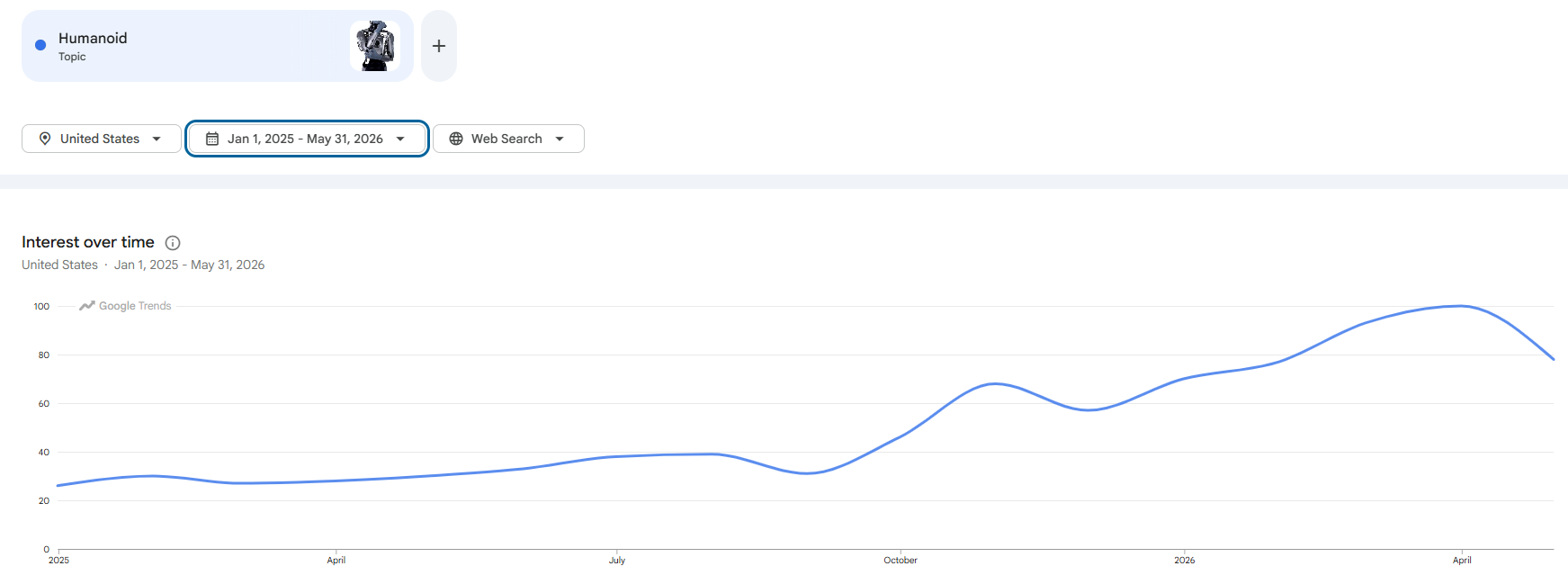
What’s new in 2026 is that retail finally caught the scent — discords, comment sections and early green signals in public securities have seen notable increased activity and volume.
The humanoid robot story is not a "who builds the best robot" story. It is, at least for the next five to seven years, a supply chain story, and the supply chain has very specific chokepoints that specific companies own.
What Makes up a Humanoid Robot?
A humanoid is simply a battery, a brain, a body, and a bunch of motors, gears, screws and other parts connecting it all together.
