


"Bull markets are born on pessimism, grown on skepticism, mature on optimism and die on euphoria."
— Sir John Templeton
Let me be blunt.
Almost every bearish indicator I track is flashing red right now.
I always treat markets like this the same — I buy incrementally throughout the downturn and through the recovery.
Sometimes it may feel like you’re doing everything wrong in times like this.
That is normal for investors 1-10 years into their investing journey, including me (currently 7 years in).
I still feel like I’m doing things wrong sometimes!
But, for some reason, I picked up a good trait in the family and can stomach these downturns, however long and deep in the red (test me market!).
But I will say, I used to feel very worried in times like this.
But over time, incremental preparation compounding over time simmers those worries and gives comfortability in decisions.
I’m not here to scream doomsday, but I want to show you what the overall market dashboard actually looks like so you can make your own decisions.

The Sentiment Picture is Ugly
The market is currently in a state of "Extreme Fear" (Index: 0-25), supported by deeply oversold technicals (RSI: 27) and a yield curve that has recently normalized to a +51 bps spread, which is historically a high-risk signal for an impending recession.
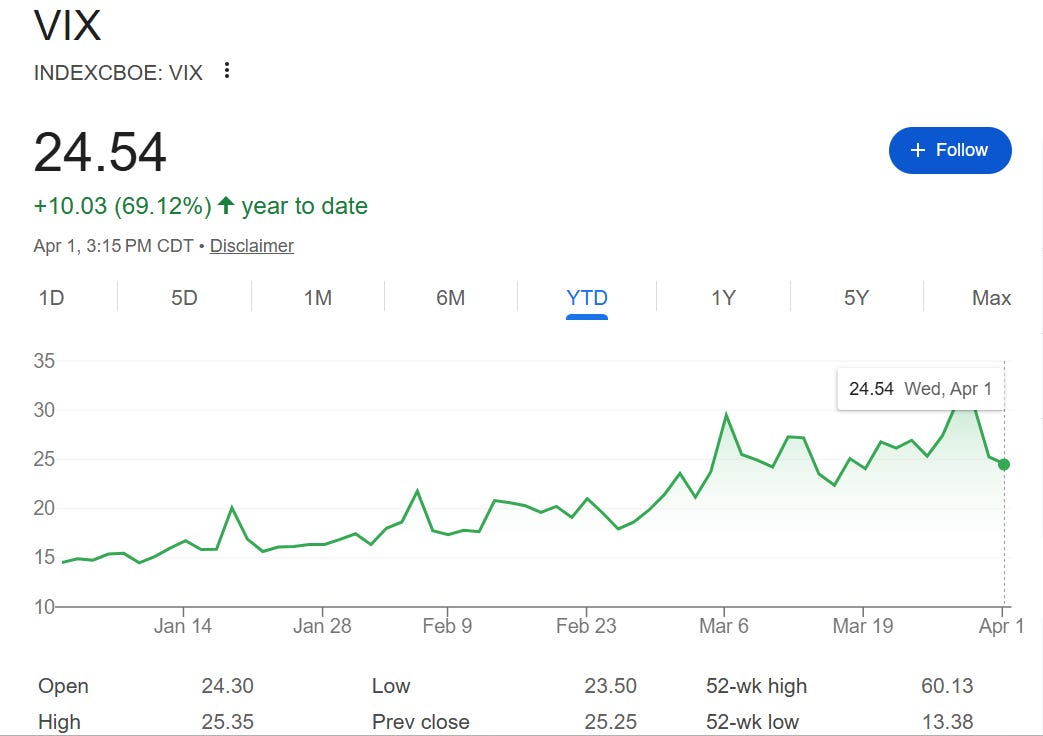
The VIX has been moving between 25-30 the last few weeks, remaining below the spike of 40 often seen at definitive bottoms.
I called this out earlier this week as a sign of the market potentially reaching a bottom in the coming couple of months.
The Indicators
The CNN Fear & Greed Index almost hit 10 this week, with the index sitting at 16 today, April 1st.
We are in deep Extreme Fear, the lowest reading of 2026, and comparable to the COVID crash and 2022 bear market lows.
Below depicts the LTM trend of the index.

Separately, the AAII Investor Sentiment Survey shows bearish readings at 49.8%, nearly 19 points above the historical average.
Bullish sentiment has sat below average for six consecutive weeks.
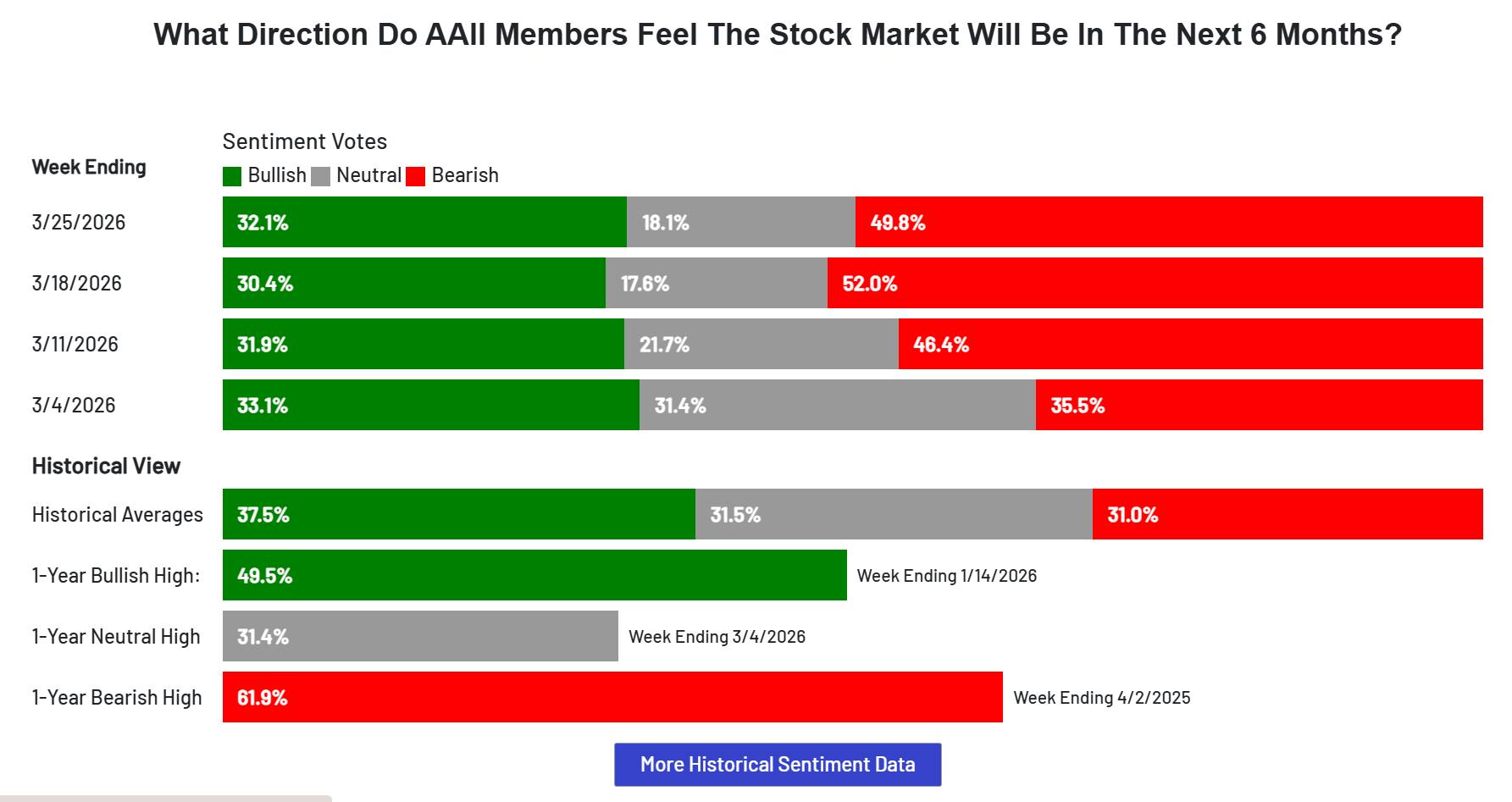
The University of Michigan Consumer Sentiment final March reading also came in at 53.3, which is a bottom 1st percentile historically.
People are scared.
Google Trends searches for “recession” and "stock market crash" have reached a one-year high, showing a significant acceleration as we’ve moved into Q1 2026.
Moody’s puts recession probability at 48.6%.
Goldman raised theirs to 30%.
Bear market talk is mainstream.
The CBOE SPX put/call ratio has also surged to ~1.3x, as it seems investors are aggressively hedging at the index level, which is the classic defensive posture you see during risky times.
The put/call ratio serves as a diagnostic for fear, measuring the volume of bets placed on a downturn against those betting on a recovery.
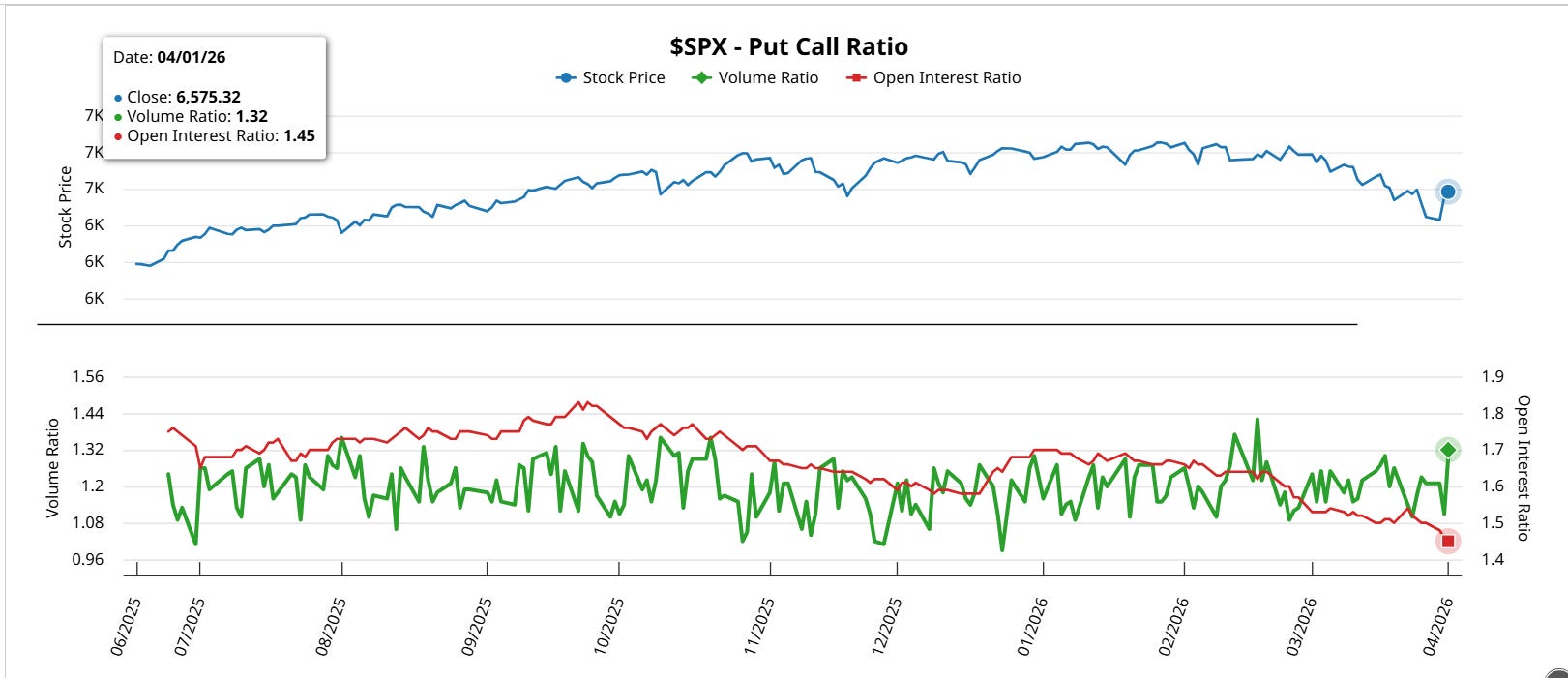
BUT, in the current climate, we are witnessing sentiment divergence:
While the daily Volume Ratio has spiked as traders scramble for downside protection (buying puts), the Open Interest Ratio (total # of active contracts actually held in the vault) is hitting a 1-year low.
This tells the story of a “washout” in progress.
While the broader crowd is currently in a state of panic-buying insurance through purchasing puts, the smart money is quietly closing out their bearish positions and taking profits.
This could mean institutional big money is preparing for the clouds to break and the market to turnaround green.
I believe this means one thing, that has stood true historically:
—> Stay invested and prudently buy
The Technicals
The S&P 500 sits roughly 5-10% below its January all-time high (on the upper end if you discount the past couple days rally, and probably will go lower after Trump’s announcement after market close yesterday).
The index is trading below both its 50-day and 200-day moving averages, and a death cross confirmed around March 28-29.
We have since bounced from that death cross, which could be market support, but I don’t bet on moving averages. Algorithm traders (algos) could easily have been the reason for this short term bump the past couple of days.
The relief day rallies have been low-conviction, short-covering events that evaporate within a day.
More notably, the VIX closed at ~25 on April 1, up ~70% YTD from the 13-15 range where it started the year.
Historically, when the VIX spikes above 30-40, the S&P 500 has delivered strong forward 12-month returns
Above 30% on average when VIX exceeds 40, with positive returns over 90% of the time since 1990.
We’re not quite at that 40 threshold yet, but we’re certainly knocking on the door.
The Macro Picture is Ugly Though
Oil first. The oil shock derived from the Iran conflict isn't just about gas prices.
Oil is used in plastics, fertilizers, pharmaceuticals, personal care products, clothing and more — it touches virtually every corner of the economy.
Those cost increases are already showing up on factory floors, with Chinese plastic suppliers raising prices roughly 15% according to CNBC.
And the full pass-through to consumer prices typically takes three to six months, meaning the worst of this inflation is potentially ahead of us, and is a reason why investors are pulling out and the market is red.
Core PCE already sits at 3.1%, which is well above the Fed's 2% target, while the labor market is softening (January added just 130K jobs; February shed 92K).
—> That puts the Fed in a brutal spot.
Futures markets have pushed the probability of a rate hike by year-end to 52%, but raising rates into a weakening economy risks tipping the U.S. market into recession.
The Fed cannot cut with inflation re-accelerating, and it cannot tighten without crushing growth.
This is CLASSIC stagflation — and the market hates it.
Stagflation: High unemployment + inflation + slow economic growth
Meanwhile, the yield curve has un-inverted after its historic 2+ year inversion, and this is actually a dangerous signal.
Recessions typically begin after the curve normalizes, not during the inversion.
We’re there now.

And then there’s AI.
The Magnificent 7 are down 20%+ from their highs.
Approximate as of 3/31/2026:
$MSFT: Down 31-33%
$META: Down 25-33%
$TSLA: Down 25-27%
$AMZN: Down 20-22%
$NVDA: Down 19%
$GOOGL : Down 15-20%
$AAPL: Down 12%
The hyperscalers plan to spend $650-700B in 2026 capex on AI, yet we haven’t seen the margin pull-through yet.
The market is waiting to see this spend pay off with MASSIVE revenue acceleration and subsequently margin pull-through.
I personally think analysts don’t really understand the scaling of AI and what that actually looks like compounding over time (parabolic growth), but that’s a story for another time.
—> We are in a digestion phase of AI.
Note: Andrei Jikh has been my go-to economic “keep up-to-date” YouTuber I watch regularly, and I highly recommend everyone reading this to check out his channel.
https://www.youtube.com/@AndreiJikh

So What’s Priced-in?
A lot, actually.
All of what we just talked about is pretty common knowledge.
Tariff uncertainty at current ~10.5% effective rates.
The Fed being on hold (51% probability of zero cuts in 2026).
AI multiple compression.
SaaS disruption fear, possibly even overdone
Consumer sentiment is already terrible.
What’s not fully priced in is a prolonged Strait of Hormuz closure pushing oil above $130 or higher, AND whether AI capex actually translates to revenue.
Those are the 2 big whammies the market is waiting on.
Now, I know what some of you are thinking.
This time is different. AI is transforming everything. The geopolitical landscape has fundamentally shifted. Fiscal policy dynamics are unprecedented.
And those folks are right!
Today’s market does have unique characteristics.
But people say “this time is different” every single cycle.
They said it in 1999 about the internet. They said it in 2007 about housing. They said it in 2021 about stimulus. They said it in 2022 with the inflation crisis. They said it during the tariff crises 12 months ago last April.
Human behavior does not change.
But, I’m not waiting for confirmation, as the market will have already moved dramatically up by then.
And if it’s bad news?
Great, I have cash to buy more.
Just remember: Stay invested, prudently buy into the market periodically, stay knowledgeable, be patient and stick to your plan.

Disclaimer: The information provided in this publication is for informational and educational purposes only and does not constitute investment, financial, or other professional advice. ThePrivatePublicInvestor and its authors are not registered investment advisors or broker-dealers. All opinions expressed reflect personal views as of the date published and are subject to change without notice. While efforts are made to ensure accuracy, no guarantee of completeness or reliability is given. Past performance is not indicative of future results. The author may hold positions in securities discussed. Use of this content is at your own risk.