About
I am sharing a completely transparent portfolio.
Every buy, sell and cost basis on every position. The $ amount and % allocated. The math behind the conviction. The reasoning when the thesis changes. And even the receipts and feedback when I’m wrong.
Who is ThePrivatePublicInvestor?
My name is Alex Harris, and I’ve been trading public markets since I was 16 years old.
I spent 4 our years studying finance and investing in college, where I founded Red Brick Capital, Miami University’s student-managed investment fund.
Two years in investment banking gaining experience in million to billion dollar mergers and acquisitions after that.
Currently buying and running businesses as a private equity associate today.
I’ve been studying public businesses long before I worked inside them.
The portfolio you’re about to see is the result of roughly a decade of that work, applied to my own money.
How it’s worked so far
Recent performance:
• 2023: +41%
• 2024: +55%
• 2025: +52%
• 2026: TBD
I run a tight basket of 5-15 stocks at any given time.
The Strategy: A Barbell Approach
My portfolio is built on a 50/50 split designed to balance stability with high-upside discovery:
The Core (50%): I focus on “Everyday Giants” — the household names we all use, from Meta and Amazon to Uber and Nike. However, I only buy the dip when the retail public hates them. I wait for these large-cap leaders to trade at a significant discount to their intrinsic value before stepping in and buying into a misunderstood thesis.
The Edge (50%): The other half of the portfolio is dedicated to organic, ground-up, deep research. These are the “new ideas” — emerging winners and overlooked plays that require deep-dive analysis and an early-mover advantage.
I like to be concentrated enough that high conviction matters, but also diversified enough that no single incorrect thesis sinks the entire portfolio.
This isn’t a weekly deep dive treadmill
Nobody finds a fresh asymmetric opportunity every Tuesday at 9am. People push out weekly deep dives just to “get out content.”
The Substack or X analysts who pretend to are either burning out or this is their full-time job.
What this is instead — my actual portfolio, walked through in public.
The day job and decade-long of experience gives me the analytical toolkit and emotional intelligence.
This personal portfolio is where I actually deploy it, and where I’ve outperformed the S&P 500 multiple years running, with big winners like Tesla, Nvidia, Celsius, AMD, and Micron.
Transparency is Everything
Anyone can write a deep dive on a stock they don’t own. Anyone can call a bottom from the sidelines. Anyone can quietly delete the tweet when the call goes wrong.
Skin in the game is different.
When every position is visible — sized, dated, with the original thesis attached — there’s nowhere to hide. The track record is the track record. The wins get celebrated, the losses get explained, and over time my work either holds up or it doesn’t.
My following is directly correlated to performance.
Publishing the portfolio in public does three things:
1. It keeps me accountable.
2. It builds trust.
3. It creates a community worth being in.
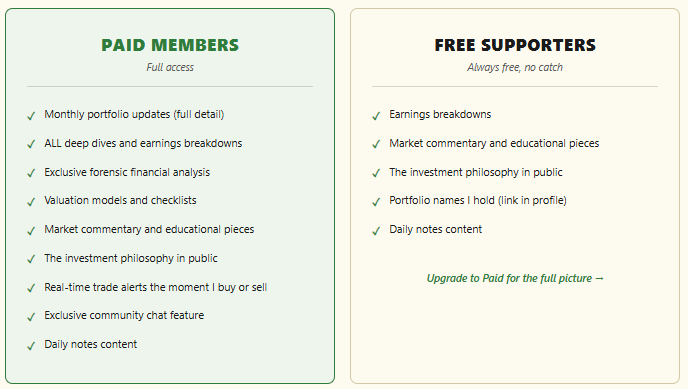
What you get as a Free Supporter vs. Paid Member:
The Long Game
I’m building a portfolio in public and a community around it.
If you want to follow real money making real decisions, with the full backup and track record on display, you’re in the right place.
I’ve been wrong before. I’ll be wrong again. The portfolio is up regardless.
Let’s go!
— Alex Harris
The Private Public Investor

Disclaimer: The information provided in this publication is for informational and educational purposes only and does not constitute investment, financial, or other professional advice. ThePrivatePublicInvestor and its authors are not registered investment advisors or broker-dealers. All opinions expressed reflect personal views as of the date published and are subject to change without notice. While efforts are made to ensure accuracy, no guarantee of completeness or reliability is given. Past performance is not indicative of future results. The author may hold positions in securities discussed. Use of this content is at your own risk.