


Investment Contents:
Executive summary & where I stand
Q2 earnings, August 4
Hardware stack & roadmap
ROCm
Partnerships
Financial projections
Valuation & sensitivities
Risks
Concluding thoughts
Executive Summary & Where I Stand
This piece updates the AMD deep dive I published in November 2025 and the April valuation note. It does not re-explain the business from the ground up like the November piece that covers the product families and the earlier partnerships.
This piece addresses changes since, including the new partnership agreements, the Advancing AI 2026 event held last week, the revaluation of the CPU market for agentic compute and a re-forecast.
Disclosure: AMD is my largest holding, accumulated primarily through LEAPS from April through July 2025 with subsequent adds. Readers should weigh the analysis accordingly.
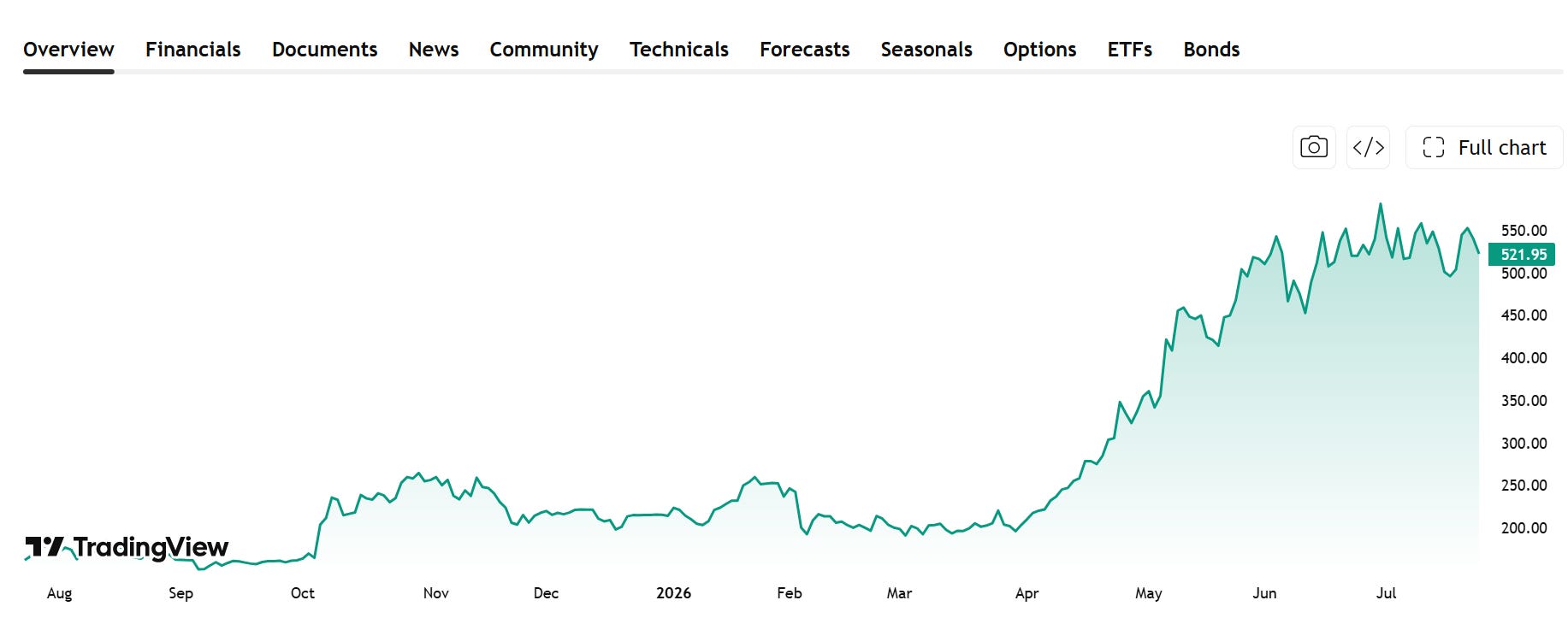
AMD trades near $520, a market cap of roughly $868B, up 144% YTD and 229% over the TTM period, and about 9% below the ATH of $584.73 on June 30.
My November Deep Dive estimated around $350 by the end of 2026 and $1,000+ by the end of 2029 — the shares passed $350 within six months. My revised base case implies $1,666 by 2030 at the midpoint, equivalent to a 29%+ CAGR over four and a half years.
For readers new to the name, AMD designs and sells:
Core Processors (CPUs): For standard laptops, desktop computers, and giant corporate servers. Recently, the market has recognized a new value proposition for these chips — agentic AI.
Graphics and AI Chips (GPUs & Accelerators): Hardware designed specifically for powering heavy AI workloads and rendering video games.
Networking and Specialized Tech: Custom chips used for routing data and powering specialized electronics.
Complete AI Platforms: Instead of just selling the individual chips and pieces, AMD has now assembled their processors, AI chips, and networking gear together into a giant, ready-to-use AI computing rack (Helios). Currently, they are the only major vendor building these complete systems entirely out of their own proprietary hardware.
Three developments shape the next eighteen months based on their product roadmap.
1.) Helios and the MI400 ramp:
AMD declared Helios in full production at the event, with first shipments in September 2026, revenue recognition beginning at the end of Q3, and volume building through Q4 into 1H 2027. 8-named customers, OpenAI, Meta and Anthropic among them, have committed to ~15GW of compute on the platform. The MI455X GPU accelerator and other chips in the MI400 product family are purpose-built to power the 72-GPU Helios rack, so this product rollout is somewhat synonymous regarding timing.
AMD needs to convert this commitment into shipped hardware over the next four quarters in order for revenue to be successfully reflected from Q3 onward.
2.) The server CPU cycle:
Agentic AI runs on CPUs due to the shift of workloads from a single prompt-and-response model to a dynamic decision-making loop that requires heavy orchestration, tool execution, and memory management.
AI servers historically carried roughly 1 CPU for every 8 GPUs, but that ratio has moved to about 1:4, and Intel’s CFO has said it “could converge to 1:1 or even tilt further in favor of CPUs.”
TrendForce models agentic deployments at 1:1 or denser, and a more speculative version of the argument has the ratio inverting to two or four CPUs per GPU as agent fleets scale.
The demand is already visible in Intel’s results. Intel’s revenue was up 25% YoY, its fastest growth since 2011, with data center up 59%, server prices up 27% and ten long-term supply agreements signed under supply constraint.
AMD holds a record 46%+ of server CPU revenue with a stated ambition of reaching more than 50% of the market. The Company has raised its own estimate of the 2030 server CPU market three times since November, and has guided server CPU revenue up 70%+ YoY for the current quarter.
Said differently, AMD’s estimate of the 2030 server CPU market has moved from around $60B in November, to $120B+ in May, to approximately $220B last week, alongside a more than 50% revenue share target against a reported 46.2% today.
Regarding timing of this general compute ramp, from what I’ve seen with Nvidia and other infrastructure compute stocks, things generally get priced-in three to nine months ahead of reported results, which suggests a portion of AMD’s 2027 P&L may be reflected in the shares during 2H2026 as Q3 and Q4 confirm the ramp of MI400 and Helios.
—> The illustrative share prices in sections 6 and 7 (financial projections, valuation & sensitivities) should be read with that lag in mind.
I expect AMD to deliver on this massive product rollout, but I do not assume it will be flawless. Helios is the most complex rack-scale system created to date, and AMD is not as experienced as Nvidia rolling something out at this scale with the anticipated demand.
The funny thing is that the performance of AMD could largely be dependent NOT on the company, but rather their suppliers and vendors responsible for integrating the hardware into the datacenter and other applications.
I still remain bullish on this rollout over the next 12 months.
As always, I would really appreciate if you shared this post and subscribed to ThePrivatePublicInvestor, as I try my hardest each week to give you custom, in-depth analysis on stock investments, market insights and portfolio strategies.
With that, enjoy this piece and let me know if you have any questions!
Q2 earnings, August 4
AMD reports Q2 on Tuesday, August 4 after market close.
Management provided no new financial guidance at the Advancing AI Summit.
Wall Street is expecting $11.3B in revenue and non-GAAP EPS of $1.61, slightly above the company's guidance of $11.2B in revenue and a 56% non-GAAP GM.
Consensus estimates imply +47% YoY of revenue growth.
My estimate based on my model later in this writeup is ~$11.5B of revenue and $1.65-1.70 of EPS. Server CPUs guide +70% YoY which accounts for most of the upside in my estimate, with continued MI355X demand contribution.
This will not re-rate the share price on its own… guidance will.
I expect guidance to be strong, since the first Helios revenue lands at the end of Q3 and is therefore partly inside the Q3 guide. I would not be surprised, though, if this gets pushed out into Q4 by the Company, as Lisa Su is always conservative.
If this gets pushed out into Q4, I don’t expect this upcoming earnings to be “shock and awe”, and I would expect AMD to selloff 10%+ after earnings. This will all depend on the commentary and Q&A AMD releases in their report and earnings call.
My view is that the November report is likely the larger event.
The Q3 print carries the first Helios revenue in reported results, and the Q4 guide is where the step-up in ramp becomes visible. August should produce a good quarter + guide, and November should produce a similar quality quarter, but could produce a monstrous guide that drives substantial model revisions in the market.
If management does end up guiding beyond a single quarter as I mentioned, while potentially framing 2027, or quantifies annual data center AI revenue, the reaction could be huge this quarter.
Hardware Stack & Roadmap
MI455X compared with MI355X:
The new flagship is a full generational step, built on TSMC’s most advanced process, and carries 432GB of memory per GPU against 288GB on MI355X, an increase of 50%.
AMD also measures 34x higher token throughput and up to 18x lower cost per token than MI355X.
Higher token throughput and cost per token are specs directly tied to memory, which is the largest bottleneck in compute efficiency and scaling today.
During AI inference, models are often memory-bound rather than compute-bound, meaning the hardware spends more time moving data in and out of memory than performing calculations. As a result, memory bandwidth and capacity play a major role in determining token generation speed and cost. Memory capacity determines how much of a model fits on each chip and therefore how many chips a customer must buy.
More broadly, AI budgets are rising, cost per token is a primary purchasing criterion, and a generational improvement of that magnitude allows a customer to serve substantially more users on the same spend.
Lisa Su actually framed it in those terms at the Advancing AI Summit during her Keynote, citing approximately 18x more tokens per dollar.
Two additional products complete the MI400 family — the MI430X, configured for scientific and government computing, which anchors the DoE’s two new systems, and MI350P, an air-cooled card for conventional enterprise data centers capable of running very large models on a single unit.
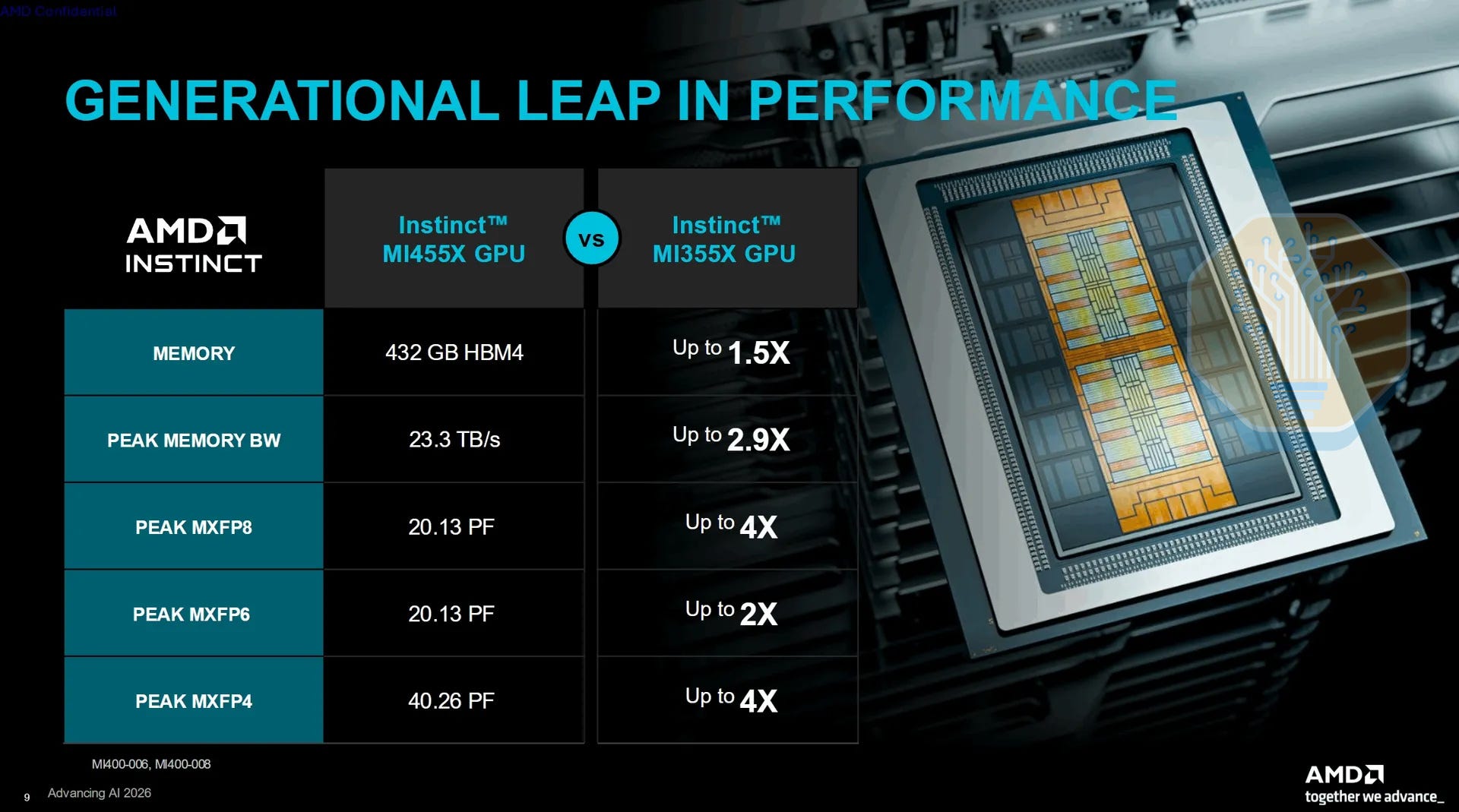
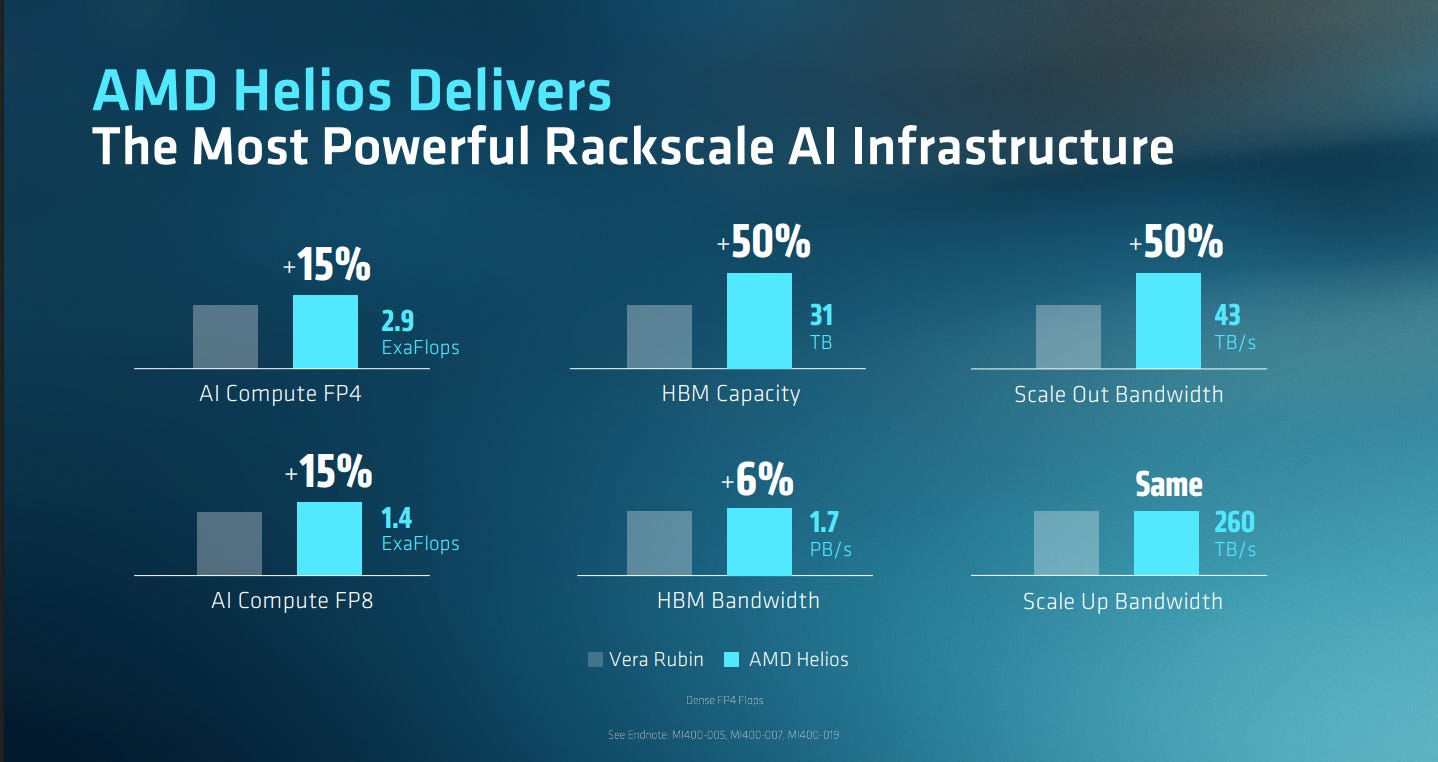
Let’s compare the MI455X against the competition. Against Nvidia, on memory, MI455X holds 432GB per GPU against 288GB on Nvidia’s Vera Rubin, which lines up with the 50% advantage AMD announced. This is the specification that determines how much of a model fits per chip.
On manufacturing, MI455X is built on TSMC’s 2nm process while Rubin uses 3nm, which makes this the first generation in which AMD holds the more advanced node rather than trailing Nvidia!
AMD’s broader rack-level claims are more total compute, 50% more networking bandwidth out of the rack, and up to 30% more tokens per dollar, though Lisa Su’s own characterization was more conservative on stage when she mentioned “an average of 10% to 15% more performance than the competition”.
Despite this, Nvidia’s rack can reportedly pool memory between its CPUs and GPUs in a way AMD cannot currently match, which is important for inference workloads.
Nvidia is also improving on their predecessor technology — CoreWeave measured Vera Rubin delivering 10x the tokens per megawatt of Blackwell, so both companies are measuring large improvements against their prior hardware.
So to be clear, my investment case does not require AMD to outperform Nvidia across every workload. I don’t think that’s possible.
Helios:
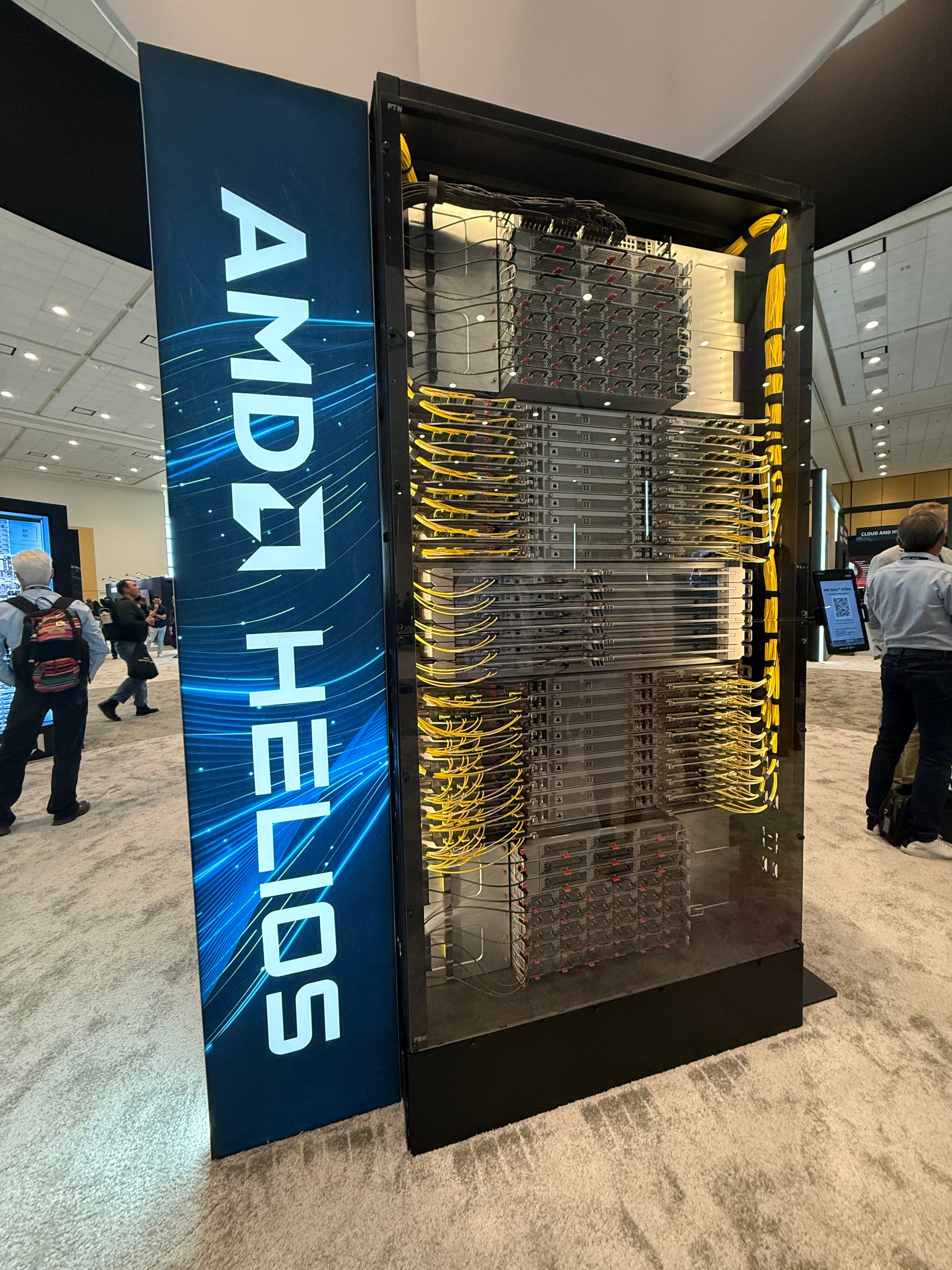
This groundbreaking, highly complex rack is comprised of 72 GPUs, 18 server CPUs, AMD’s own networking cards and security processors, and liquid-cooling infrastructure, in a double-wide cabinet weighing roughly as much as two pickup trucks and drawing as much power as a small neighborhood, at an estimated $5–5.5M per rack.
Per rack, it carries more total memory and more memory bandwidth than Nvidia’s equivalent, which is the design choice underpinning AMD’s inference positioning.
The rack runs on a first-generation networking standard with hundreds of supporting components per rack, which is why I do not assume a flawless rollout.
Helios is a reference design rather than a machine AMD builds itself. HPE (Hewlett Packard) leads integration, with Supermicro, Lenovo and others assembling the racks, and the vendors installing them in customer data centers control the final steps.
So the rollout depends as much on that supplier and integration chain as it does on AMD, which is the dependency I flagged in the summary.
Lisa Su, following the keynote, stated that “declaring production means we are ready to ship.”
The Helios rollout could be bumpy.
The CPU:
Venice, the sixth EPYC generation, is the first server CPU on TSMC’s newest process, offering up to 256 cores per chip and up to 1.8x the performance of the outgoing Turin generation, which AMD characterizes as among the largest generational gains in EPYC’s history.
It ships in four configurations, including one designed as the host processor in AI racks and another aimed at what AMD described on stage as the “agentic data center,” a build-out with dedicated CPU tiers for running fleets of AI agents.
Turin continues to carry current financial results (previous EPYC generation), and is the basis for the +70% YoY server CPU guide, the reported 46.2% revenue share, and EPYC deployment across more than 60% of the Fortune 100.
As mentioned earlier in the writeup, the Company raised its own estimate of the 2030 server CPU market three times since November, and has moved from around $60B in November, to $120B+ in May, to approximately $220B last week, alongside a more than 50% revenue share target.
Not only is the market expanding, but CPUs are starting to look like they may be a key bottleneck in advancing agentic compute. This is a recipe for pricing power, and we have already begun to see it.
Intel’s Q2 results highlighted this shift, with client processor ASPs increasing 27% YoY despite unit volumes falling 8%. Their data center revenue also grew 59% YoY to $6.3B, and the company raised prices on several high-end Xeon processors while extending lead times from roughly two weeks to six months.
Management attributed the increases to “demand-based pricing actions.”
Both Intel and AMD have effectively sold out 2026 server CPU supply, with server CPU pricing up 10-20% since March.
AMD’s pricing story is slightly different I think. Rather than relying primarily on supply shortages, it’s gaining market share while selling a larger mix of premium EPYC processors.
AMD now generates 46.2% of x86 server CPU revenue on just 27% of industry units, reflecting its concentration in higher-value products. In my model, which we’ll go through in detail later, continued CPU pricing and product mix expansion are larger contributors to margin growth than my GPU assumptions.
Ryzen AI laptops:
AMD also expanded its AI PC portfolio with new Ryzen AI processors capable of supporting up to 192GB of memory, allowing larger AI models to run locally on a device rather than in the cloud.
Local AI reduces latency, improves data privacy and eliminates cloud inference costs, aligning with growing enterprise demand for on-device AI.
The launch also comes as businesses refresh PCs ahead of Windows 10 end-of-support, supporting AMD's push into the higher-margin premium laptop market.
Radeon:
AMD also introduced a new Radeon gaming GPU, continuing the recovery in its gaming business.
Gaming revenue reached $3.9B in FY2025, +51% YoY, driven by a new GPU product cycle and a multi-year agreement with Microsoft to co-develop custom chips for future Xbox consoles and handhelds.
While gaming is unlikely to be AMD's primary growth driver, the business provides a stable, contracted revenue stream that complements the faster-growing data center segment.
FPGAs:
The Xilinx FPGA portfolio is an area where I think AMD will have substantial growth down the road, specifically in robotics. I’ve been talking about this for over a year since their acquisition of Xilinx, the undisputed leader in FPGAs.
During the Advancing AI Summit, AMD introduced its Kria AI robotics platform, expanding the company's presence in physical AI. The platform combines CPU, GPU, NPU, and FPGA compute into a single development system designed for autonomous robotics and industrial AI applications.
AMD believes physical AI represents a significant long-term opportunity, and I hope they continue to have this vision, and start making it a priority going forward into future years as robotics and humanoid manufacturing accelerates.
Roadmap:
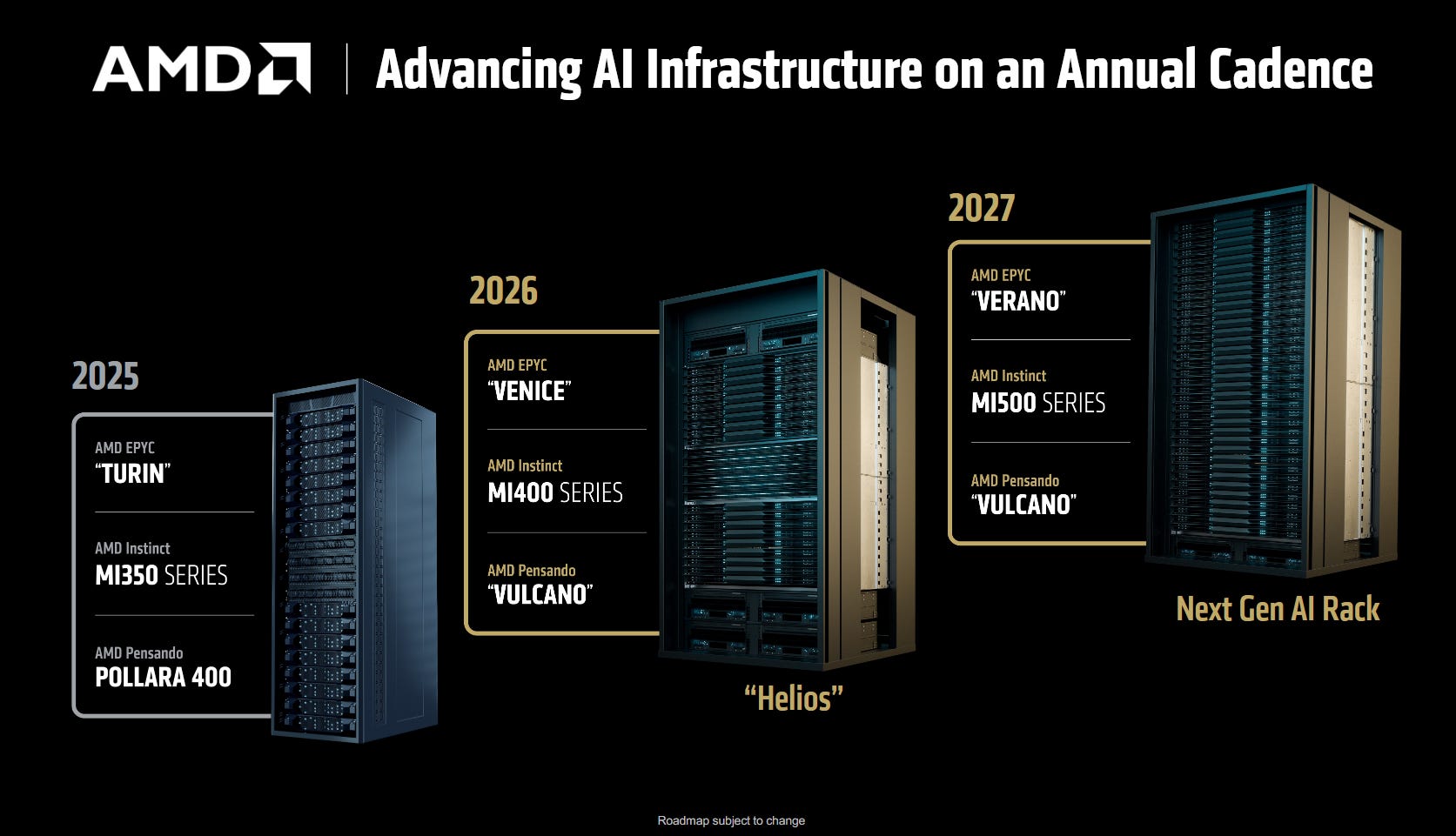
AMD has committed to an annual cadence of innovation, with the MI500 in 2027 described as its largest generational step to date, followed by MI600 in 2028, each accompanied by a new Helios generation and new EPYC series.
ROCm:
My November piece identified software as AMD’s principal weakness, which I still think is the case despite recently announced progress at the conference.
Nvidia’s CUDA has benefited from more than 15 years of ecosystem development and will continue to be the industry leading software through 2030, at least.
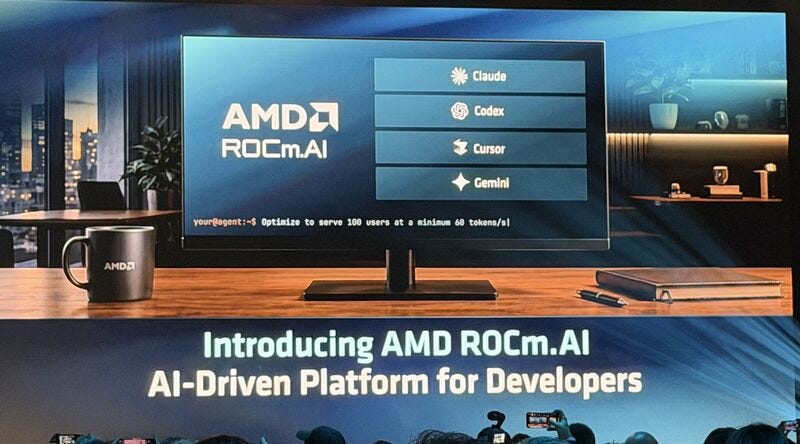
The primary update was the launch of ROCm.ai.
Rather than asking developers to learn AMD’s software directly, AMD is enabling the AI coding assistants developers already use (Claude, Cursor, Codex) to generate AMD-optimized code on their behalf.
So a developer will essentially describe the workload and the performance target, and the assistant handles the AMD-specific work.
Vamsi Boppana, AMD’s SVP of AI, described the goal as turning AI assistants into “ROCm superusers,” tools that can help accelerate software development and optimize AMD’s ecosystem.
AMD highlighted early examples of AI-assisted optimization, including one engineer using the system to tune 14,000 models, a task Boppana said would not have been feasible previously. In a live demonstration, AMD also showed AI-generated low-level code outperforming the existing human-written version by 38%.
AMD’s latest software release delivered a 3.3x improvement in inference and 2.4x improvement in training performance on identical hardware versus the prior release, driven entirely by software improvements.
The company also noted that its stack now integrates with major AI frameworks without custom configuration, with MI455X support available at launch.
Independent benchmarks place AMD at roughly 90-95% of Nvidia’s inference performance at 15-30% lower cost, while training remains 20–30% behind.
This gap in performance is less concerning given AMD’s view that inference will represent roughly 60% of AI compute demand by 2026 and is the faster-growing workload, where memory capacity and cost per token are key purchasing factors.
One notable reference to AMD’s software stack capabilities during the conference was when Anthropic co-founder and Chief Compute Officer, Tom Brown, shared that a single engineer hooked up Claude to an AMD MI355X rack, tasked the AI model with bringing up and optimizing the hardware, and left it running over the weekend.
By Monday morning (without human intervention) they were met with a real performance graph of Anthropic's leading model steadily climbing up and up throughout the weekend.
Because these automated enhancements flow directly into the open-source ecosystem, AMD customers can benefit from those improvements broadly. AMD has made meaningful software progress over the past eighteen months, although Nvidia’s ecosystem remains more mature.
I am hopeful AMD can continue closing this gap with CUDA.
SemiAnalysis argues that AMD’s infrastructure for external developers to test and optimize workloads on its newest hardware remains underdeveloped, with improvements expected in October. An important validation point will be independent benchmarks confirming whether MI455X can deliver near-Nvidia inference performance at a lower cost per token.
Partnerships

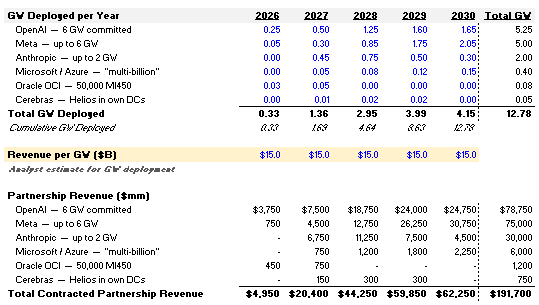
OpenAI — 6 GW committed, $78.8B forecast below (October 2025)
OpenAI’s 6 GW agreement represents the largest commitment to date.
The first GW is expected to begin deploying in 2H 2026, with Helios coming online in Q4 2026. OpenAI also holds a warrant for up to 160M AMD shares at $0.01, tied to GW deployment milestones and a $600 share price.
AMD has described the agreement as worth “tens of billions.” In the forecast, I included 5.25 of the 6 GW within the forecast period, with the remaining capacity extending beyond 2030.
Meta — up to 6 GW, $75.0B forecast below (February 2026)
Meta’s agreement includes a custom accelerator variant, Venice CPUs, first shipments beginning in 2H 2026 and a similar warrant structure.
Meta’s infrastructure head, Santosh Janardhan, highlighted the shift toward evaluating “the whole data center as one integrated system,” including servers, networking, cooling, and power, rather than individual components.
AMD is positioned across multiple parts of that stack, supplying CPUs, GPUs, networking, and FPGAs through its own portfolio, while supporting Meta’s rack architecture.
Meta has already deployed millions of EPYC CPUs and serves as a key validator for Venice.
Anthropic — up to 2 GW, $30.0B forecast below (July 22)
The agreement includes AMD’s commitment to invest up to $5B in Anthropic, with the first GW expected to begin deployment in 1H 2027.
Unlike OpenAI and Meta, Anthropic did not receive a warrant.
Anthropic also demonstrated Claude being used to optimize workloads on AMD MI355X accelerators, with one engineer reportedly improving frontier model performance over a weekend, as mentioned previously in this writeup.
The significance is that the relationship appears to extend beyond procurement into engineering collaboration, while the result was achieved on current-generation hardware rather than the future MI400 series.
Microsoft / Azure — $6.0B forecast below (July 20)
Microsoft is expected to deploy Helios at scale beginning in 2H 2026 for model inference, alongside the new Venice product.
I called out months ago that a Microsoft Helios announcement would likely appear around this event.
In the forecast, I sized the partnership from the language of “multi-billion-dollar” at $6B, which is a conservative estimate with potential upside revision, in my opinion.
SemiAnalysis believes OpenAI may be the anchor customer for Azure’s AMD capacity, representing an additional channel for the broader 6 GW deployment.
Oracle OCI — $1.2B forecast below (October 2025).
Oracle announced plans for 50,000 MI450-class GPUs beginning in Q3 2026.
While this is modest in revenue contribution, the agreement provides a tangible near-term deployment milestone and could become one of the first publicly verifiable Helios installations.
Cerebras — $750M forecast below (July 23)
First, Cerebras and AMD target different parts of the inference workload. Helios handles high-volume processing, while Cerebras’ wafer-scale systems focus on final token generation, where latency is most important.
The companies claim the combined architecture can deliver up to 5x more tokens per second per watt.
The approach is particularly relevant for AI agents, where multi-step reasoning causes latency to compound across each action.
Cerebras will deploy Helios in its own data centers, with the joint offering launching through Cerebras Cloud in 2H 2026.
My $750M estimate is immaterial against a projected $263B of 2030 revenue, but could prove conservative if this two-system architecture becomes a broader industry standard for AI agent workloads.
Financial Projections
Revenue:
The revenue build splits revenue into the contracted GW partnership revenue from the schedule above, server CPUs, other Instinct and data center GPU sales (HUMAIN, DOE, neoclouds, enterprise), and client, gaming and embedded.
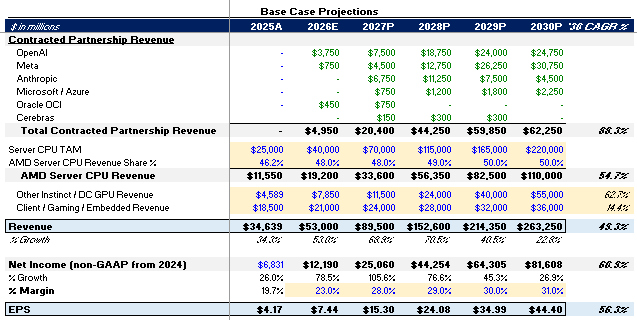
Notice how the CPU revenue opportunity is larger than both the other GPU revenue and client / gaming / embedded revenue line items combined.
This may differ from how AMD is usually discussed, but the CPU market is growing rapidly with the pace of innovation in agentic compute.
The server CPU line assumes a market expanding from $25B in 2025 to $220B in 2030, with AMD’s revenue share moving from 46.2% to 50%, in accordance with Lisa Su’s latest commentary during the Summit.
This is a baseline view on the CPU from Lisa Su directly, and could even be underestimated a year from now.
Relative to consensus estimates of $49.7B revenue and $7.48 EPS for 2026, $77.5B and $13.50 for 2027, and $104B and $18.70 for 2028, my model is 7% above consensus revenue in 2026 while essentially in line on EPS ($7.46 vs. $7.48). The model is 14% above consensus revenue in 2027 and 29% above in 2028.
In addition, I am assuming $15B per GW deployed, lining up with the conservative end of Street expectations . $ / GW could easily reach $20B per GW in a bull case.
Consensus estimates also vary widely on the street, with FY2028 EPS ranging from $13.15 to $28.74, highlighting the uncertainty around longer-term forecasts.
Consensus itself has also moved meaningfully recently, rising from roughly $6.15 in early July to $7.48 today.
The 2026 revenue cadence is one of the more testable parts of the model because half the year has already been reported or guided:
Q1: $10.25B reported (+38% YoY), above the high end of guidance
Q2: $11.20B (guidance midpoint), reporting August 4
Q3: $14.50B (my estimate), reflecting initial Helios shipments beginning in September
Q4: $17.20B, calculated as the amount required to reach the annual forecast
This results in H1 revenue of $21.45B and requires H2 revenue of $31.70B, or ~1.48x the first half of the year, with the majority of the acceleration occurring in Q4 as the MI400+Helios ramps.
Margins:
On margins, the assumptions are more modest than the revenue forecast.
The model uses a 23.0% non-GAAP net margin for 2026, compared with an implied 22.8% in the first half based on Q1 results and Q2 guidance. This requires approximately 23.2% in the second half, implying little change over the first half of the year.
Margins then expand to 28% in 2027 and 31% by 2030, driven by higher rack-scale pricing, server CPU pricing and operating leverage, partially offset by higher memory costs and the lower margins associated with rack-scale systems.
Note: Rack-scale systems have lower profit margins than standalone chips because they bundle semiconductors with expensive, lower-margin physical infrastructure like cooling, power supplies and cabling.
For reference, AMD’s 19.7% non-GAAP net margin in FY2025 was already a company record, so the model assumes continued margin expansion over the following five years.

A couple things worth noting before going any further are two assumptions made regarding timing:
First, deployment timing is intentionally conservative.
The model includes 12.85 of the 14.65 committed GW within the forecast period, leaving roughly 1.8 GW beyond 2030.
Other models out in the market estimate the majority of the GWs can be deployed throughout 2027 and into 2028, which appears aggressive to me given current packaging and memory supply constraints.
Slowing this deployment schedule changes the timing of revenue rather than the total opportunity.

Second, revenue recognition occurs before deployment.
Revenue is recognized when AMD ships hardware to the rack builder rather than when systems are deployed at the customer site (per ASC 606).
Because shipments can occur one or more quarters before deployment, a model based on deployed GW may understate near-term reported revenue, with revenue recognition potentially occurring earlier than deployment milestones.
For comparison, AMD’s long-term targets from its November 2025 Analyst Day included a revenue CAGR above 35%, data center revenue reaching $100B, AI revenue growth above 80%, and more than $20 of EPS within three to five years.
Under my base case, EPS approaches $20 on an exit run-rate basis in late 2027 and exceeds that level on a full-year basis in 2028.
Valuation & Sensitivities
At approximately $530, AMD trades at 70x my 2026 EPS, 34x 2027, 22x 2028, and about 11x 2030, and at roughly 16x P/S.
Those multiples are consistent with a company growing revenue ~50% for five years.
Whether those multiples prove reasonable depends primarily on the earnings trajectory.
My valuation framework assumes multiples compress gradually over time.
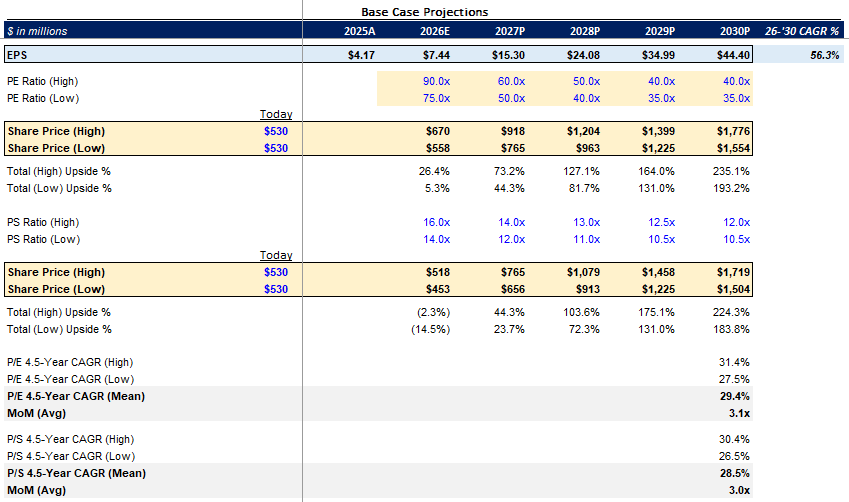
The two valuation approaches produce similar outcomes.
P/E implies a 2030 share price of $1,554-$1,776, while P/S implies $1,504-$1,719.
Under both valuation methods, they imply a 28.5-29.4% CAGR.
The valuation framework assumes the earnings multiple compresses from 75-90x in 2026 to 35-40x by 2030. The model does not assume AMD reaches Nvidia’s profitability or software economics, which for reference, Nvidia currently commands TTM net margins of ~63%… I am projecting AMD to mature at 31% net margins in 2030. I’d say under half of Nvidia today is conservative.
To be as accurate as possible, I am assuming 1.638B of DSO (diluted shares outstanding) through 2027, increasing to 1.838B beginning in 2028 to reflect the ~200M shares from the OpenAI and Meta warrants that will dilute the share base.
Because the warrants vest over time, actual dilution would occur gradually rather than all at once. All 2028-2030 EPS figures are fully diluted.
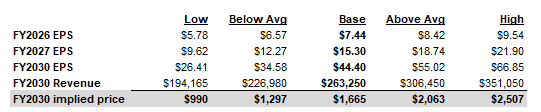
Because a sensitivity grid is difficult to interpret without knowing what each cell represents, the following table maps 2030 EPS against exit multiple, with the EPS rows corresponding to the five scenarios:

To make the sensitivity tables mean something, here’s what each driver is actually worth in share price, using the 37.5x midpoint from the base case forecast:
One GW of 2030 deployment is worth about $95 a share:
The path: $15B of revenue, about $4.65B of net income at a 31% margin and $2.53 of EPS. This is the biggest lever in the model. The company has confirmed the September 2026 first shipment and Anthropic’s first GW in 1H 2027. Every other YoY GW figure is based on my personal projections.
A point of server CPU share is worth about $14 a share:
On a $220B market, $2.2B of revenue and $0.37 of EPS.
1.00% of 2030 net margin: $1.43 of EPS and worth about $54 a share.
Five turns of the exit multiple: worth about $222 a share.
Notice that’s only about two GW’s worth. People will argue endlessly about whether 35x or 40x is the right 2030 multiple, and the answer matters less than whether two racks’ worth of GW ship on time.


Risks
I figured I’d put this towards the end to remind the reader not to get too excited on the financial projections. There is still notable risk in AMD’s execution going forward.
Helios Execution:
Helios is the most complex AI rack system launched to date, combining new hardware, networking and OEM partners at significant scale.
SemiAnalysis expects volume production to slip toward Q2 2027, while AMD continues to target its existing timeline.
The key data points to monitor are Q3 and Q4 results.
If Q3 or Q4 revenue is materially below the cadence outlined above, or if they announce a Helios deployment delay in 2027, AMD will sell off aggressively.
Developer Access & Software Ecosystem:
The software progress discussed earlier depends in part on developers having access to AMD hardware.
One challenge internally is limited availability of stable GPU clusters for software development and automated testing, which can slow both software development and the AI coding agents AMD is increasingly relying on. Externally, on-demand access to AMD accelerators also remains limited.
The founder of one of the few cloud providers offering AMD GPUs on demand has argued that AMD has historically underinvested in its cloud ecosystem and that access to MI455X may require multi-year commitments given current supply constraints.
If developers have limited access to current-generation hardware, software improvements may progress more slowly than expected.
Valuation & Expectations:
At roughly 70x 2026E EPS, the current valuation likely reflects a portion of the expected 2027 earnings ramp.
AMD shares DID decline following the Advancing AI Summit, but that is consistent with the stock’s historical tendency to sell off after major product announcements for some odd reason.
If the market tightens, I would view the ~$450 range as a potential area of support.
Nvidia:
Nvidia is expected to bring its Rubin platform to market first, and CUDA remains the leading software ecosystem for AI training.
Nvidia also retains architectural advantages, including its memory-sharing technology, while operating at gross margins above 70% and can provide flexibility on pricing if competitive pressure increases.
Supply, Power & Memory:
Advanced packaging capacity remains constrained through 2026, with AMD controlling a smaller share than Nvidia.
Next-generation HBM memory is also supply constrained, and higher memory costs remain a potential margin headwind.
Beyond 2028, power availability may become a larger constraint than semiconductor supply, which has been a shadowing overhang in compute conversations.
AMD has consistently noted that its long-term market opportunity depends on the availability of power, supply, and capital, which remains an important consideration.
China:
MI308 sales currently operate under export licenses and a 15% revenue-sharing arrangement.
AMD has not disclosed the level of China revenue included in its Q2 guidance, and prior export restrictions reduced annual revenue by approximately $1.5B.
As a result, I treat China as potential upside to the model rather than incorporating it into the base case.
Concluding Thoughts
The central question in my November piece was whether AMD would become a credible second source for AI compute. I believed it, but it wasn’t evident yet to investors.
That question is now resolved, with ~15GW under contract across the eight most significant AI labs, the first full-stack rack shipping in September, the software gap narrowing and server CPUs growing more rapidly than ever.
Execution risk does remain against this contracted demand, and unfortunately, that responsibility does not lie in AMD’s hands, but rather downstream in the supply chain.
My base case requires the MI400+Helios reaching volume between now and mid-2027, GWs cleanly converting near $15B or more each on the ~15GW of negotiated compute, CPU share crossing 50% during or before 2030, net margins reaching 30%+ by EOY 2030 and continuous, successful innovation down the line.
If this holds, AMD can easily reach $1,554-$1,778 by 2030.
Overall, I have never been more bullish on the business.
This is mile 9 of the marathon.
Further reading from event week: Lisa Su’s full CNBC interview and the Helios throughput clip; Su with Brian Sozzi on AI demand and hyperscaler spending; CNBC’s first look inside a Helios rack; Su’s post-keynote press conference on open source and the inference mix; Forrest Norrod on Helios economics; Meta’s Omar Baldonado on open networking; Boppana on ROCm.ai; and the opposing view from SemiAnalysis, which is worth reading particularly if you are long.
Disclaimer: The information provided in this publication is for informational and educational purposes only and does not constitute investment, financial, or other professional advice. ThePrivatePublicInvestor and its authors are not registered investment advisors or broker-dealers. All opinions expressed reflect personal views as of the date published and are subject to change without notice. While efforts are made to ensure accuracy, no guarantee of completeness or reliability is given. Past performance is not indicative of future results. The author may hold positions in securities discussed. Use of this content is at your own risk.
Interesting article for sure. I agree, AMD has evolved from simply competing with Nvidia to becoming a major AI infrastructure provider with significant customer commitments. If it executes on Helios, server CPUs, and software improvements, the stock has substantial upside but I am still concerned about stability. Margins, cash flows and capital efficiency are not stable and nowhere near Nvidia. Will be interesting to watch how the company evolves.