


I have followed Celsius Holdings for about 7 years which is longer than any name I cover.
I pitched the stock in a college finance club when it traded around $7.
And I was sitting in a senior-year finance class when the Pepsi partnership hit the news in August 2022.
This piece is the full breakdown of the company as it stands today.
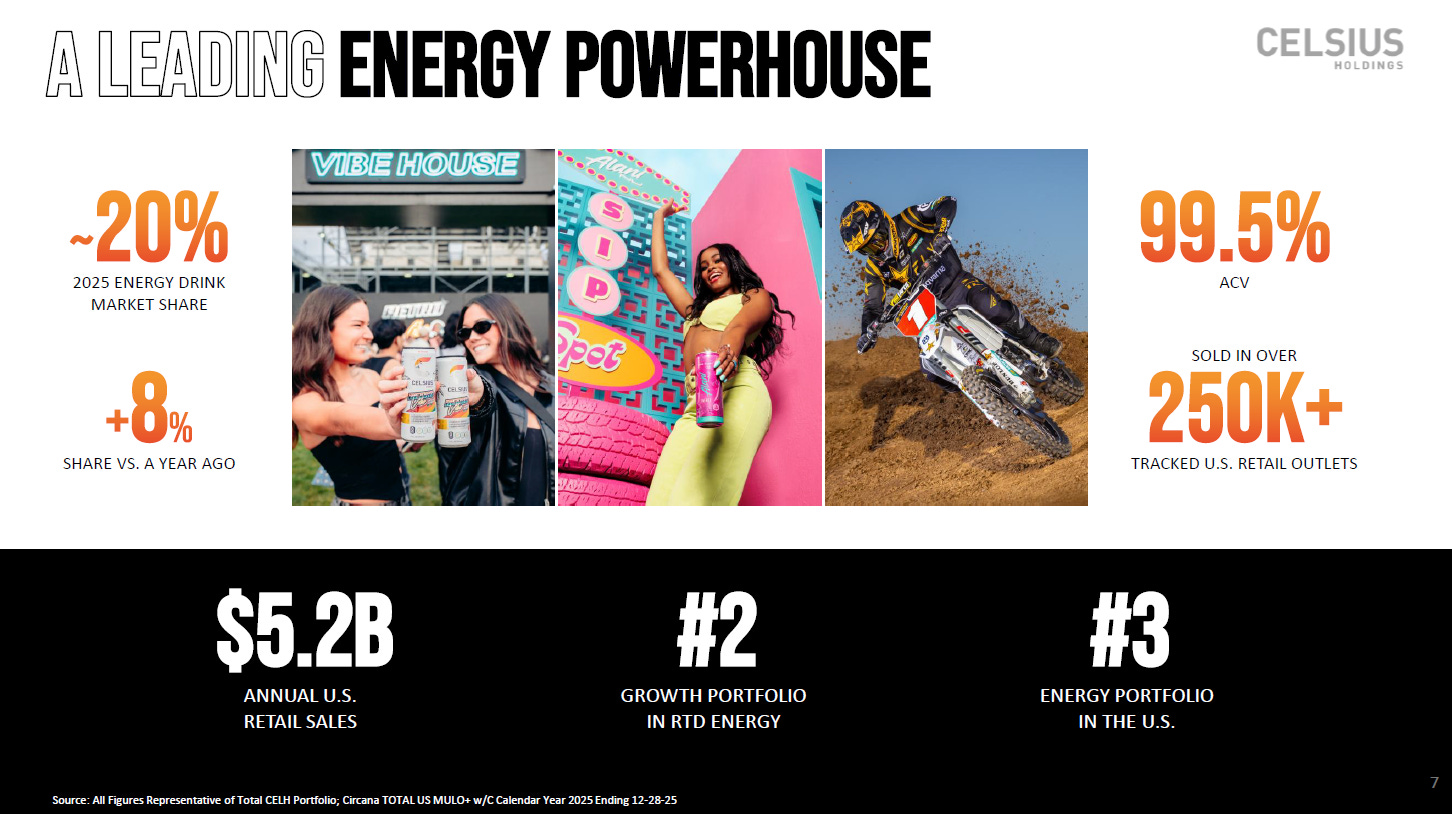
Over the past 18 months, Celsius went from a single-brand growth story to a 3-brand platform holding roughly 21% of the U.S. energy drink category — the #3 portfolio energy drink company in the market behind Red Bull and Monster.
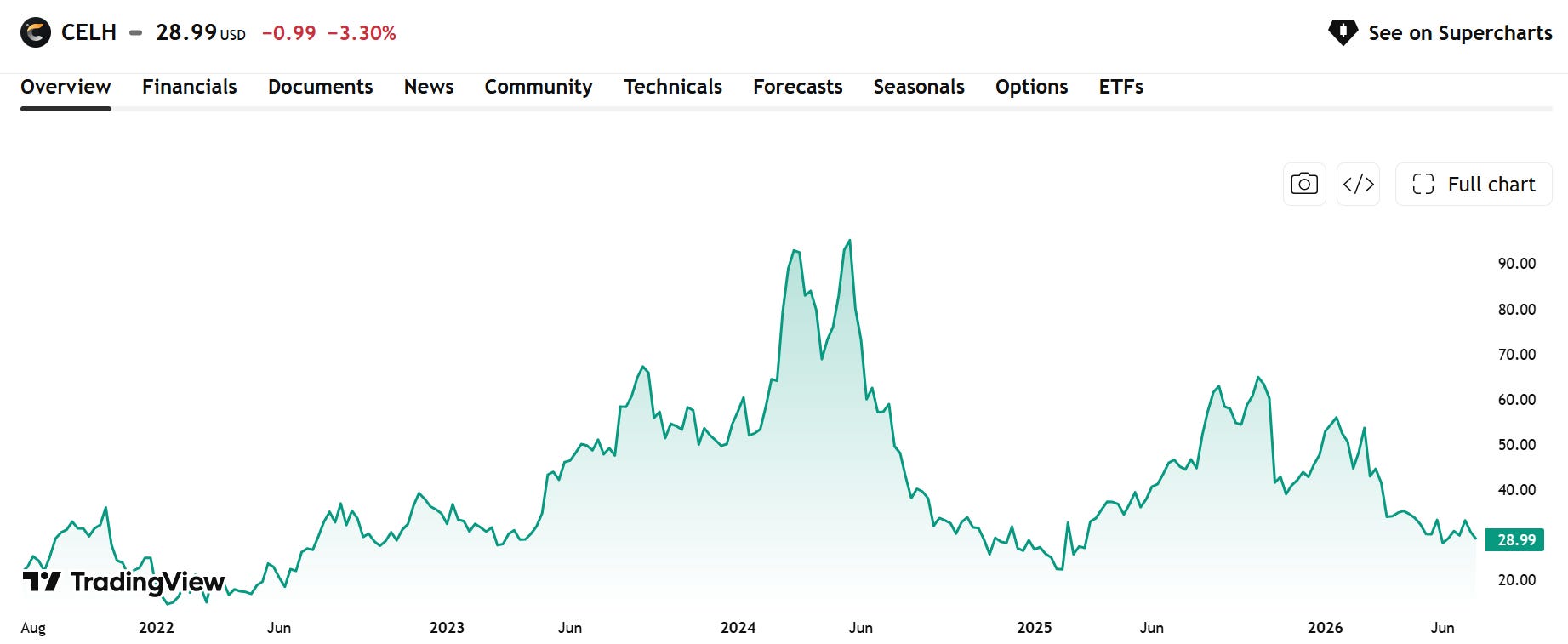
Over that same stretch, the stock fell roughly 40% YTD to around ~$30, well below its 2024 all-time high near $100.
This business transition is very misunderstood by the investing community.
And honestly, this transition screens terribly. A core brand growing 6%, gross margin down ~4%, and a distributor at ~60% of revenue all read as red flags.
I believe every one of those numbers is a snapshot rather than a true representation of what the company will look like in the 2H of this year and into 2027.
Transitions are where the market misprices businesses.
Let’s get into it.
Investment Contents
Company Background & Overview
Industry Overview & Market Positioning
Competition & Consolidation
The Pepsi Partnership
Alternative KPI Data: Velocity & Distribution
Key Areas for Growth
Risks
Valuation, Financial Forecast & Scenarios
What I’m Doing With My Money / Concluding Thoughts

As always, I would really appreciate if you shared this post and subscribed to ThePrivatePublicInvestor, as I try my hardest each week to give you custom, in-depth analysis on stock investments, market insights and portfolio strategies.
With that, enjoy this piece and let me know if you have any questions!
Company Background & Overview
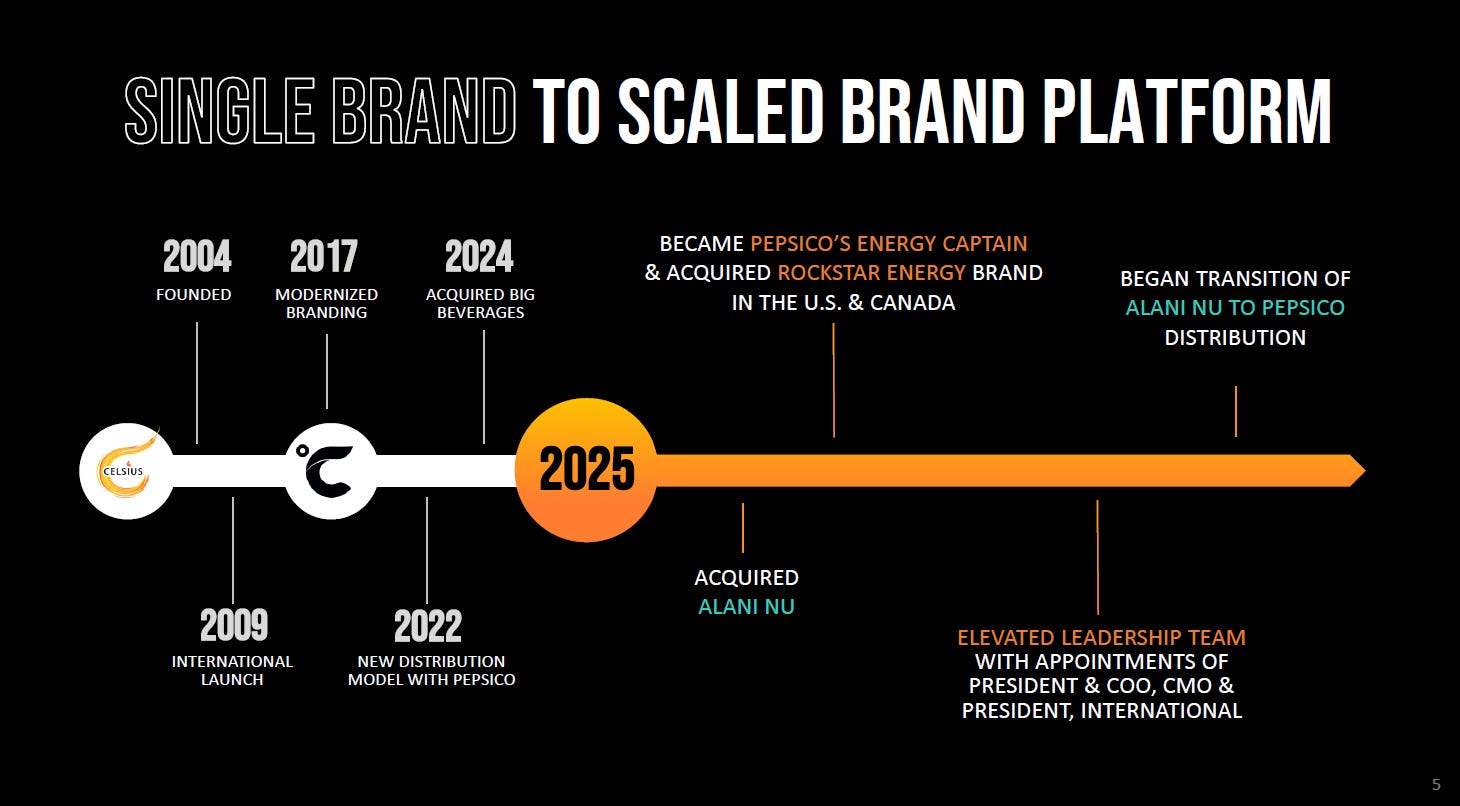
Celsius was founded in 2004 in Boca Raton and spent its first decade going nowhere.
The original positioning was a “negative-calorie” diet drink, which struggled significantly with distribution and consumer adoption.
In 2011, the company's stock price plummeted so low that it was delisted from the NASDAQ and forced to trade on the OTC pink sheets. The brand lost roughly half its retail placement and revenue almost overnight as major grocery chains wiped them from the shelves. The company nearly went under.
Instead of filing for court-restructured bankruptcy, Celsius was saved through an out-of-court restructuring and private capital injection.
They were bankrolled by an investor who believed in the business, and Celsius continued to operate as a public company.
John Fieldly joined as CFO in 2012 and became CEO in 2018. Under him, the company repositioned entirely. Revenue went from roughly $52M in 2018 to $1.32B in 2023.
The repositioning worked because it found white space. Traditional energy (Monster, Red Bull, Rockstar) sold sugar and adrenaline to a roughly 70/30 male-skewed customer. Pre-workout powders sold intensity to gym-goers.
Celsius positioned between them: a functional energy drink with a proprietary ‘MetaPlus’ blend, backed by university clinical studies, a clean white can with fruit imagery, and explicit zero sugar, no aspartame callouts that made it feel safe for daily consumption.
The customer base that showed up looked nothing like the traditional energy consumer. Celsius sells to a nearly 50/50 gender split and gears toward $100K+ household incomes.
Distribution did not start in mainstream beverage aisles early on, but rather in coolers in CrossFit boxes, boutique gyms, GNC and Vitamin Shoppe. When Celsius re-entered grocery, it negotiated placement in health and wellness areas instead of the crowded energy aisle.
By the time the rest of the better-for-you (BFY) wave scaled up, Celsius held the fitness demographic and the shelf space around it.
The marketing was built on the same idea — to meet the customer where they already are.
Instead of extreme sports sponsorships, Celsius made “Live. Fit. Go.” a lifestyle slogan. Fieldly has said he wanted the can to work like the Starbucks “green straw” — a visual signal that the person holding it takes wellness seriously.
The company used everyday personal trainers and wellness creators on TikTok and Instagram rather than superstar athletes, ran branded run clubs through Strava and showed up at lifestyle events like the Breakaway music festival (EDM festival full of the exact 18 to 26-year-old consumer Celsius targets).
Today that has scaled into Formula 1 (Aston Martin Aramco), MLS, and Formula DRIFT sponsorships.
Even though Celsius seemed like an overnight success, it was not. After 2 decades of brand building, during 2025, the company yielded:
~$5.2B in annual U.S. retail sales across the portfolio
Sold in more than 250,000 tracked U.S. outlets at 99.5% ACV
Household penetration of 34% for the core brand, 22% for Alani Nu, and roughly 43% for the portfolio
Repeat purchase rates above 65%
For context, Monster needed 8+ years to reach 40% U.S. household penetration. Celsius reached 34% in roughly three years of scaled distribution.
Fieldly framed the current strategy as:
“We’re building a portfolio that reaches more consumers during more occasions, and we’re doing it with discipline, collaboration, and a commitment to organizational excellence.”
The management team was rebuilt around that goal, with Eric Hanson as President & COO, Jarrod Langhans as CFO, a new CMO, and a dedicated President of Celsius International.
Industry Overview and Market Positioning
Energy drinks are the growth engine of the entire non-alcoholic beverage industry right now.
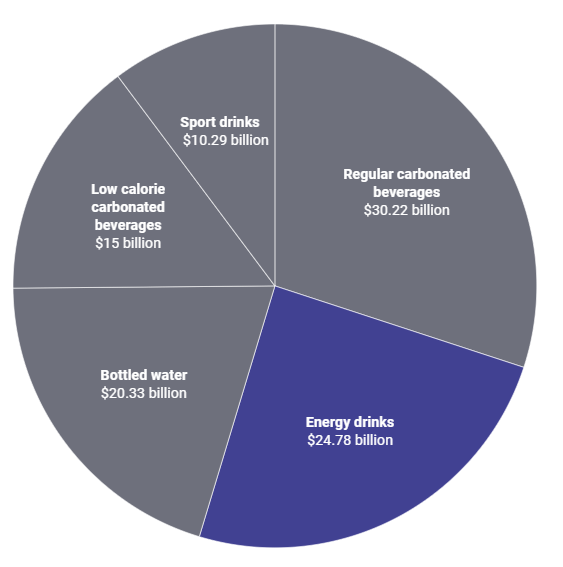
U.S. energy drink sales reached approximately $24.8B for the 52 weeks ended in early March 2026, up almost 14% YoY, which is the fastest growth of any major packaged beverage category.
Energy is now the second-largest non-alcoholic packaged beverage category in the country, behind only regular carbonated soft drinks at around $30B.
The category is also concentrated. The top five companies control over 90% of U.S. energy drink sales, and within that group, Celsius and Keurig Dr Pepper grew more than 20% over the trailing year while the incumbents grew single digits. Industry forecasts have the category compounding around 8% annually over the next decade.
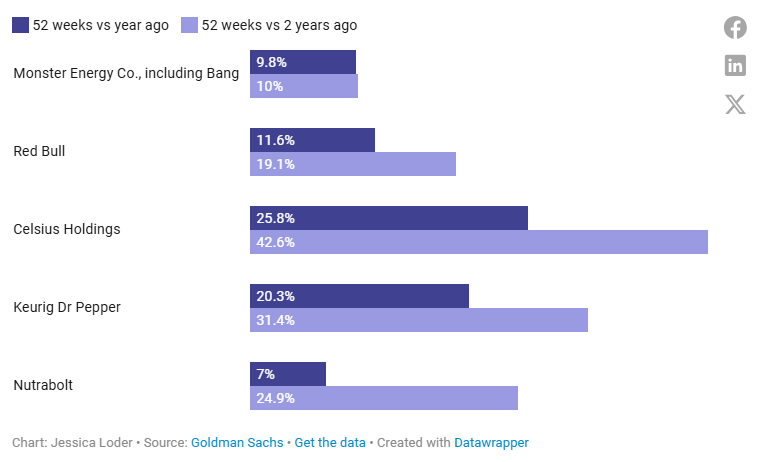
More importantly, 85% of 2025’s energy drink growth came from zero-sugar products.
And the category is splitting.
Celsius management says the two halves are traditional energy (transactional, sugar-heavy, impulse-driven) and modern energy (zero sugar, daily routine, lifestyle and wellness).
This maps onto the broader move toward healthier food and drink in the U.S.
More than 85% of American adults consume caffeine daily, which coffee still accounts for roughly 60% of those occasions, but energy drinks are continually converting more and more young adults to energy drinks.
More than 2 in 5 Gen Z consumers drink energy drinks regularly, double the rate of millennials and older cohorts.
The two halves of the category also market differently. Traditional energy built its equity on extreme sports, gaming, and truck-stop culture (think Monster). Modern energy markets at fitness events, run clubs, music festivals, and campuses (think Celsius).
Celsius sits at the center of that shift: the portfolio accounted for 33% of all zero-sugar RTD energy growth in 2025, the largest single contribution in the category.
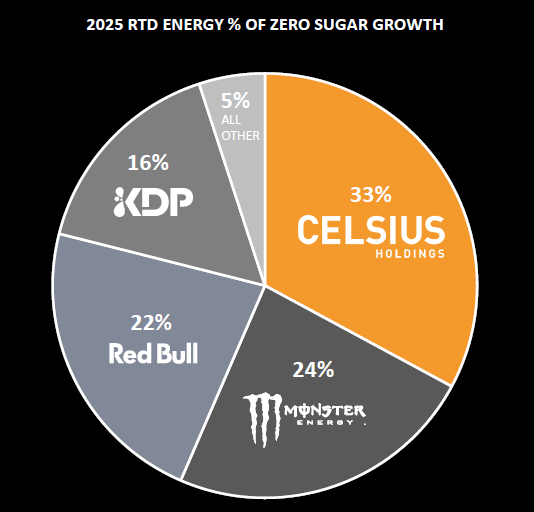
Regarding trend durability, roughly 32% of consumers are drinking energy drinks on more occasions than before and 51% of category growth comes from increased frequency among existing buyers (not new users trying the category).
In addition, 37% of Celsius consumers drink it with a meal, and 33% drink it socially.
The female consumers, the demographic Celsius and Alani Nu index toward, consume energy earlier in the day and as part of a routine, versus the impulse-driven male consumer traditional energy was built on.
—> Routine consumption means repeat purchase. Repeat purchase is what retailers give shelf space to.
Not every challenger captures this. Prime, the viral 2022-23 brand founded by Logan Paul and KSI, saw sales fall nearly 65% over the past year. Monster’s acquired brands are also shrinking, with Reign down 7%, Reign Storm down 4% and Bang down over 4%.
Brand image/loyalty and product velocity support long-term growth of brands in this category.
International
Celsius still generates roughly 95% of revenue from North America.
Monster generates approximately 45% of its sales outside the U.S.
That gap between the two companies is either a hole in the Celsius story or the biggest untapped growth lever, depending on execution from here.
Run the simple math — if Celsius ever reached a Monster-like international mix on today's revenue base, international would be a $2B+ business. Today it is around $93M.
The numbers are small for Celsius but the segment is directionally moving well, as international revenue reached $35.3M in Q1 2026, up 55% YoY, with Europe at $25.4M (+36%) and Asia-Pacific growing over +200%.
Some investors flagged that international actually shrank as a share of total revenue (6.9% to 4.5%) — but that's just the denominator, not the segment. The U.S. business is simply growing that much faster with Alani still on its growth curve.
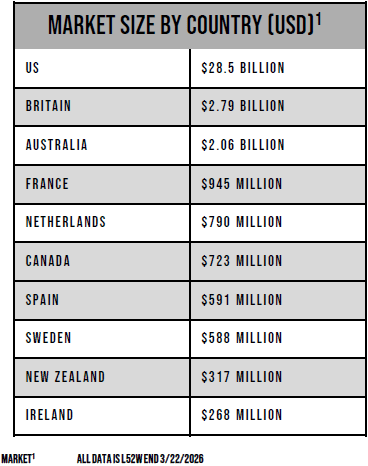
When I was looking deeper in the international footprint, I was surprised, as it’s wider than most realize. Celsius has presence in the UK, Ireland, France, Australia, New Zealand, Benelux, and the Nordics, and entered Spain in March 2026 through an exclusive distribution agreement with Suntory Beverage & Food, with Portugal next under the same partnership.
The whole operation is now coordinated from a global headquarters in Dublin as well, under a dedicated President of Celsius International, which was a role created specifically to run this expansion. The man in charge of International is Garrett Quigley, who actually previously spent 25+ years with Pepsi, most recently as SVP of Global Franchise.
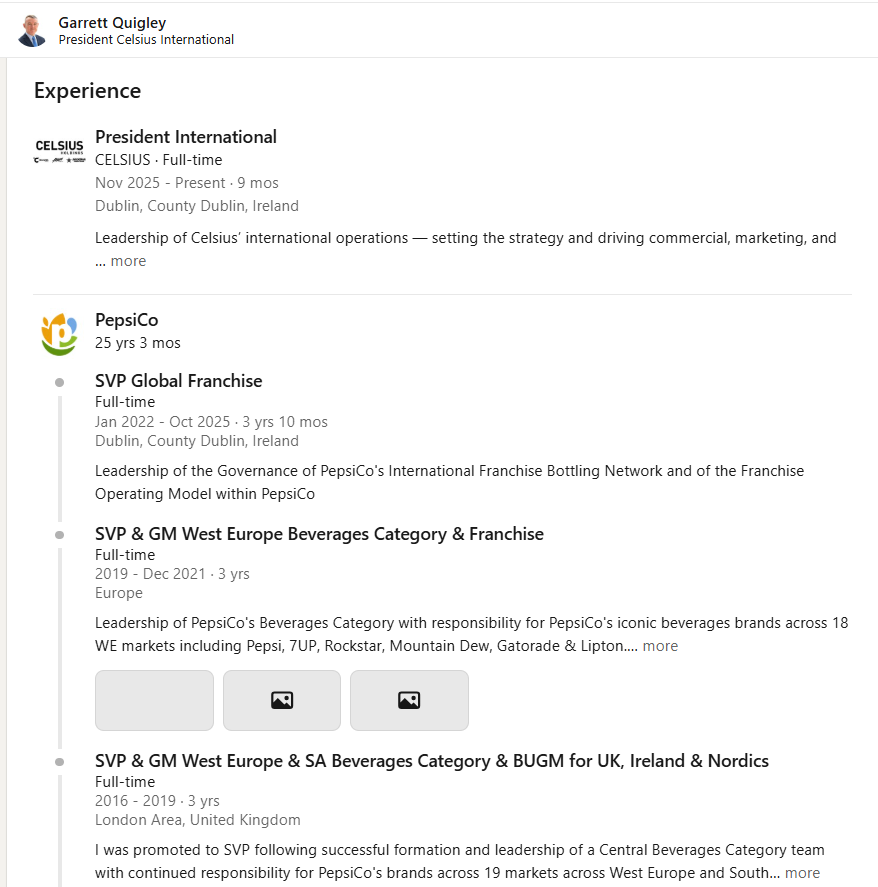
This is a great sign for Celsius, as they are bringing in someone with robust experience from their closest distribution partnership.
Separately, regarding the international strategy of Celsius, they are not focused on building their own infrastructure country by country. Rather, Celsius signs established local operators who already own the routes, the retail relationships, and the reps.
Fieldly describes the approach as “key markets, strong local partnerships, disciplined launch plans and sustained marketing and distribution support.”
It is the same capital-light playbook Coke and Monster used to take energy global.
There’s some early evidence the brand is traveling well abroad as well, with Celsius reaching 88% grocery penetration in the UK and France within 12 months of entry.
This is a great sign of progress.
The energy category penetration across most of Europe DOES trail the U.S. by years, with the zero-sugar modern segment barely existing abroad yet, and the health-and-wellness positioning maps onto markets like the UK, Australia, and Benelux where that consumer trend is already established.
It won’t map to every market due to differing consumer habits and regulatory hurdles, but Celsius has great momentum
Competition & Consolidation
Red Bull holds roughly 35.9% of the U.S. category.
It sold a record 14B cans globally in 2025 (+10.2% YoY) with global sales up 8.6% to over $14B, and its Red Bull Zero line grew nearly 200% following its early-2025 wide release. Red Bull clearly also realizes the zero-sugar shift is where the growth is.
Red Bull is also the category’s structural outlier, as it invented modern energy drinks and built its own global distribution network, something no brand since has replicated.
Monster is the next big dawg and holds roughly 27.3%. It posted its first $2B quarter in Q4 2025 (net sales +17.6%) and grew Q1 2026 net sales 26.9%, which is actually a genuine reacceleration after a soft 2024.
The core Monster Energy segment still produces about 93% of its revenue, distributed globally through Coke’s system since 2015, and the stock hit an all-time high in July 2026 at a market cap around $92-96B. Notably, Monster’s growth is coming from its namesake and Ultra families, while its acquired brands (Reign, Bang) are shrinking.
So the incumbents are healthy and reaccelerating growth.
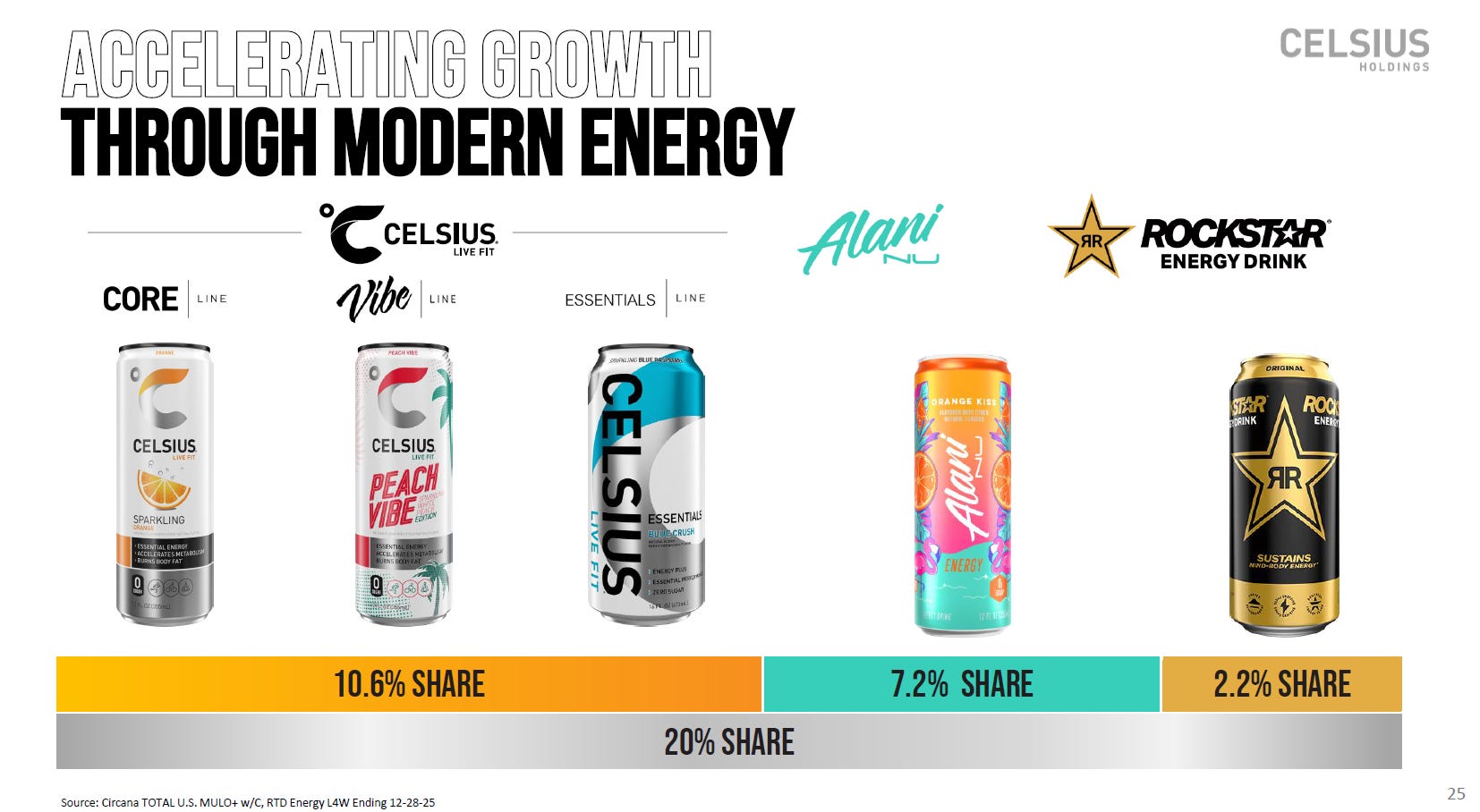
This makes the data interesting. The Celsius portfolio reached 20.9% of the category in Q1 2026, and legacy Celsius is, to date, the only brand in the category’s history to take meaningful, sustained share while Red Bull and Monster were both still growing.
Prior challengers (Bang most famously) took share briefly and collapsed.
Note: Image below is outdated and excludes Alani Nu, but includes Rockstar
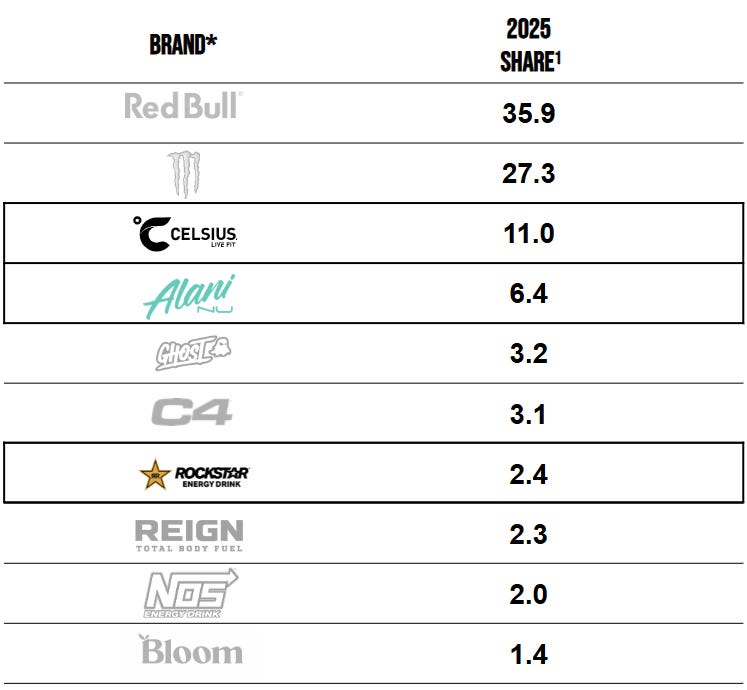
The category now functions as a three-portfolio market:
Red Bull
Monster
Celsius
Where the three companies differ most is the consumer they're built around.
Red Bull and Monster built their equity on extreme sports, gaming and high-octane masculinity, and their heaviest users skew male and is impulse-driven.
The Celsius portfolio was built around fitness, wellness and a 50/50 gender split.
All three are now converging on the same zero-sugar consumer — Red Bull with Zero and Monster with Ultra, which means the modern energy segment Celsius pioneered is no longer uncontested and competition has intensified.
The incumbents bring more distribution muscle and marketing budget to this fight, but Celsius brings the brand equity of having defined the space.
New Entrants
The BFY positioning became a more fierce playground for Celsius around 2021.
Ghost, Zoa, Alani Nu, and a long tail of founder-led startups all entered the energy segment, each with a niche:
Ghost through flavor collaborations and gaming culture
C4 through supplement stores and Bloom Nutrition through traditional channels
Zoa through Dwayne Johnson’s fitness following
Alani Nu with the young female consumer.
We’ve seen consolidation since in the past few years.
Ghost sold 60% majority ownership to Keurig Dr Pepper for $990M in late 2024, at an implied valuation around $1.65B, with a path to full KDP ownership by 2028.
Zoa was bought by Molson Coors for $53M in cash in late 2024.
Bang (not BFY, but worth mentioning) held roughly 10% of the category at its 2019 peak, but went through Chapter 11 bankruptcy and was bought by Monster for $362M in 2023. It has kept shrinking inside Monster’s portfolio.
Celsius ended up on the other side of that table and was the acquirer.
Alani Nu
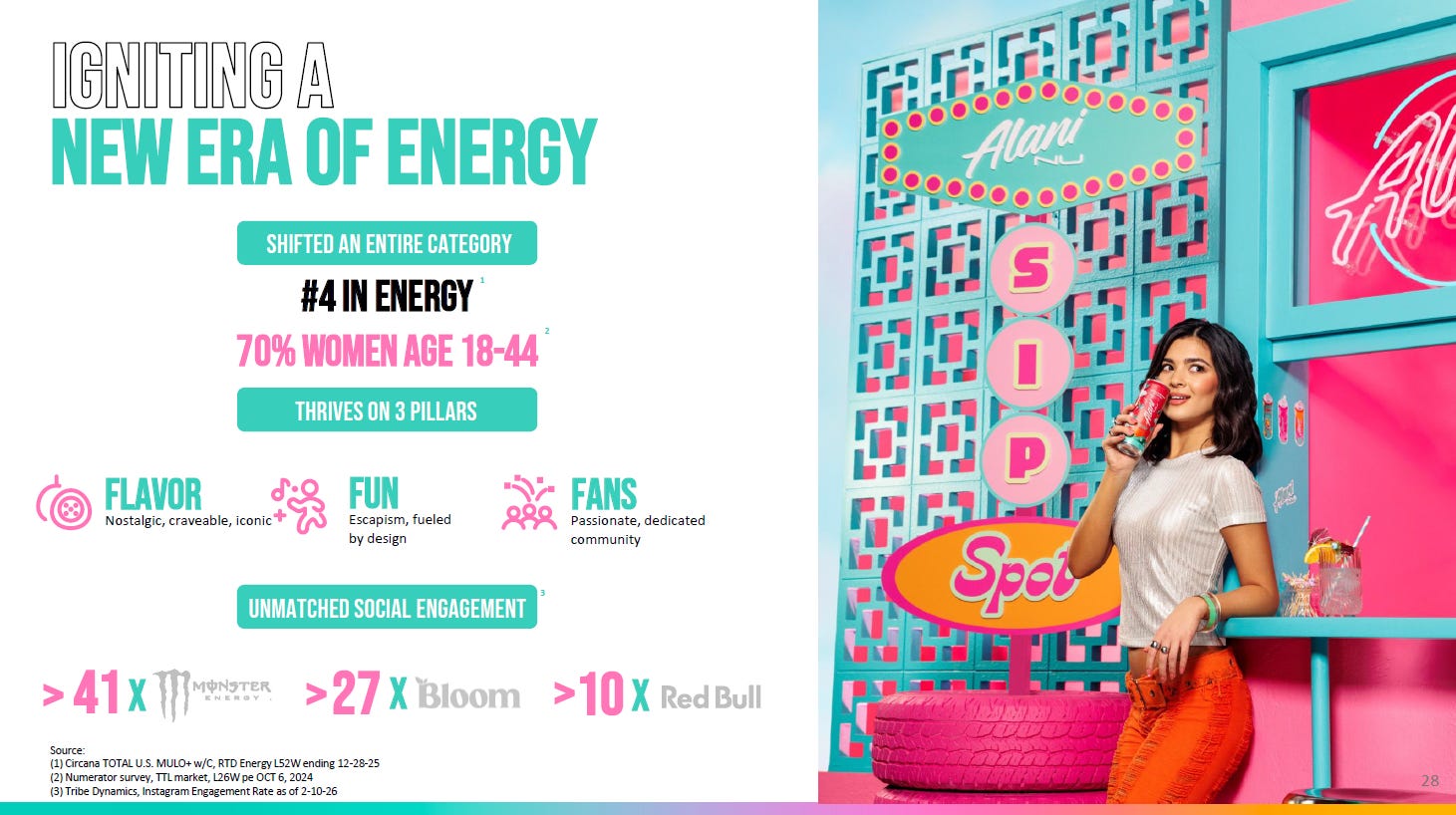
Celsius closed the $1.8B acquisition of Alani Nu in Apr-25. The price worked out to under 3x net revenue and roughly 12x fully synergized EBITDA with minimal leverage.
The results since close:
Approximately $1B of revenue contribution in 2025, and roughly $1.6B in retail sales over the trailing year — nearly double YoY
$368.1M in Q1 2026 net sales, up approximately 60% PF, with scanner growth near 100%
ACV up from the high-80s to 94.2% after moving into Pepsi’s DSD network
9.0% share of the U.S. category on its own
On a run-rate basis, Alani Nu has already passed the legacy Celsius brand in size.
Why did this work so well for Celsius? A few things:
First, energy is the lifeblood of Celsius and they have been operating for 20+ years.
Second, is the demographic — Alani owns the young female wellness consumer the way legacy Celsius owns the fitness consumer. The two brands overlap less than you would think, causing less cannibalization. I’m not sure Celsius would have made this acquisition if cannibalization was the case.
And third is the continuous innovation — Alani runs rotating limited-time flavors (Cherry Bomb in Q4, Lime Slush in Q1, each becoming the brand’s top seller in tracked channels), which keeps trial and social media attention refreshed.
What’s crazy is the awareness data illustrates there is tremendous remaining runway for the brand — Alani sits at only about 20% brand awareness nationally. Among consumers who know it, purchase conversion runs around 72%, which is comparable to Red Bull. Low awareness with high conversion paired with a recent acquisition where the company has dominant domestic distribution and international exposure is a perfect combination. The constraint here is visibility, not the product, and Celsius/Pepsi’s network will help amplify the visibility of the brand.

Rockstar
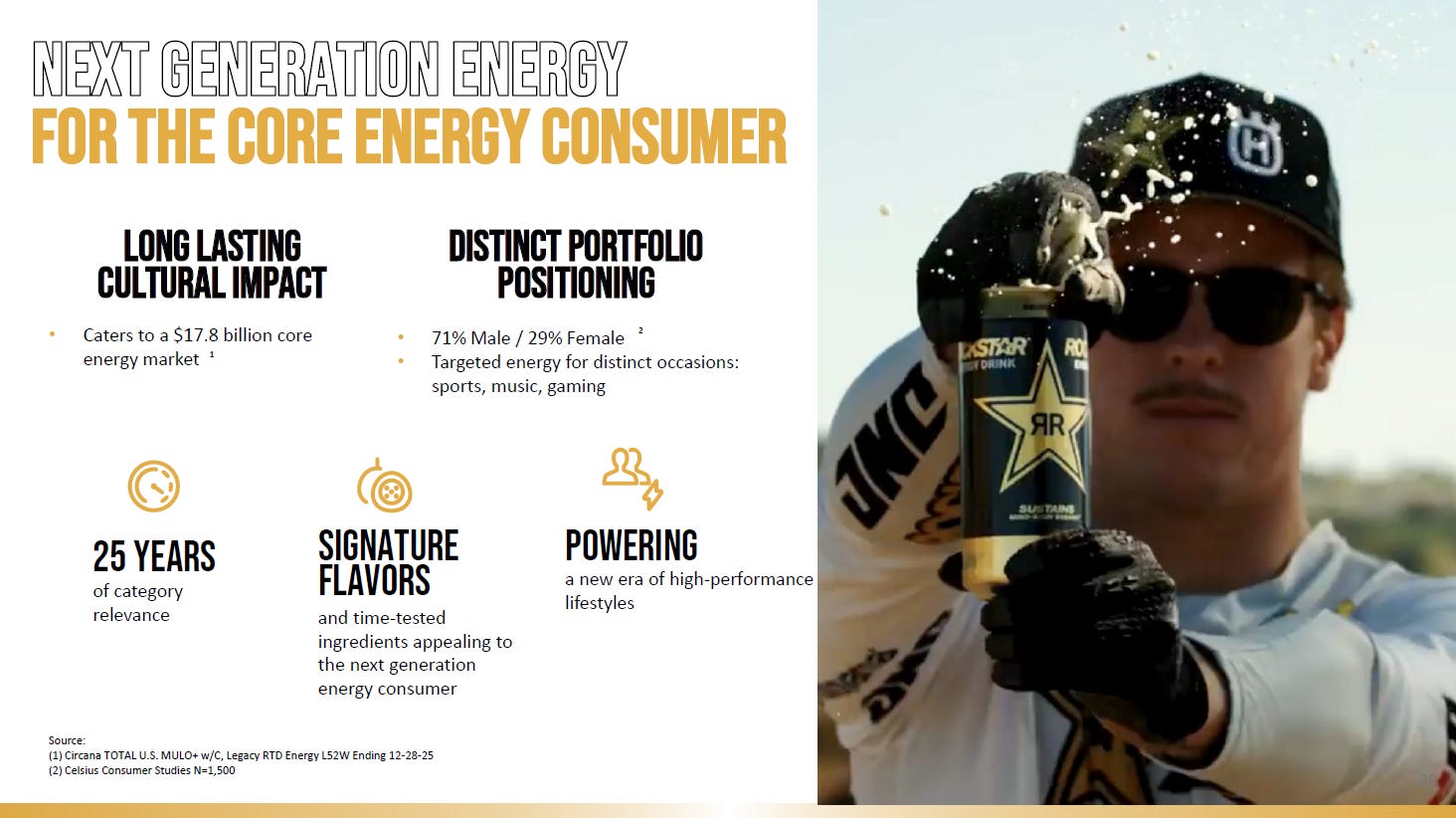
In Aug-25, Celsius acquired the U.S. and Canadian rights to Rockstar Energy from Pepsi for $585M in convertible preferred stock — this transaction lifted Pepsi’s equity stake to 11%, gave Pepsi a second board seat, and made Celsius Pepsi’s energy captain in North America.
Rockstar is the weakest asset in the portfolio and still has to be fully integrated into Pepsi’s DSD network. Q1 2026 revenue was $66.6M with retail sales down (13%) YoY. The brand held flat net shelf space through the spring resets.
Fieldly has described 2026 as a stabilization year for Rockstar, to focus on fixing the SKU set, sharpen positioning and improve execution, with a rebuild he has framed as taking “a handful of years.”
So why’d Celsius buy this brand if it was going to be so much work?
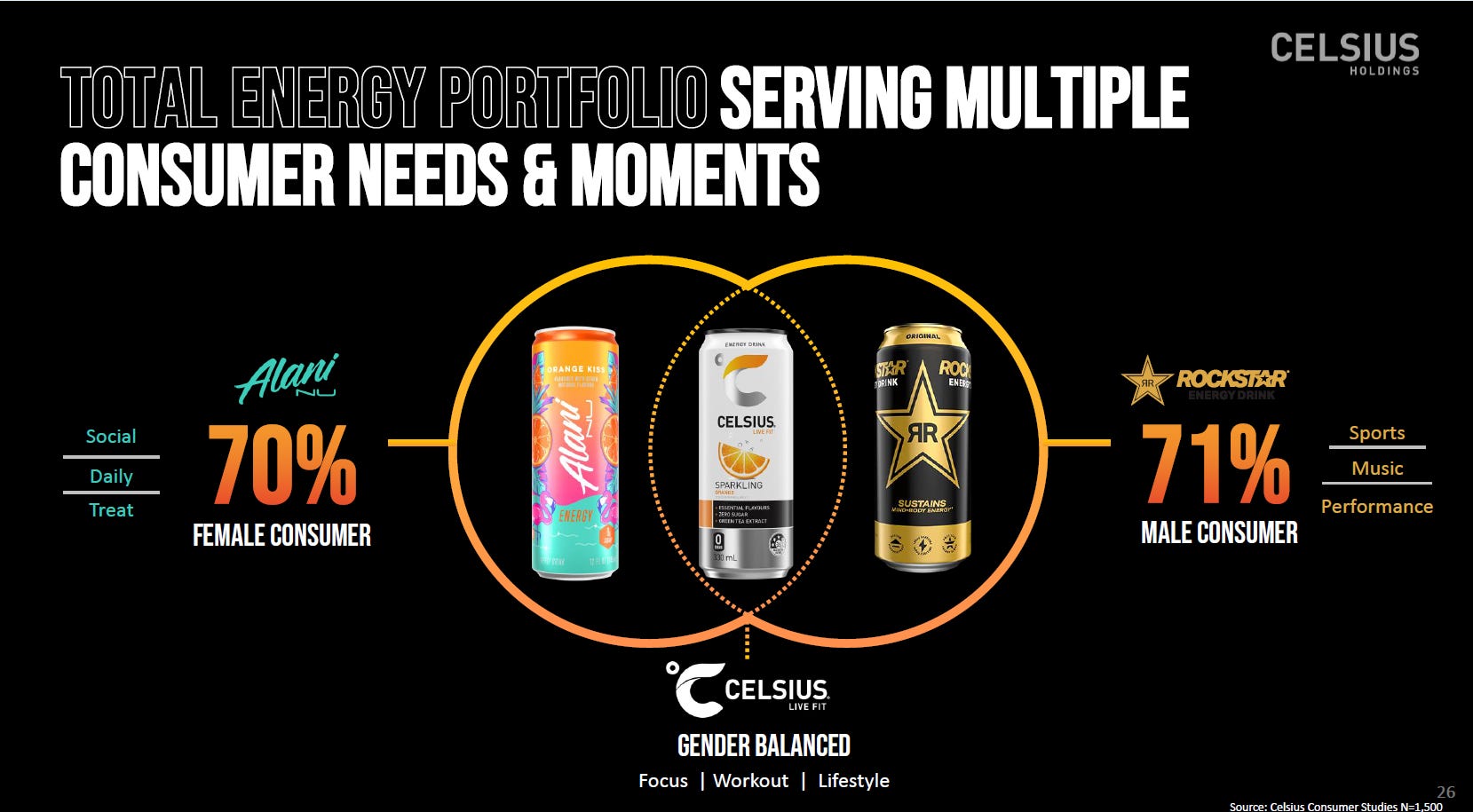
The logic for buying it is that Rockstar covers a portion of the market where legacy Celsius and Alani don’t. This is the convenience and gas channel, the value price tier, and the traditional male energy consumer, which is a core energy market worth around $17.8B that skews 71% male.
With all three brands, Celsius can offer a retailer a complete shelf solution for every energy segment. Neither Monster nor Red Bull can make that claim across modern and traditional energy.
The Pepsi Partnership
The Pepsi relationship is the most important fact about Celsius, and the most misunderstood, in my opinion. It deserves the full history, including the part that went awry a couple years ago.
The 2022 deal
In August 2022, Pepsi invested $550M for an 8.5% stake and took over long-term distribution.
The immediate unlock was access to Celsius’ core target market. Pepsi held exclusive beverage contracts covering campuses with roughly 61% of the U.S. college student population, which was a channel Celsius had struggled to reach historically. This also included the vending, foodservice, and convenience distribution capabilities of a top-two global distributor.
Celsius ACV climbed toward the high-90s over the following two years, and revenue grew 102% in 2023.
The revenue recognition problem
Celsius recognizes revenue when product ships to Pepsi, not when a consumer scans and buys a can.
After the 2022 deal, Pepsi loaded inventory aggressively to avoid shortages. That means a meaningful piece of 2023’s spectacular reported growth was Pepsi’s warehouses filling, not consumers actually purchasing that inventory.
By early 2024, Pepsi had stocked an estimated $100M-$120M, which was more than consumers demanded, and the unwind ran through Celsius’ P&L for around a year.
One stretch of late 2024 saw reported revenue take a 31% hit while retail sell-through remained stable and growing. The stock fell 52% in 2024 as investors read the shipment decline as brand decay.
—> The growth on the way up was overstated, and the decline on the way down was overstated, by the same accounting policy of revenue timing.
Separately, Celsius paid a $3M SEC penalty and consented to a cease-and-desist over materially inaccurate 2021 financial statements tied to accounting-control failures around stock awards. A 2026 class action alleging executives misrepresented the Pepsi inventory dynamics was dismissed quickly.
So a practical lesson for anyone analyzing this company is that reported revenue and consumer demand routinely diverge around distribution transitions. It’s definitely an annoying financial aspect of the business, but I think this helps contribute to the divergence of opportunity and asymmetric upside.
The 2025 restructuring
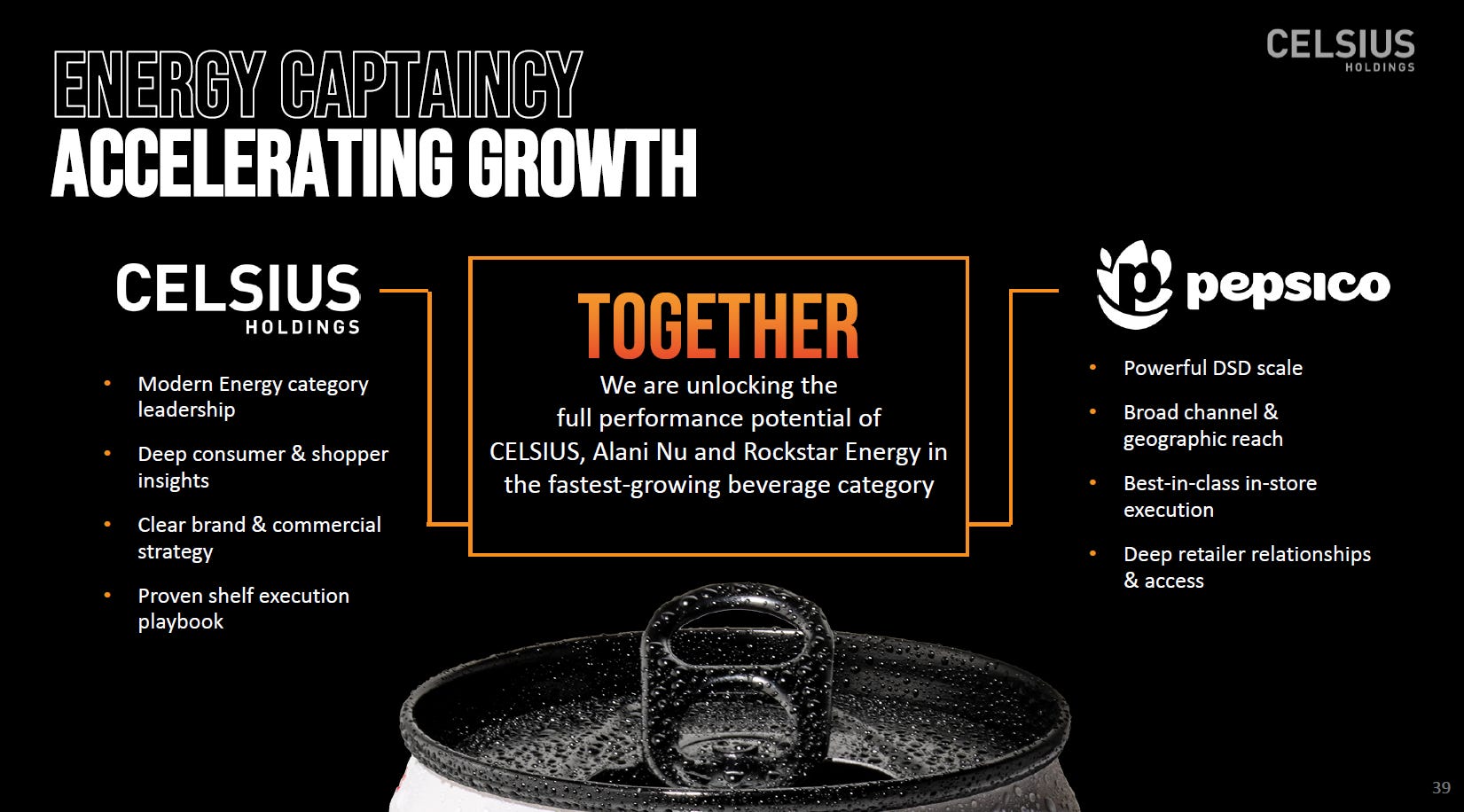
In August 2025 the alliance deepened between Pepsi and Celsius, when it was announced that Alani Nu is moving into Pepsi’s DSD network, Celsius bought Rockstar’s domestic rights, and Pepsi’s equity stake rose to ~11% in Celsius. It was also announced then that Celsius formally took over the energy category for Pepsi design, SKU prioritization and promotional execution in the U.S..
By Q1 2026, Pepsi accounted for 59.0% of Celsius revenue.
That concentration number is the first thing analyst skeptics raise, so it’s worth laying out why the structure exists and why the history of this category suggests it can be an advantage rather than a risk.
Coke bought ~16.7% of Monster in 2015 for $2.15B and became its preferred global distribution partner across 190+ countries. That transition was painful, with Monster’s Q1 2015 net income falling 95% on distributor termination costs, with full-year termination obligations of $218.2M.
Following this pain, the core Monster brand compounded domestically and internationally utilizing Coke’s distribution model into a company worth roughly $92-96B today.
Celsius has been running that same sequence. Approximately $400M in distributor termination fees were realized through its P&L during the transition (funded by Pepsi) — this is the same short-term earnings distortion and resulting market skepticism. The remaining termination balance fell from $264M in December to $40M by the end of Q1.
The incentive structure is also different from a normal vendor or customer relationship. Pepsi owns 11% of Celsius, holds two board seats, and named Celsius its energy captain after its own energy brands (Amp, Kickstart) shrank 28% over the past year to around $130M.
Pepsi spent 15 years trying to build energy internally before handing the category to Celsius.
More broadly in this category, every major energy brand utilizes a conglomerate’s distribution:
Monster with Coke
Ghost with Keurig Dr. Pepper
C4 with Keurig Dr. Pepper
Celsius with Pepsi
Zoa with Molson Coors
Red Bull is the only self-distributing exception, and it invented the category with a two-decade head start.
Whether the ~60% Celsius/Pepsi concentration reads as a moat or a vulnerability is a judgment call — I’ll give you mine in the risks section below, but the history section above is what I’d weigh it against.
Alternative KPI Data: Velocity and Distribution
“In retail, if you are off-shelf, you are not selling,
We live or die each day by our supply chains.”
— John Fieldly, CEO
Rather than rely on the reported financials, this section goes around them and focuses on distributor disclosures, distribution KPIs, retail data, ecommerce rankings, consumer survey work, and the company’s job postings.
Shipments vs. Scanning
This table stacks the past four reporting periods of core-brand wholesale revenue against U.S. retail scanner demand:
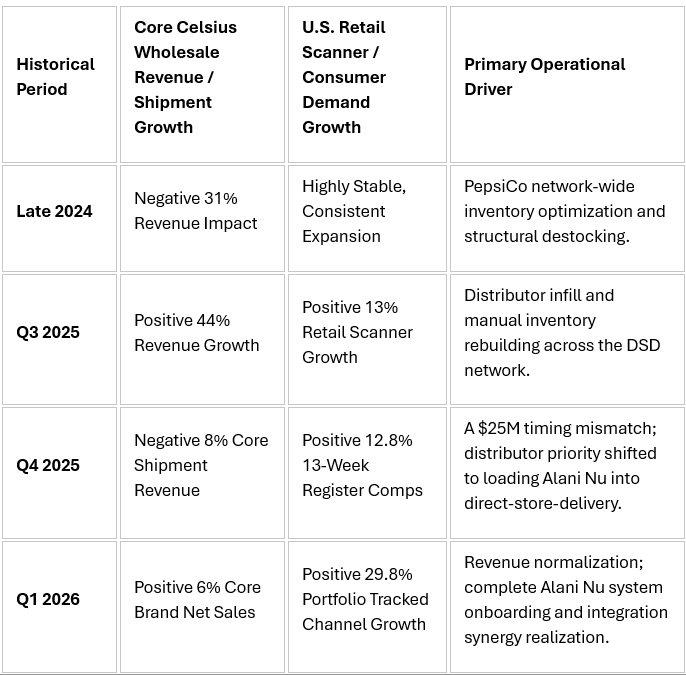
During four straight periods where reported revenue and consumer demand pointed in different directions, consumer sell-through of the core brand stayed positive and stable while shipments moved with Pepsi’s warehouse decisions.
By Q1 2026 the order patterns had normalized: record consolidated revenue of $782.6M, the full $50M Alani synergy target captured, and the distributor termination cleanup nearly complete.
The 6% legacy Celsius brand growth that spooked investors deserves a similar perspective — Celsius deliberately cut its slow-moving flavors ahead of the spring resets.
These cuts happen instantly while the replacement shelf space builds over months.
As COO Eric Hanson put it on the Q1 call, “we see the reduction faster than the ACV build.”
Dollars per point of distribution rose while total distribution points dipped, which is a sign of a productivity tradeoff rather than demand decay.
Management has indicated that Q2 should be a side-step in settled demand, with ramp turning around during the end of the year and into 2027.
This is definitely one of my closest watch items as we head into the remainder of the year.
Shelf Expansion & Optimization
The expansion of Celsius from a single-brand upstart into a multi-brand energy platform has reshaped its physical retail footprint and category placement.
During the spring 2026 category resets, which finalized between June and July, Celsius successfully expanded its physical shelf space across grocery, convenience, mass, and club channels:
Core Celsius: +17% incremental shelf space across national chains, including new cooler doors and secondary placements
Alani Nu: ACV distribution rose from the high-80% range in late 2025 to 94.2% by early 2026, driving +100% space gains across channels
Rockstar: flat net space while the SKU set gets rebuilt
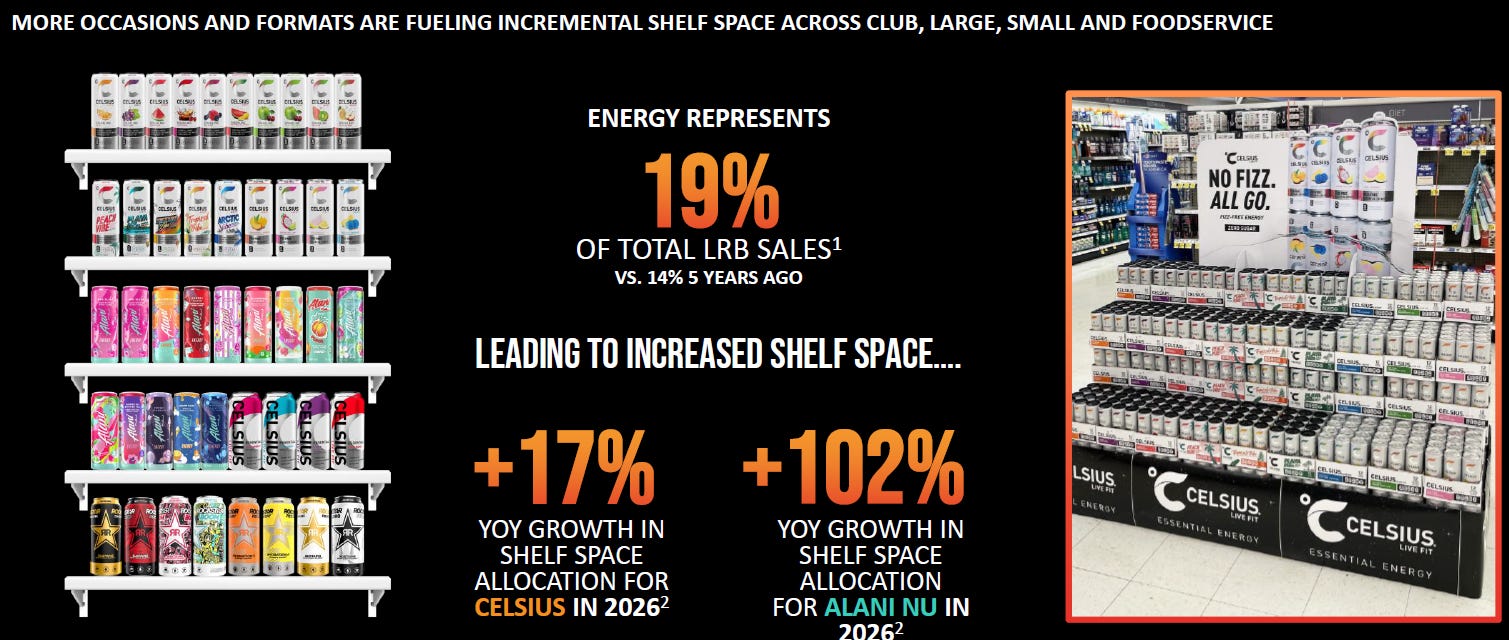
To complement its presence in traditional retail channels, Celsius has expanded into foodservice, which now accounts for ~11% of the company’s Pepsi-routed revenues.
Key milestones in this expansion include national partnerships with Dunkin’ and Jersey Mike’s Subs. Dunkin’ added Celsius Sparkling Orange to its beverage coolers, while Jersey Mike’s introduced a three-flavor lineup nationwide.
However, this rapid retail expansion faces headwinds from private-label products.
In early 2026, Costco launched its Kirkland Signature Sparkling Energy Drink, priced at $16.99 for a 24-can variety pack containing Peach, Orange, and Tropical flavors.
This private-label product is positioned as a direct competitor to Celsius, matching its 200mg caffeine dose, zero-sugar formulation, and key vitamins at a 40% to 55% discount to the branded equivalent.
Because Costco represents approximately 11% of Celsius’ total sales, the introduction of this private-label alternative caused a temporary 7% decline in Celsius stock and presents a risk of velocity dilution in high-volume club store Costco channels.
Despite this, Celsius has a much stronger brand image and marketing strategy / scheme, and pop-up brands like this Kirkland Signature beverage fade quickly once after consumers try it a couple times.
Digital velocity
While physical shelf expansion remains the primary driver of bulk volume, digital e-commerce channels serve as a key leading indicator of consumer pull and velocity.
E-commerce demand for functional energy beverages remains strong, with the online retail energy drink segment projected to grow at a 7.5% CAGR through 2035.
Within this digital landscape, Celsius maintains a leading market share position, routinely outpacing legacy incumbents on digital platforms.
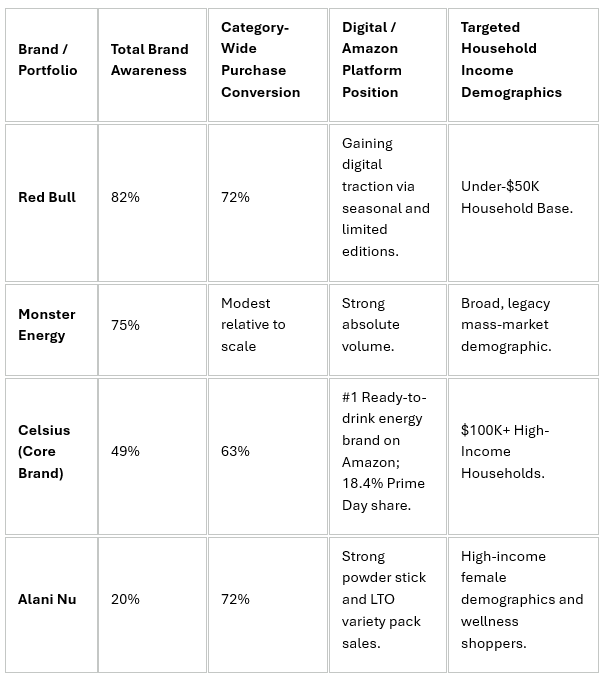
On Amazon, Celsius remains the top-selling ready-to-drink (RTD) energy drink brand. During peak promotional periods, such as Amazon Prime Day, Celsius achieved an 18.4% weekly market share in the energy drink category (2025 Prime day).
Right now as I write this, it appears Celsius still appears at #1, and also appears at #4, #7, #18 and in other places, with Alani starting at #15 and #16. Rockstar starts appearing at #38, which is pretty far down the list, but matches up with management’s commentary and intention of turning around this business.
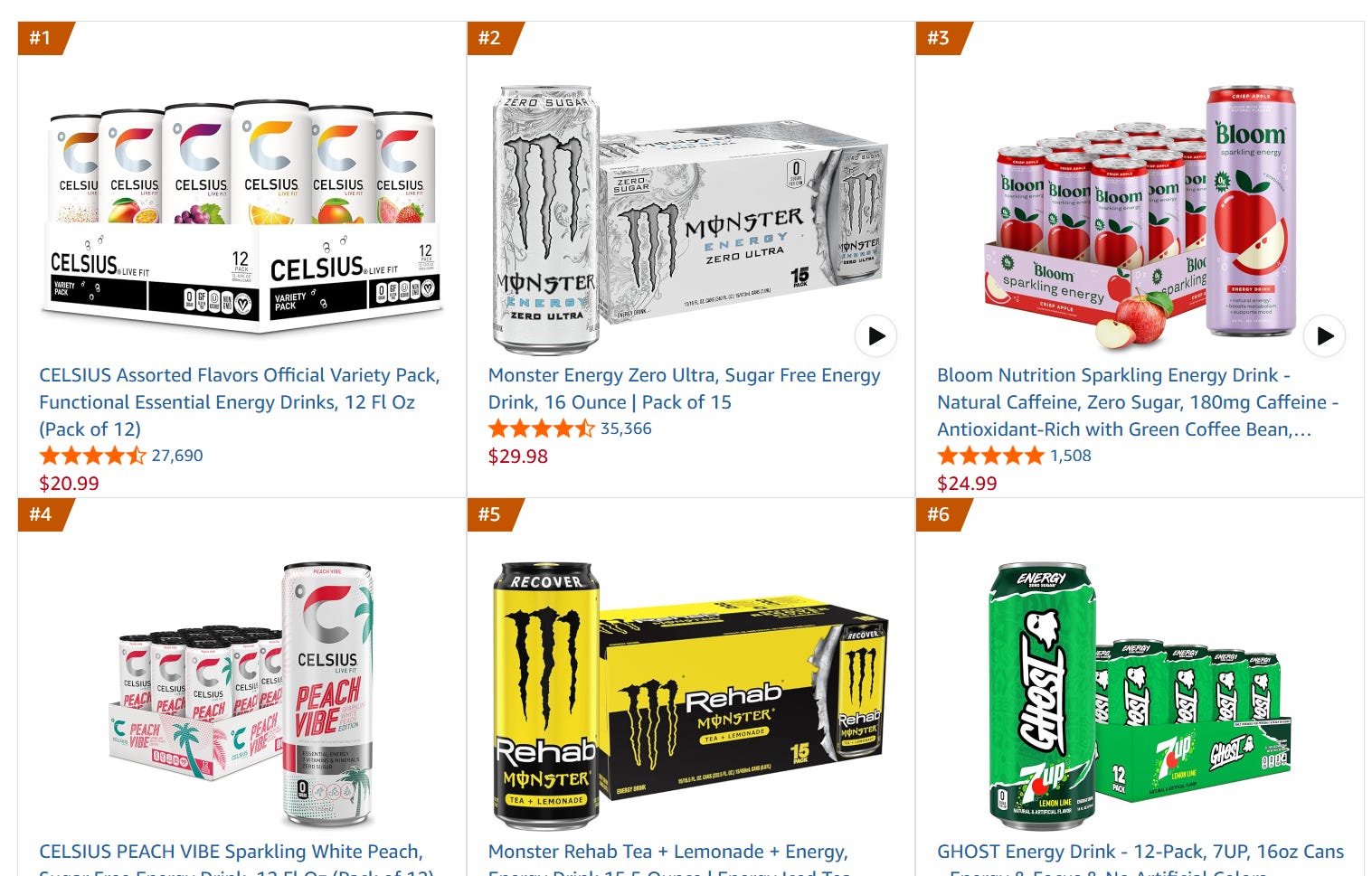
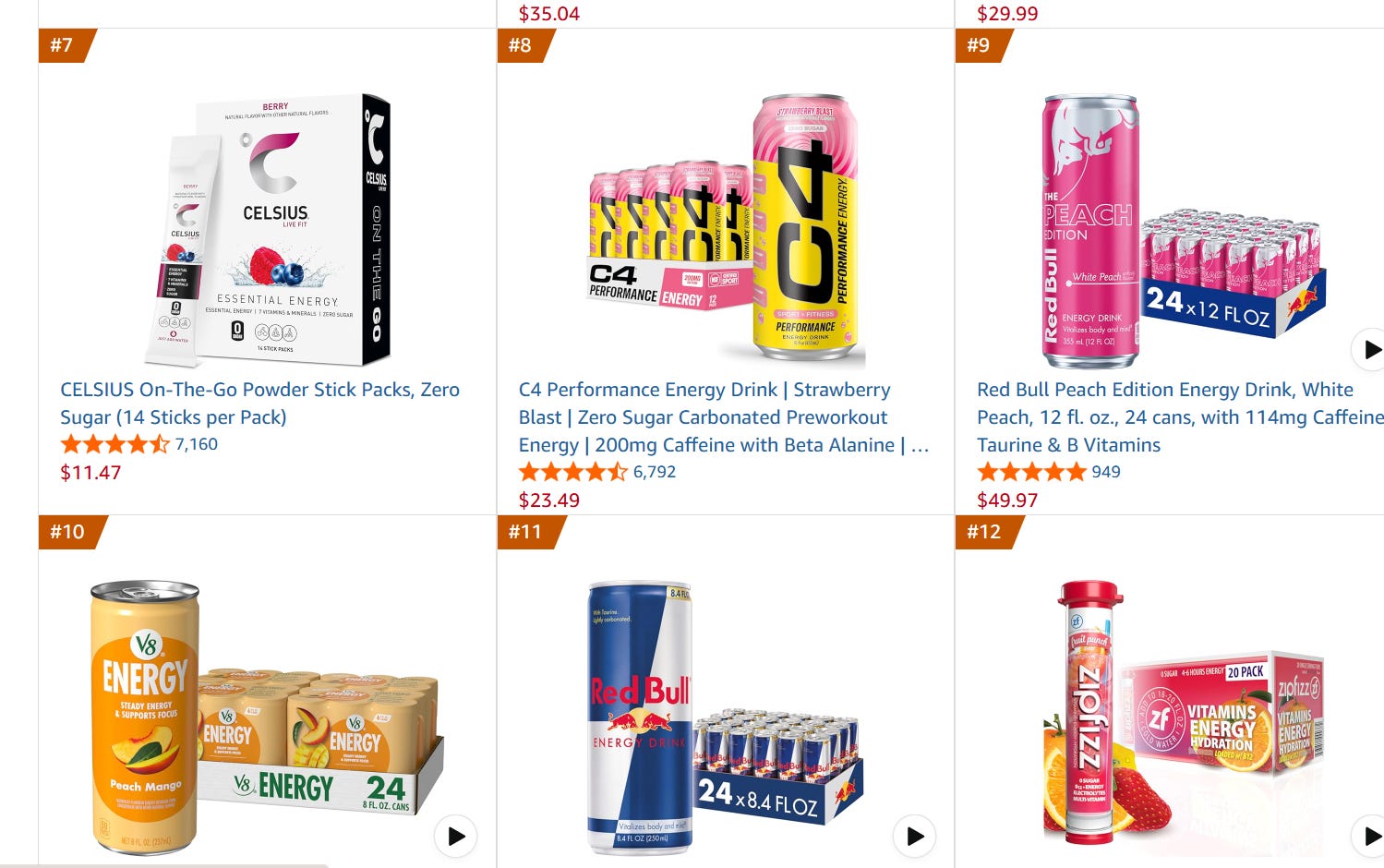
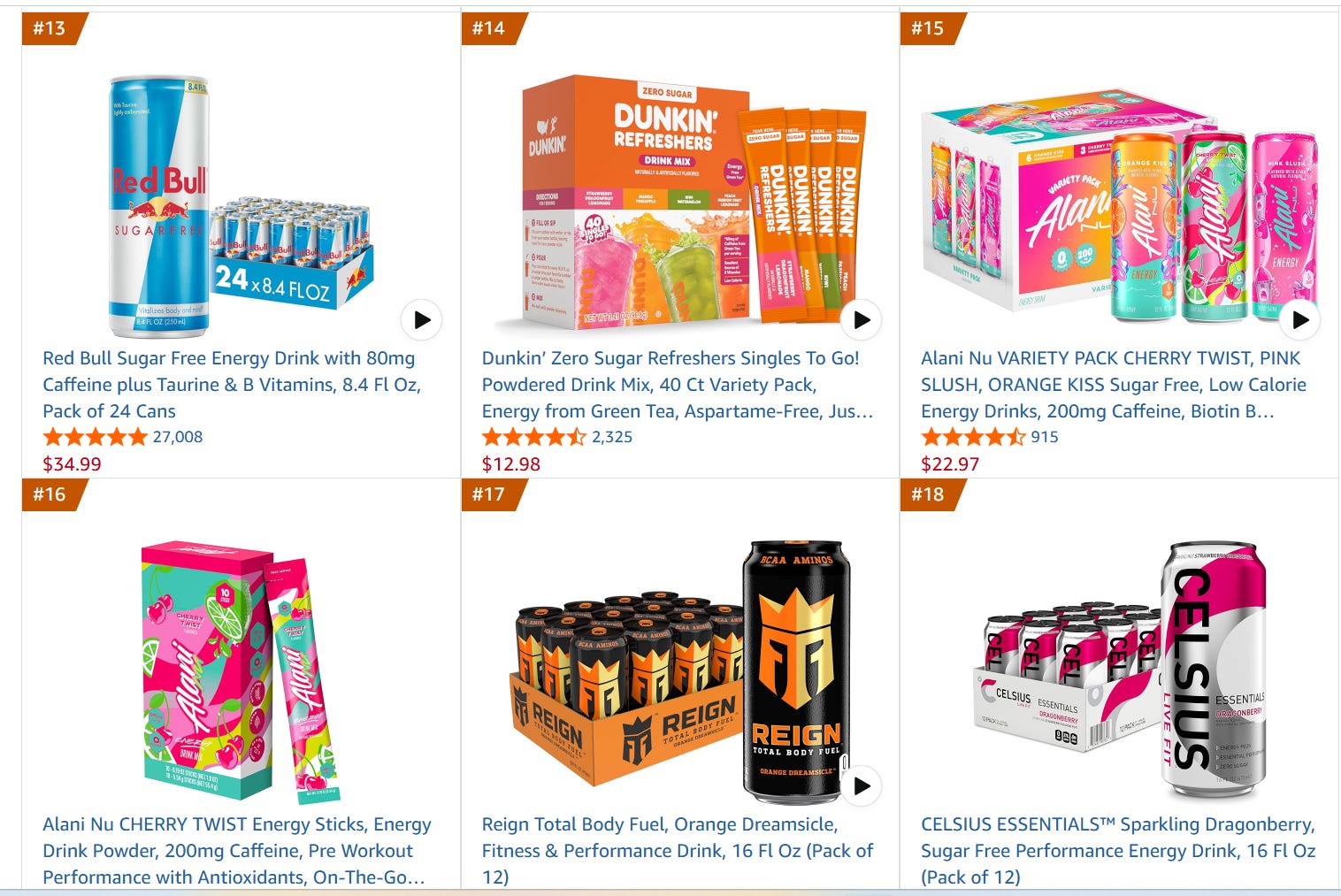
This digital velocity is driven by the performance of multi-flavor variety packs, which attract consumers looking for convenient home delivery and bulk savings.
According to digital influencer indexes and e-commerce tracking data, the Celsius Assorted Flavors Official 12-Pack Variety (featuring Sparkling Orange, Peach Mango Green Tea, Kiwi Guava, and Fuji Apple Pear) holds a prominent position within e-commerce search rankings, placing at #46 in the highly competitive Grocery & Gourmet Food category influencer index.
This strong e-commerce performance is supported by high customer acquisition and conversion rates. Analysis of consumer purchasing behavior indicates that Celsius displays high conversion efficiency relative to its total brand awareness.
Awareness vs. conversion
The consumer survey data reframes the competitive picture:
Red Bull: 82% brand awareness
Monster: 75%
Celsius: 49% — with 63% of aware consumers connecting the brand to an active purchase occasion
Alani Nu: 20% awareness, but converting around 72%
Half the country still hasn’t properly met these brands yet, while the consumers who have met them buy at rates comparable to the incumbents.
That combination of low awareness and high conversion is what distribution systems and marketing budgets exist to exploit, and Celsius now has access to both at Pepsi scale.
Additionally, Celsius’s digital consumer base has a favorable demographic profile, showing high penetration among $100K+ high-income households.
—> This demographic is relatively insulated from inflationary pressures, supporting premium price resilience on digital platforms.
Organizational Capability & Field Sales Hiring
To support Celsius’ retail space gains and ensure execution at the shelf, Celsius has scaled its internal sales organization.
They’ve transitioned their field operations from a reliance on external agencies to an in-house model while prioritizing execution quality to monitor SKU compliance, display compliance and local distributor alignment.
An analysis of Celsius Holdings’ active job openings in 2026 reveals two primary operational profiles that drive regional execution:
Field Execution Representatives (FERs): This entry-level role is paid $25 per hour plus overtime and a vehicle allowance. Operating on a Wednesday-to-Sunday schedule, FERs are tasked with setting up in-store displays, securing end-cap placements, conducting product sampling demos, and executing 15 to 20 account audits per day to ensure correct pricing and shelf alignment.
Territory Sales Managers (TSMs): This professional-level role features a base salary range of $60,000 to $65,000 per year plus performance bonuses and RSUs. TSMs manage regional distributor partnerships (such as local Pepsi bottlers), conduct distributor “route rides” and “market blitzes,” and oversee 12 to 15 store visits per day to resolve shelf distribution gaps.
The geographical distribution of these open positions reveals the focus areas of Celsius’ retail strategy.
Rather than focusing solely on mature, high-volume states, the company’s hiring activity is concentrated in regional clusters designed to expand distribution depth and defend market share in highly competitive markets.
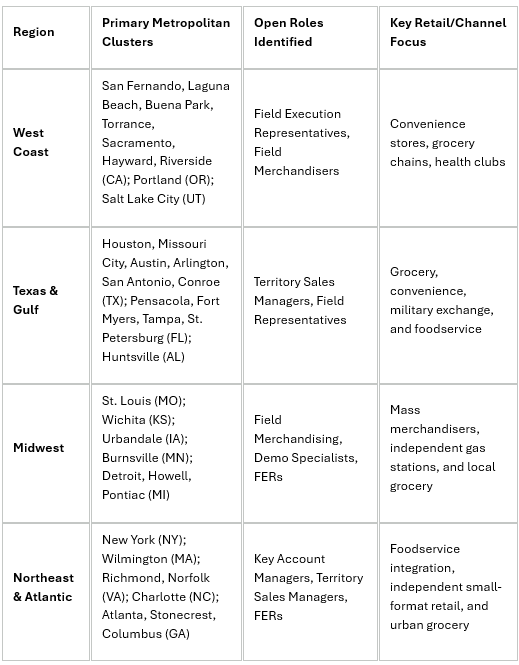
This hiring pattern demonstrates that Celsius is actively allocating capital to feet-on-the-street merchandising. This field sales presence is designed to minimize out-of-stock scenarios and secure secondary placements during high-volume seasonal windows.
Key Areas for Growth
There are roughly six areas for growth that I believe will determine the next 12-36 months of Celsius’ stock performance:
1.) Legacy Celsius brand growth
The past year was the first in which this organization managed a multi-brand portfolio, and management’s attention went where the integration risk was.
That work is now largely complete with Alani’s integration finished, synergies captured and the SKU standardization finished.
Fieldly’s argument on the Q1 call was that consistency itself is the growth lever, which means the same core flavors in every store, because “consistency drives repeat purchase.”
The setup for the back half according to management is 17% more shelf space, a permanent Fizz-Free sub-line scaling at rising velocity and a World Cup activation cycle for the core Celsius brand.
The Monster precedent is worth keeping in mind as its flagship Monster drink reaccelerated after the 2015 Coke distribution transition ended. Whether the Celsius flagship does the same is the central question of H2 2026.
2.) Channel whitespace inside Pepsi DSD
Campus contracts covering around 61% of U.S. college students continue to deepen into vending, dining halls, campus markets and peer-marketing programs.
Beyond campuses, hospitals, medical centers, and shift-work environments (think hotel grab-and-go pantries, resort pool bars, and cruise lines).
Cross-CPG plays only a Pepsi partner can run would be a growth driver as well — like meal-deal bundling at checkout and participation in Pepsi’s digital loyalty ecosystem.
Each of these is individually small but together they extend distribution into everywhere Pepsi already does business.
3.) Shelf optimization
ACV (all-commodity volume) measures the percentage of total market sales flowing through stores that carry your product, weighted by store size.
So being in Walmart counts far more than being in a corner shop.
Celsius’s portfolio ACV is 99.5%, which means the product is already in effectively every store that matters. From here, growth comes from more space, better placement and faster sales cycles within existing stores. This is actually what the reset gains and SKU rationalization are engineering!
Alani was the exception, as its ACV was deliberately pulled from the high-80s to 94.2% by plugging it into Pepsi DSD.
The clean way to track all of this would be weekly scanner growth, as NielsenIQ and Circana data is the ground truth on velocity and share, but that data sits behind five-figure institutional paywalls, so the tracked-channel disclosures KPIs explained above are the available proxies.
4.) Bolt-on M&A
This is essentially replicating the Alani / Rockstar playbook — buying a high-growth, independent brand, plug it into Pepsi’s DSD, increase distribution and expand shelf space, and repeat.
The balance sheet has net leverage around 1.0x, which is more than enough room to fund another deal.
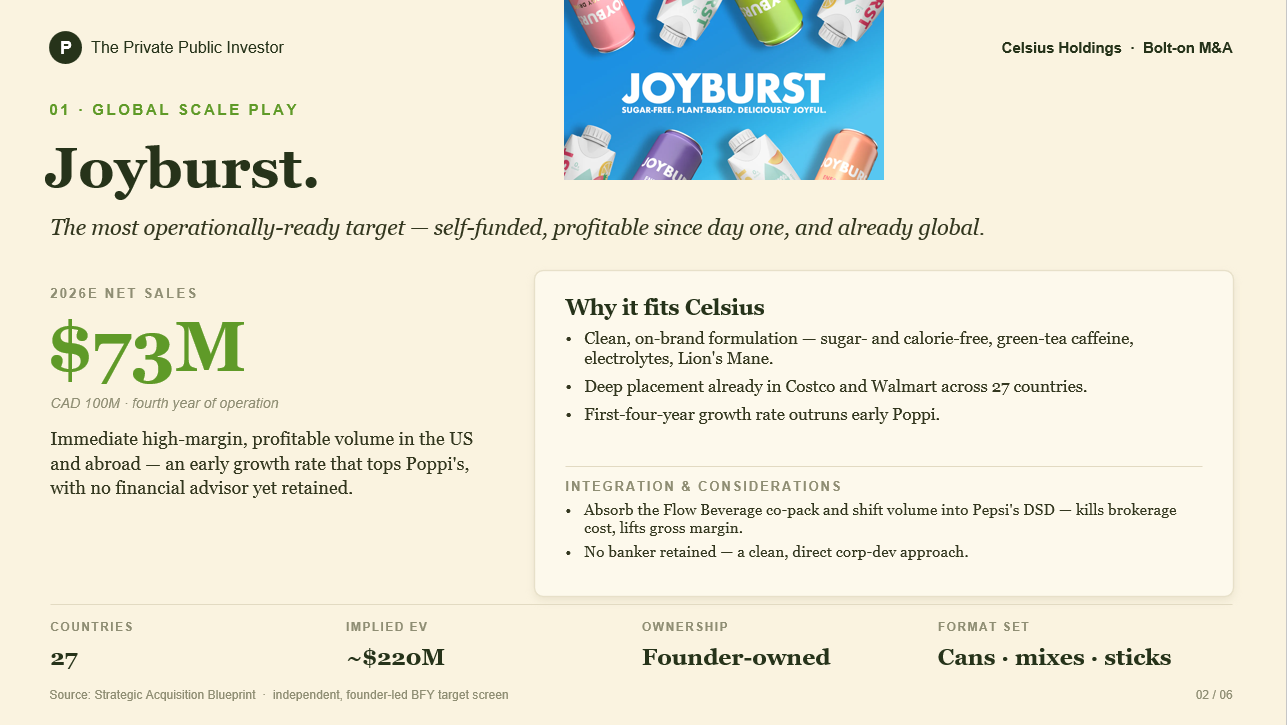
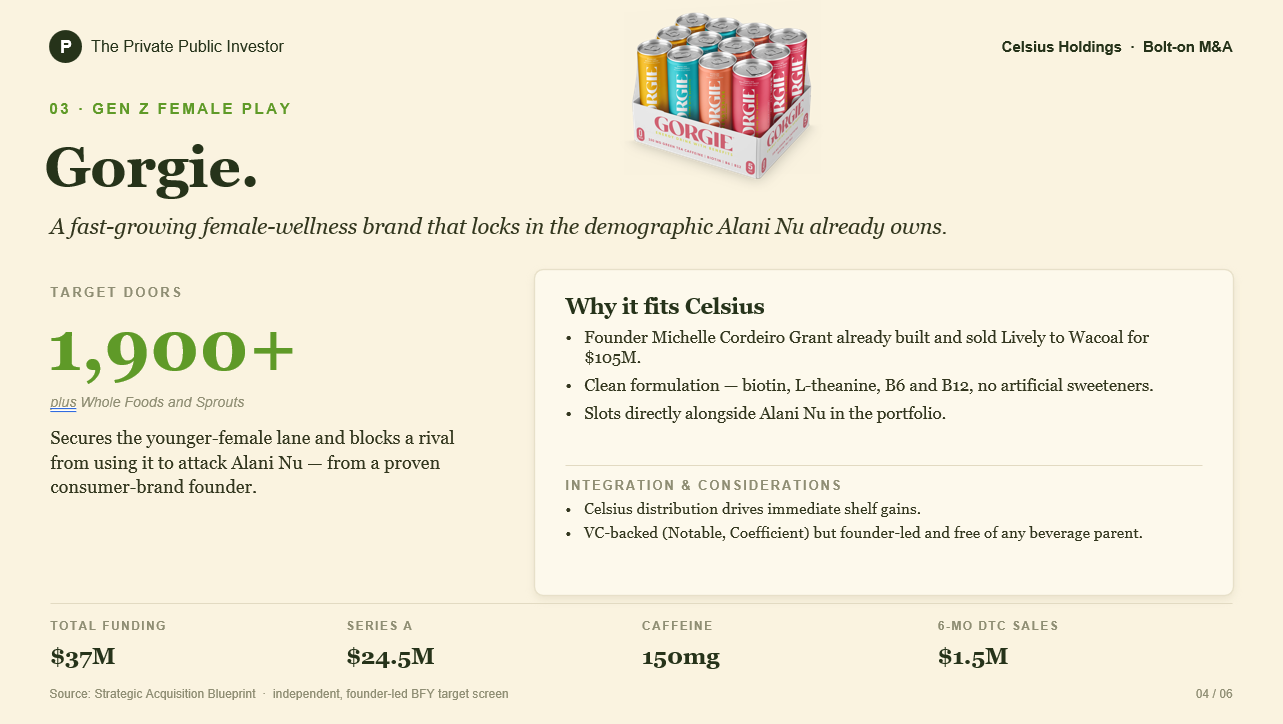
I’ve screened for independent, founder-led BFY brands whose formulations fit the portfolio’s clean-energy identity (ex. green tea caffeine, yerba mate, adaptogens), and it produces a reasonably short list.
I’ve put together an M&A deck below (since that’s what I’m good at, lol):
Note: Links are provided below to each brand’s website
Joyburst
Gorgie
CLEAN Cause
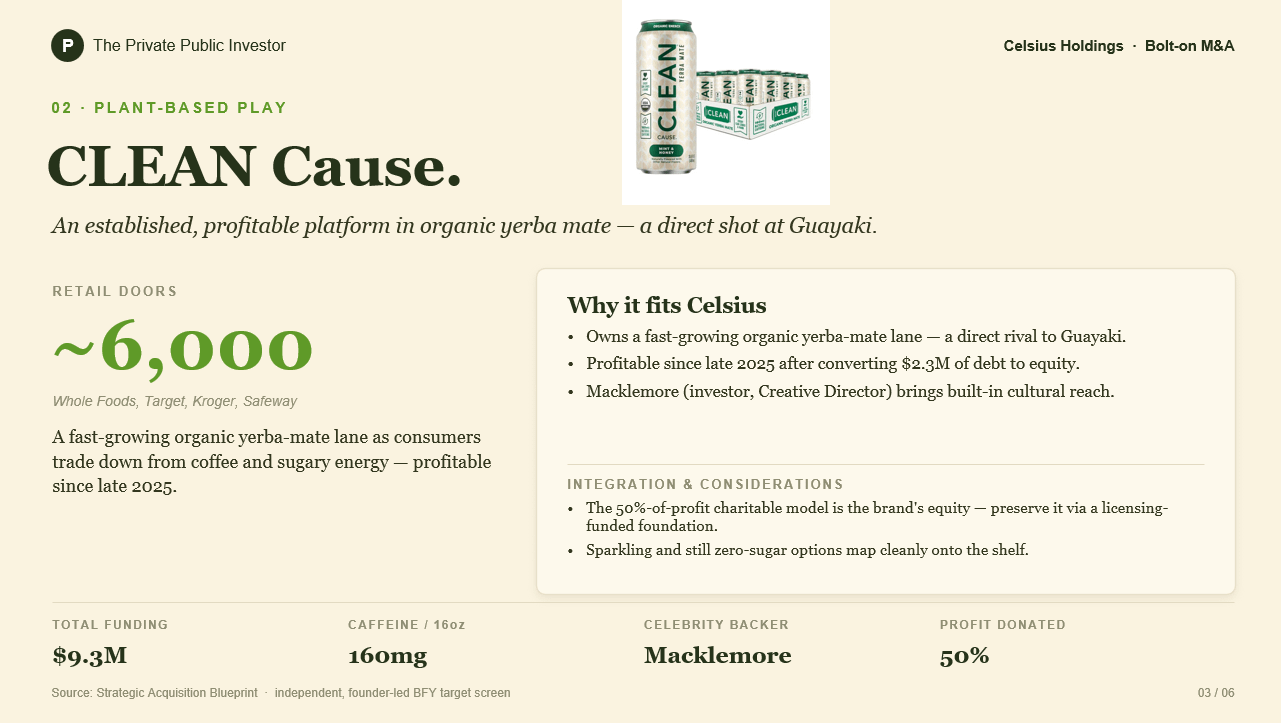
Odyssey
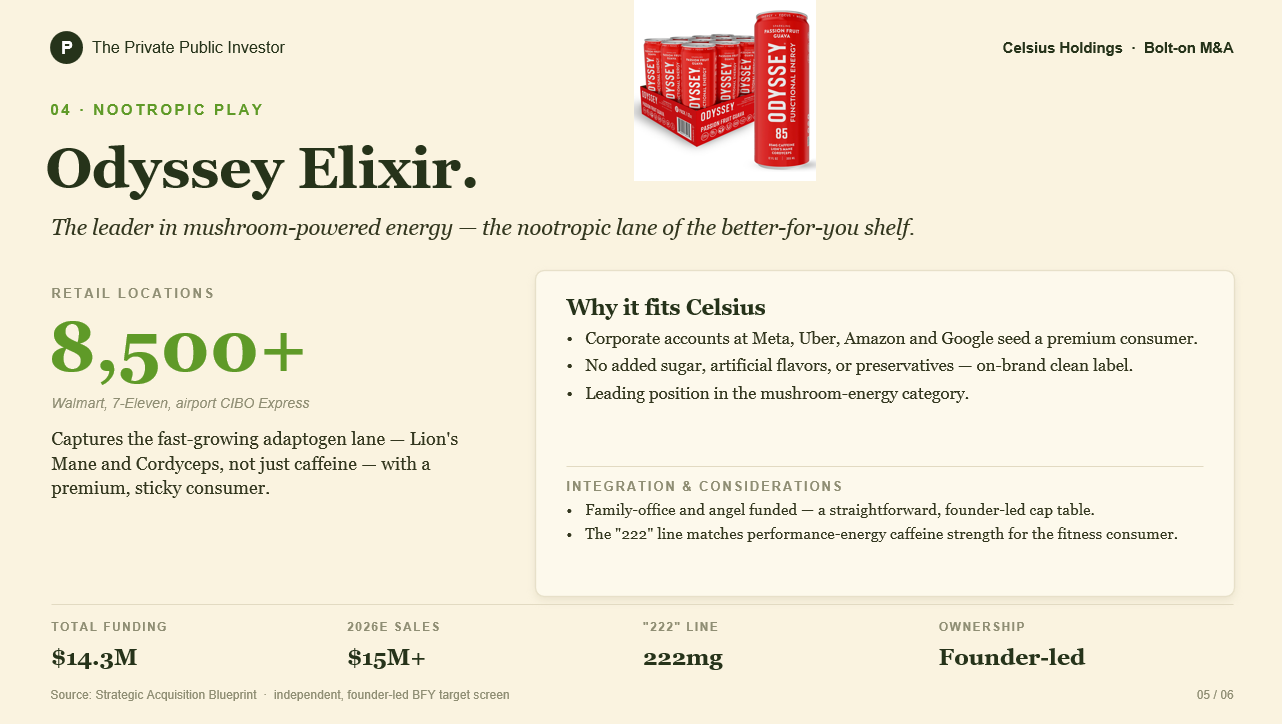
Proper Wild
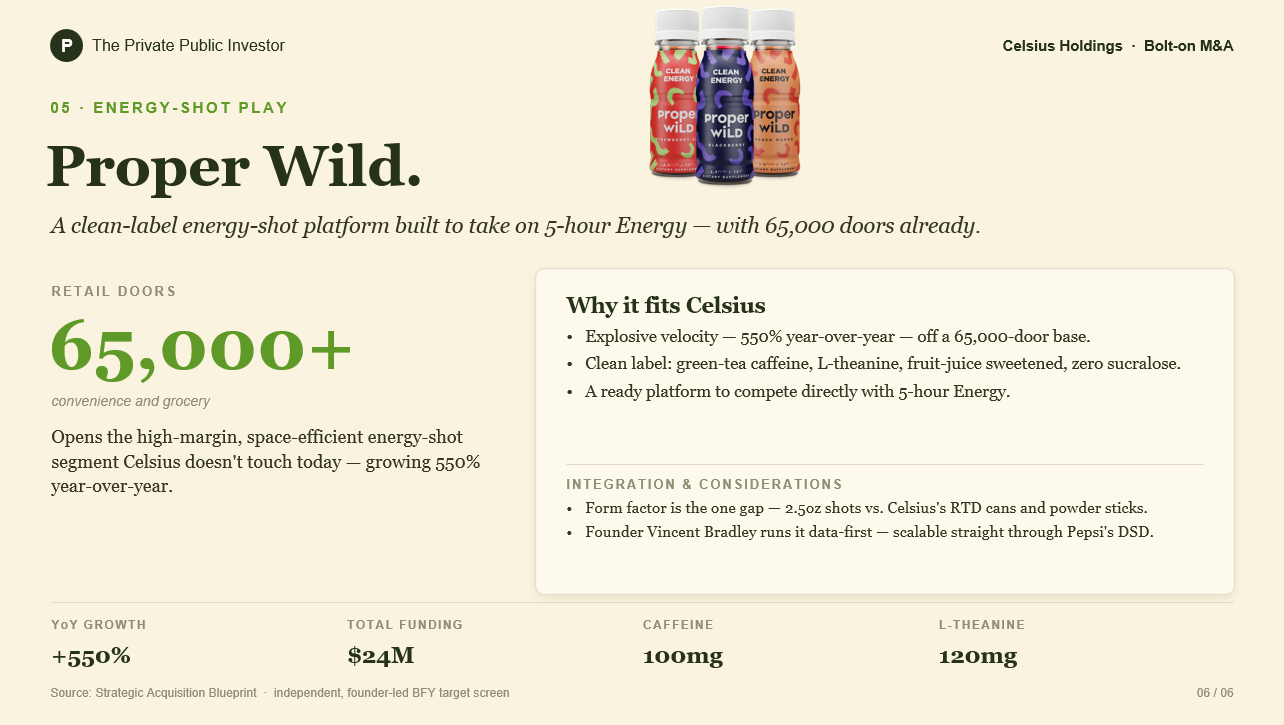
Other brands such as Uptime, Gym Weed, Marquis, and Phocus are further down the list.
None of these is required for the growth story though — M&A is all incremental to my thesis
5.) International expansion & growth
As mentioned previously in the industry section, 95% of Celsius’ exposure is in North America versus Monster’s roughly 45% international mix.
Celsius is executing on a similar strategy to Monster back in the day, and if successful, will boast meaningful growth for Celsius over the years. This includes strong local distribution partners, market-by-market launches and sustained marketing support.
An example of this is the Suntory Beverage & Food agreement in Spain signed in March of this year. Portugal is next under the same distributor, layered on top of the UK, Ireland, France, Australia, New Zealand, Benelux, and the Nordics.
It’s the same international business plan Monster used with Coke’s bottlers
6.) Category adjacency
This one is a long shot but I thought it’d be fun to include — food for thought.
Monster owns alcohol brands, so the question comes up: should Celsius eventually buy a BFY alcohol brand, an electrolyte company, or a functional / nootropic platform?
The Monster experience argues for caution, as it impaired roughly 55% of its CANarchy craft-brewery purchase and the alcohol segment still loses money.
Alcohol also runs through a legally separate three-tier distribution system Pepsi can’t touch, and Monster notably had to hand its non-energy brands to Coca-Cola when their alliance formed (the same would have to be done with Pepsi, or Pepsi wouldn’t allow it under their agreement).
Hydration, functional wellness and nootropics are the more natural adjacencies though, and Celsius already sells hydration powders which are similar.
This is all optionality.
Risks
There are roughly six areas that I believe could impair Celsius’ business and stock performance over the next 12-36 months:
1.) Legacy Celsius brand growth fails to reaccelerate
One of the largest risks is that the core Celsius brand does not return to meaningful growth following the Alani Nu integration.
My base case assumes the recent ~6% growth reflects temporary disruption from integration activities rather than a structural slowdown in consumer demand.
—> For context, this 6% comes after a quarter where the company reported growth of 7.5% for Q4 2025 and 13% YoY growth for Q3 2025… a QoQ step down 3 times in a row, which is why the stock has sold off so violently.
If the core brand remains around this level into early 2027 — after distribution resets are complete and major marketing investments such as the World Cup are behind the company — it would suggest the flagship brand has matured sooner than expected.
And that would cause a continued decline in the stock price most likely.
In that scenario, Celsius increasingly resembles a multi-brand beverage platform rather than a high-growth company anchored by its original brand, which would likely warrant a lower valuation multiple as well.
Scanner data continues to suggest underlying demand remains healthy, but the second half of 2026 will be an important period for validating that assumption.
2.) Commodity costs, tariffs, and slower margin recovery
Gross margin declined to 48.3% in Q1 2026 from 52.3% a year earlier, primarily reflecting higher aluminum costs and tariff-related pressures. Aluminum, the company’s largest packaging input, experienced meaningful price increases during the quarter, and management has indicated Q2 will likely represent a temporary pause in margin improvement.
The company has several initiatives intended to offset these pressures, including locked-in conversion costs extending into future years, a second North Carolina production line expected to come online in the second half of 2026, and continued optimization of its pricing and package mix.
Management expects margins to improve through the remainder of 2026 and into 2027.
But if commodity inflation remains elevated for longer than expected, margin recovery could simply take longer than currently projected.
3.) International adoption of BFY energy drinks develops more slowly than expected
A meaningful portion of the long-term growth opportunity depends on international markets adopting healthier energy drink alternatives at a pace similar to the U.S.
That outcome is not guaranteed, particularly as several markets have introduced or proposed tighter regulations around high-caffeine beverages. The UK has announced restrictions on sales of high-caffeine energy drinks to consumers under 16 beginning in 2027, Canada limits caffeine content to 180mg per serving, and proposed U.S. legislation would require additional warning labels on beverages containing more than 150mg of caffeine.
Current regulations appear manageable, but slower international adoption could delay Celsius’ expected expansion.
Sell-through trends in markets such as the UK and Spain will likely be more informative than announced distribution gains alone.
4.) Regulatory scrutiny around youth marketing
In June, the Texas Attorney General opened an investigation into Alani Nu’s marketing practices following a consumer death.
While the legal merits remain uncertain, the case highlights the broader regulatory attention surrounding energy drink marketing.
Celsius has previously resolved regulatory matters without material long-term financial impact, including settlements related to labeling and SEC disclosures.
The primary concern is less about direct financial liability and more about reputational risk if additional investigations increase consumer scrutiny around energy drink safety, particularly among younger consumers.
At this stage, I view this as a risk worth monitoring rather than a change to the long-term investment thesis.
5.) Competitive intensity increases
Competition within the energy drink category remains significant.
Private-label offerings such as Kirkland continue to expand at meaningful price discounts, while established competitors including Monster and Red Bull continue introducing new products and investing behind their brands. Pepsi and Starbucks are also growing their energy portfolio from a relatively small base.
We also have other brands popping up, similar to Celsius, that are quite popular this summer, such as Bloom Nutrition, a brand of C4, whose parent company is Nutrabolt.
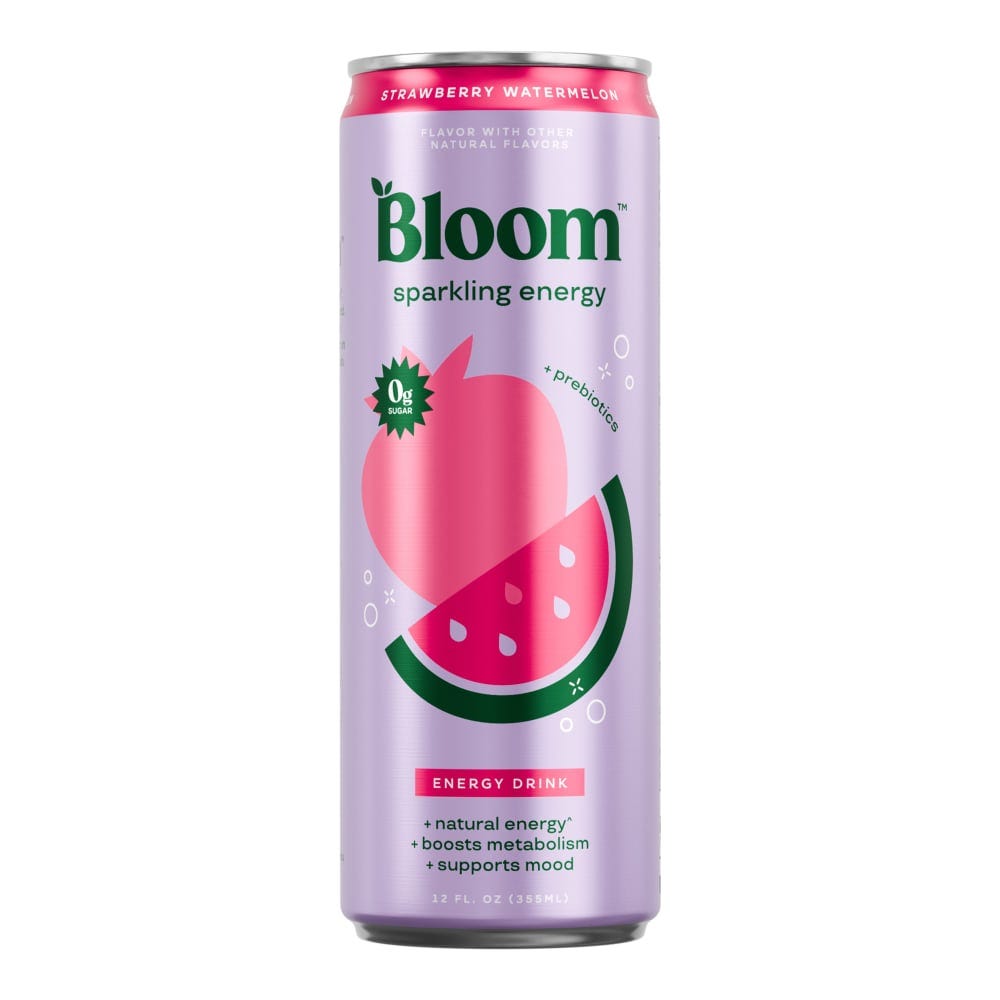
Celsius does retain several competitive advantages, including strong brand recognition, a differentiated portfolio following the Alani acquisition and leading product velocity within many retail channels.
However, shelf space remains highly competitive, promotional activity could increase, and maintaining pricing power may become more challenging if consumers become increasingly value-conscious.
6.) Customer concentration with Pepsi
Pepsi accounted for approximately ~60% of Celsius' revenue in the most recent quarter, making concentration one of the most frequently cited risks.
While the distribution partnership has been instrumental in the company's growth and resembles the model Monster used to scale nationally, it also creates meaningful dependence on a single partner.
Any future contract renewal or renegotiation would occur with Pepsi fully aware of that dynamic, which could likely mean margin pressure for Celsius.
The company's previous transition to Pepsi also resulted in approximately $400M of one-time termination costs, illustrating the financial and operational complexity involved in changing distributors.
Although I currently view the partnership as a net positive given the distribution reach and aligned incentives, the concentration risk remains real and should be considered as part of the overall thesis.
Valuation
At today's price, Celsius trades near the low end of its historical valuation range and grows materially faster than most large beverage peers.
At around $31, CELH trades at approximately 19x forward earnings on consensus FY26 adjusted EPS of around $1.60.
Its five-year median forward P/E is roughly 77x.
Monster, the closest comparable, grows consolidated revenue a fraction as quickly but trades around 37-40x forward earnings, near its five-year average of 35-40x.
On sales, Celsius trades around 2.3x forward revenue against Monster at approximately 10x.
The trailing GAAP P/E for Celsius appears elevated (around 70x on some finance sites) because reported earnings still include one-time distributor termination costs (remember, Pepsi funded this) and acquisition-related expenses. Those charges reduce the usefulness of trailing earnings when comparing today’s valuation to prior periods.
I’m also not assuming Celsius should trade at Monster’s valuation though…
Monster continues to generate higher margins (55%+ gross) and has a substantially longer operating history.
The comparison simply illustrates that Celsius currently trades at a significant discount despite materially higher expected revenue growth.
Applying Monster’s five-year average 35-40x to the Street’s $1.60 gets you $56-64 — right where sell-side consensus already sits ($64-68, Strong Buy) — that’s without relying on the long-term assumptions used later in this model.
For a nearer-term anchor: my own model’s 2026 EPS at a 30-40x multiple implies a fair value range of roughly $38-51 this year.
That’s an implied move of +26-70% before year end, with a midpoint at +48%.

Two things stand out in the sensitivity table above.
The first is which axis drives the most change. Moving down a margin row adds $11-12 to the implied share price, while moving across a growth column adds only $1-2.
This implies that this is a margin story before it’s a growth story.
Whether Celsius grows 8% or 12% matters far less than whether net margins land at 10% or 14%, which is why the forecast section spends most of its time on the margin bridge.
Top-line growth is more of a sentiment bar for investors, which can have a material effect on stock prices, so I wouldn’t be surprised if a beat on the topline drove the stock up materially.
Second, the low end of the table (still referring to the above sensitivity table, not below): at 6% growth and 8% margins, a scenario where the core brand stalls and the margin recovery largely fails, the model still produces $46 at 30x.
That’s still a 50%+ return in a bear case.
The current share price sits below every cell in the grid, which implies the market is either assuming fundamentals below these ranges or applying a multiple well under 30x.

This other sensitivity table above shows where the stock sits today in the top-left corner. Around $30 is almost exactly 20x on $1.50, which is the lowest multiple on the table applied to the lowest EPS on the table.
The Street’s numbers with Monster’s historical 35-40x multiple land in the $56-64 band. This implies a return of +87-113%.
My base case ($3.00 of EPS by 2030) at 30x is $90, which implies a return of 200%.
The table also covers the ‘compression’ case, which is if the multiple never moves past 25x, $2.50 of earnings still produces $63, which implied a return over 100%.

One last way I like to frame this valuation is on a relative basis through market capitalization.
My P/E base case scenarios in my forecast model imply a $23-31B market cap in 2030, roughly 24-33% of what Monster is worth today.
Even under the higher-end P/S scenarios ($41-46B), Celsius would still represent less than half of Monster’s current market capitalization, with 4+ years of category growth baked in.
In other words, the model does not require Celsius to reach Monster’s current scale for the investment to work.
Financial Forecast
This is one of (and always is) the most important sections of the piece, so let’s walk the model line by line.
Every forward number below is my estimate, not guidance from the business.
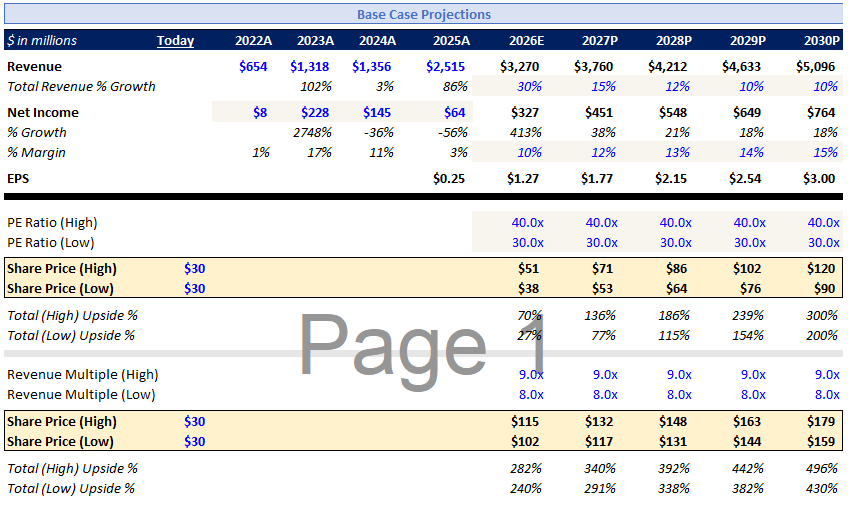
Revenue:
I’m modeling $3.27B in 2026 (+30%), then +15% in 2027, +12% in 2028, and +10% in 2029 and 2030, reaching approximately $5.10B by 2030, which is a 15.2% 5yr CAGR.
The 2026 number is mostly back of the napkin arithmetic, which assumes:
Alani annualizes toward its roughly $1.5B retail run-rate with scanner growth still near triple digits
The core brand comps ease in H2 once the integration reset noise clears
Rockstar stabilizes
International grows modestly off a small base
Note that I’m below the Street on revenue (consensus sits near $3.45B for 2026), and the deceleration from 2027 forward assumes Alani matures quickly and no fourth brand gets added.
—> Conservative on purpose.
Margins:
I’m modeling net margins recovering from around 3% in 2025 to 10% in 2026, then growing modestly 1% a year — 12%, 13%, 14%, and 15% by 2030.
A 3% to 10% jump in one year is a big move, I agree, so let me explain where this is coming from.
But honestly, it matches what the Street’s 2026 numbers already imply, which is what makes it a base case rather than a bull case, but obviously still deserves a real explanation, because margins don’t triple on hopium (aka hope):
FY2025 absorbed approximately $400M in one-time distributor termination fees (expensed through the P&L even though Pepsi funded them), acquisition and integration costs and inventory step-up accounting.
Strip these one-timers and the underlying business was already running far above a 3% margin.
A meaningful piece of the jump is simply those costs not repeating.
Net income to common was $85.1M on $782.6M of revenue in Q1, nearly an 11% margin.
The 10% full-year assumption is just the business roughly holding what it just reported, through a Q2 aluminum ‘side-step’ and World Cup marketing spend.
The $50M of Alani Nu synergies is captured in full this period, with consolidated procurement across three brands (aluminum, sweeteners, ingredients), co-packing consolidation, back-office and marketing overhead reduction, and freight and warehouse optimization (although Rockstar still has a bit to go, but this is a much smaller $ share) creating compounding value into 2H 2026 and forward.
The past year of management attention went to integration — think distributor transitions, SKU reconfiguration and moving over various systems.
With that noise behind the team, the focus returns to velocity, shelf productivity and revenue management.
Adjusted SG&A already fell to 26.4% of revenue from 33.6% a year earlier, and scale should keep pushing in that direction.
Management has explicitly stated visibility back to low-50s gross margin on their last conference call, with locked aluminum conversion costs, the second North Carolina line ramping in H2 with full benefit in 2027, and price-pack architecture.
A ‘Q2 side-step’, then ‘Q3/Q4 stair-steps’ was also mentioned on the call, continuing into 2027.
In my opinion, this makes forward guidance the important piece in the next report, but Celsius does not usually release guidance, so a quick stock price dip after the next report wouldn’t surprise me if reported figures are lackluster.
So, overall, from 10% in 2026, the path to 15% by 2030 is a percentage point a year from gross margin normalization and SG&A leverage.
For reference, Celsius reported a 17% net margin in 2023 as a single brand, so I would imagine asking for a similar figure 5 years from now is not a crazy ask for a multi-brand organization.
This path produces net income to common of roughly $327M in 2026 rising to $764M by 2030, or EPS of approximately $1.27 in 2026, $1.77 in 2027, $2.15 in 2028, $2.54 in 2029, and $3.00 in 2030 on a ~256.5M share count.
Note: total outstanding shares include 0.5% buybacks from 2027-2030, consistent with past shareholder buyback patterns.
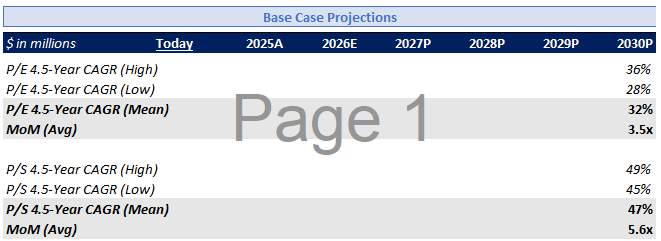
Apply a 30-40x P/E — below Celsius’s own history, in line with Monster’s recent range — to $3.00 of 2030 EPS and you get $90-120 per share, versus around $30 today.
That’s a 28-36% CAGR, roughly 32% at the midpoint, or about 3.5x money over the period.
If the multiple only rerates to 25x, the 2030 price is still $75.
The sensitivities above show the full grid, including the downside corner, which even at 6% revenue growth and 8% net margins, the model produces around $46/share at 30x.
Bull vs. Base vs. Bear Cases
As a reminder, the forecast above was the base case.
Each scenario below is the same model with different answers to four questions: core-brand growth, Alani durability, international adoption, and cost/legal friction.
Bull Case:
Legacy Celsius reaccelerates into low-to-mid double digits as the reset space, Fizz-Free, and World Cup marketing convert and the Monster-after-2015 pattern plays out.
Alani keeps compounding on its awareness runway, international accelerates as Spain and Portugal replicate the UK’s penetration curve, aluminum pressure fades on schedule and Texas settles quietly like its predecessors.
My revenue path proves too low, margins reach the high end sooner, and 2030 EPS pushes through $3.50 with a growth multiple attached.
The P/S-based scenarios in the model ($159-179) live in this world, but I’m not underwriting them for my overall thesis. That is purely the cherry on top.
Base Case:
I’ve explained this case throughout the entire writeup, so I’ll keep this short.
Core brand in high single digit growth, Alani strong but maturing, international compounding steadily, gross margin stair-stepping to the low-50s through 2027, and lawsuits resolved for nuisance amounts.
This implies $90-120 by 2030, a 200-300% return.
Bear Case:
Core growth slips to 5% or lower and stays there, revealing the 6% as demand decay rather than integration noise.
International stalls as Europe regulates harder and the positioning doesn’t translate.
Texas metastasizes into a multi-state action that bleeds into Alani’s momentum, and value competition caps gross margin in the high-40s.
Celsius loses reset leverage with retailers as velocity flattens, and the platform stagnates as a roughly $4B revenue business at high-single-digit margins.
This translates into the $46-58 corner of the sensitivity grid, with a path toward the mid-$20s on the stock in 2026 before steadily moving upwards.
Even that scenario describes a profitable, cash-generative #3 platform inside Pepsi’s distribution system.
Not a zero.
What I’m Doing With My Money / Concluding Thoughts
Now the part I held back until the end!!!
I own 1,670 shares of CELH at an average cost around $31, which is currently a top-five position for me.
Management has been buying alongside me — in a single week in May, Fieldly bought 8,475 shares at $29.36, President & COO Eric Hanson added 7,500 at $29.04 (an 11% increase to his stake), and director Hal Kravitz added 8,400 at $29.73.
My plan from here is to trim part of my AMD position, my largest holding, into what I expect to be a strong stretch around its upcoming AI conference and earnings, and roll those proceeds into Celsius.
I could see this position growing another 50% from my current share count over the coming months.
It won’t reach the size of my AMD stake (nothing else ever will I don’t think), but it will sit firmly in my top three.
The main areas I’m watching as the time plays out is the core-brand growth reaccelerating in H2 2026, gross margins stair-step arriving in Q3 and Q4 as ‘guided’, Rockstar’s retail declines flattening as it completes its move into Pepsi’s system this summer, and international sell-through in Spain and the UK.
My takeaway is that Celsius has spent 18 months paying the full cost of becoming a multi-brand platform, with margin noise, shipment distortions, management distraction, and the market repricing the stock as though those costs were permanent and growth has permanently decelerated.
The KPI data we walked through says the consumer never left the brand. The shelf data says distribution is still expanding.
The model says the earnings power shows up over the next 24 months.
I believe the current valuation reflects temporary issues rather than permanent changes to the business, and if margins recover as management expects while growth stays anywhere near my base case, today’s price understates what this company earns by 2030.
I’ve followed this name for 7 years. This is the setup I’ve been waiting for.
Disclaimer: The information provided in this publication is for informational and educational purposes only and does not constitute investment, financial, or other professional advice. ThePrivatePublicInvestor and its authors are not registered investment advisors or broker-dealers. All opinions expressed reflect personal views as of the date published and are subject to change without notice. While efforts are made to ensure accuracy, no guarantee of completeness or reliability is given. Past performance is not indicative of future results. The author may hold positions in securities discussed. Use of this content is at your own risk.
Very impressive work! I especially liked how you sliced the market in various ways to show the strategic positioning of Celsius!
Thanks for the piece!
I found it very compelling although I don't drink energy drinks so it's a market I really don't understand and will therefore probably be staying away from.
Awesome piece and great work! Not often does someone stick with a company for 7 years!